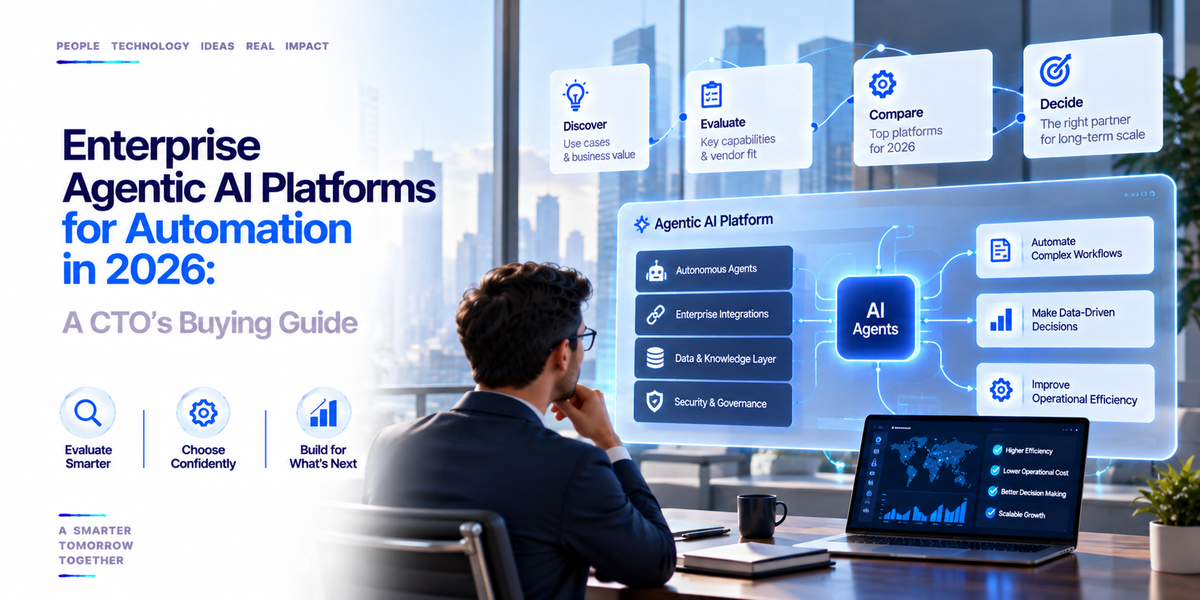

Agentic AI Use Cases for Enterprises in 2026: Where AI Agents Deliver Real Business Value
Agentic AI is moving enterprises beyond simple automation toward intelligent systems that can plan, make decisions, and execute tasks with minimal human intervention. In this blog, explore the most practical Agentic AI use cases for enterprises in 2026, from autonomous customer support and intelligent IT operations to sales, finance, supply chain, and business process automation. Discover where AI agents can deliver measurable business value, improve operational efficiency, and help enterprises build more adaptive, scalable workflows with the right AI strategy.

AI stopped being just a content generator a while ago. The systems enterprises are deploying now can take a business objective, break it into steps, pull data from your applications, make decisions within set boundaries and actually execute actions. That's what people mean by agentic AI, and the distinction from a chatbot is bigger than it sounds.
Here's the difference in one example. A chatbot answers a customer's question about an order. An AI agent checks the order status, spots the issue, triggers an approved fix and updates the customer, all in one flow. Same conversation on the surface. Completely different amount of work done underneath.
We build these systems at Applore, and the most common mistake we see isn't technical. It's companies asking "where can we put AI?" instead of "which process actually has enough repetitive, structured work to justify it?" Not every workflow deserves an agent. The ones that do can return serious value.
So let's get specific. Here's where agentic AI is delivering real results in enterprises right now, and just as importantly, where it isn't.
What is agentic AI, in plain terms?
An AI agent pursues a goal through multiple steps instead of producing a single answer. It understands a request, breaks it into tasks, retrieves information, picks the right tools, acts inside your software, checks its own results, and escalates to a human when it hits its limits.
The loop looks like this: goal, reasoning, tool selection, action, result, evaluation, next action.
Say an employee writes, "I can't access the CRM." A basic bot sends troubleshooting steps. An agent verifies the employee's identity, checks whether the CRM is down, reviews their permissions, finds the likely cause, runs an approved access workflow, confirms it worked, and escalates only if it can't resolve the issue. That last part matters: a well-built agent knows when to hand off.
Why enterprises are moving on this now
Walk through any large organisation and you'll find people spending hours searching for information, copying data between applications, classifying tickets, updating CRM records, preparing the same reports and answering the same requests. None of it requires continuous human judgment. All of it costs salary hours.
That's the target. Not replacing people, but taking the coordination and repetition off their plates so they can do the work that actually needs them.
10 agentic AI use cases that work
Customer support automation
This is the most mature use case, and for good reason. Take a customer who says, "my payment failed and I need to update my billing information." An agent can authenticate them, pull the account, check payment status against policy, identify the cause, update approved fields, create a ticket if needed and notify the customer. Your support team touches only the cases that genuinely need them.
The metrics are clean too: first-contact resolution, handling time, cost per ticket, escalation rate, CSAT. You'll know within a quarter whether it's working. This is a natural extension of the AI-powered automation and chatbot work we already do for enterprise clients.
IT helpdesk agents
Password resets, software access, provisioning, ticket classification. IT teams drown in these. An agent sits between employees and your IT systems: it identifies the issue, checks the knowledge base, verifies permissions, calls an approved tool, then resolves or escalates.
One design rule we insist on: the agent never gets unrestricted access. Tightly scoped permissions, always. The value comes from the workflow, not from giving software admin rights.
Software development agents
Coding assistants handle individual tasks. Development agents coordinate whole chunks of work: read the ticket, understand acceptance criteria, inspect the codebase, generate changes, write and run tests, analyse failures, prepare a pull request.
The engineer still reviews everything that matters. What changes is the split of labour. AI takes repetitive implementation; engineers keep architecture, judgment and accountability. Teams that get this balance right ship noticeably faster without lowering their quality bar.
Sales research and lead intelligence
Ask any sales rep how long they spend researching an account before a call. An agent can pull company research, industry context, tech stack, leadership changes, recent developments and likely pain points from approved sources, then hand the rep a structured brief.
You're not automating sales. You're giving every rep a research analyst. That's a much safer and more valuable ambition.
Finance and accounting workflows
Finance is full of structured, rule-bound processes, which makes it ideal agent territory. An agent can read an invoice, extract the details, match it against the purchase order, verify the vendor, flag discrepancies, route exceptions and stage the transaction for approval. The authorised human still makes the final call; they just stop doing the data entry that precedes it. Reconciliation, expense classification and report preparation follow the same pattern.
Document and contract intelligence
Enterprises process enormous volumes of documents. Agents handle classification, extraction, summarisation and compliance checks well. The more interesting workflow: an agent compares a contract against your predefined business requirements and flags the clauses that need legal review. Legal judgment stays human. The hours of manual screening before that judgment don't.
Procurement automation
Supplier research, quote comparison, contract term extraction, renewal monitoring, procurement summaries, draft communications. An agent handles the administrative grind while your procurement team keeps full control of supplier selection and commercial decisions. Nobody misses the spreadsheet work.
AI-powered data analysis
Most business teams have more data than time. An agent can take a question like "why did conversion drop this month?", pull the approved datasets, compare periods, segment the results, surface what changed and produce a preliminary explanation with areas flagged for deeper investigation.
That's the shift from reporting to analysis, and it's where strategic tech consulting and agent development start to overlap: the hard part is defining which questions and datasets the agent is allowed to work with.
Cybersecurity operations
Security analysts face alert volumes no team can fully investigate. Agents can gather context on suspicious activity, authentication anomalies and system alerts, then prioritise incidents so analysts spend their time on the complex ones. High-risk actions keep human approval, full stop. The win is triage speed, not autonomous response.
Employee onboarding
A new hire needs email, identity access, HR records, collaboration tools, licenses, security training and department apps, usually coordinated across five or more systems by someone chasing tickets. An agent runs the approved provisioning workflows end to end. New employees are productive on day one instead of day six, and nothing gets missed.
Where agentic AI does not belong
We turn down agent projects more often than you'd think, and it's usually for one of these reasons.
The task is so simple that a basic automation rule would do it cheaper. The underlying process is undefined, and AI cannot fix a broken process, it just executes the mess faster. Errors are so expensive that every action would need human approval anyway. The volume is too low for the ROI to ever close. Or the business has no way to measure success, which means no way to prove value.
If any of those describe your workflow, don't build an agent for it. Yet.
What a good opportunity looks like
The strong use cases share six traits: the task repeats frequently, it involves multiple coordinated steps, the data lives in accessible systems, the allowed actions are clearly defined, the outcomes are measurable, and the risk of errors can be contained through controls and oversight.
Score your candidate workflows against those six. The right first project usually becomes obvious.
Measuring the ROI
Treat agentic AI like any business investment. Track time saved, cost per transaction, processing volume, error reduction, resolution rates and, where relevant, revenue or customer experience impact.
The formula is simple: ROI = (business benefit − AI investment) ÷ AI investment × 100. The trap is undercounting the investment. Model usage is the small part. Development, integration, infrastructure, monitoring, security, maintenance and human oversight are where the real costs sit. Budget for all of it, and your ROI numbers will survive scrutiny.
Why custom agents beat generic ones
Every enterprise runs different systems, processes, data structures, security requirements and approval chains. A generic off-the-shelf agent doesn't know any of that, which is exactly why so many pilots stall.
Custom AI agent development means the system is designed around your actual workflow: your integrations, your data access rules, your role-based permissions, your approval processes. It costs more upfront and fails far less often. That trade is almost always worth making for enterprise deployments.
Conclusion
The strongest agentic AI use cases aren't the futuristic ones. They're the workflows where an agent can safely do meaningful, measurable work today: support, IT, development, sales research, finance, procurement, documents, analysis, security and onboarding.
The goal was never full autonomy. It's useful, controlled, measurable autonomy. Enterprises that start with a clear business problem, define the workflow, set guardrails and measure outcomes turn agentic AI into a capability. Everyone else runs an expensive experiment.
If you're weighing where to start, talk to us at Applore. We'll help you score your workflows, pick the right first use case and build an agent that actually ships. One conversation now beats six months of pilot drift.
Frequently asked questions
What are the best agentic AI use cases for enterprises?+
Customer support, IT operations, software development, finance, procurement, data analysis and document workflows, because they contain repetitive multi-step work.
What is the difference between AI agents and chatbots?+
A chatbot responds to users. An AI agent reasons through multiple steps, uses approved tools and takes actions toward a defined objective.
How can enterprises measure agentic AI ROI?+
Track time saved, cost reduction, productivity, error rates, resolution rates and revenue or customer experience impact.
Are AI agents suitable for every business process?+
No. Evaluate each process on volume, complexity, data availability, risk and measurable business value.
What are enterprise AI agents?+
AI systems designed to perform defined business tasks while integrating with organisational data, software and workflows.
Should enterprises build custom AI agents?+
Yes, when they need proprietary workflows, deep integrations, specialised controls or full ownership of the solution.