Agentic AI for Regulatory Reporting and Compliance Operations in Banks - Applore Technologies
Explore how Agentic AI can transform regulatory reporting and compliance operations in banks by automating data collection, validation, report preparation, exception handling, and workflow coordination. Learn how financial institutions can deploy AI agents with strong governance, audit trails, explainability, and human oversight to improve efficiency without compromising regulatory requirements.
Banking compliance isn't just knowing what the rules say. Teams have to interpret requirements, monitor changes, collect evidence, run reviews, prepare reports, and maintain audit trails, and most of that is information-heavy.
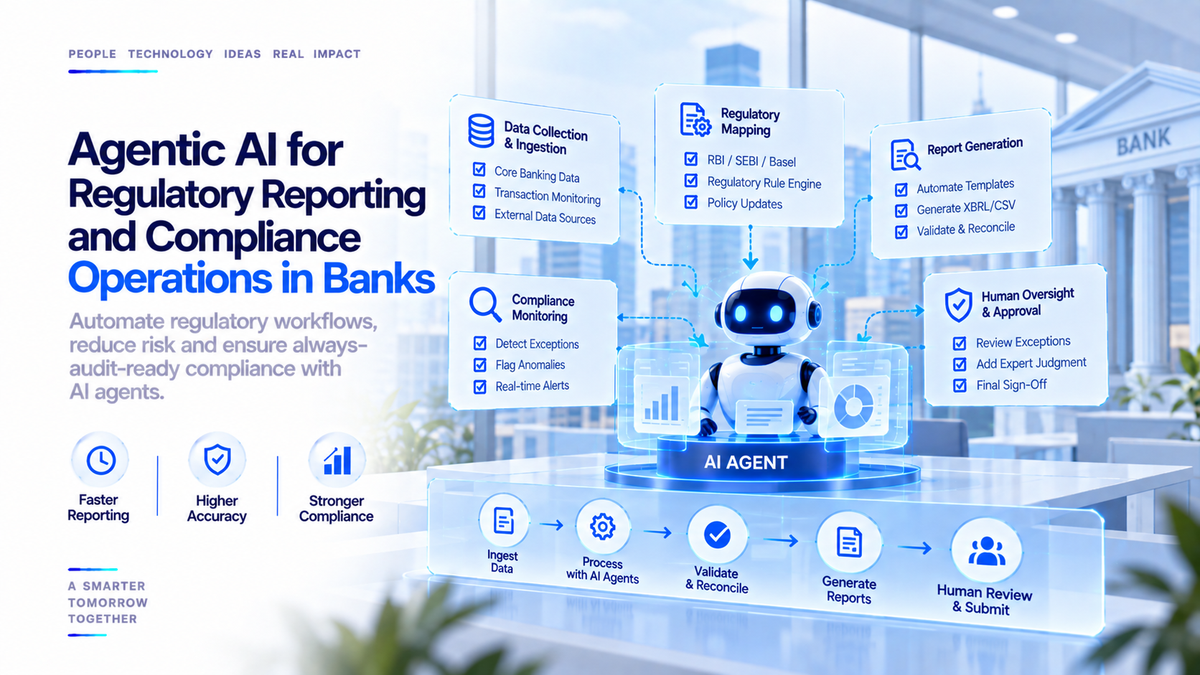
That makes it a strong use case for agentic AI. Agents can help compliance teams collect information, compare policies, prepare documentation, and monitor defined workflows. But compliance demands accuracy, traceability, and accountability, so the AI should act as a compliance operations assistant, not an uncontrolled decision-maker, the same governance-first stance the finance agentic AI hub takes.
What agents do, and how reporting and monitoring work
Potential applications include regulatory document summarisation, policy comparison, evidence collection, compliance checklist preparation, reporting support, exception identification, audit preparation, internal policy monitoring, and case routing, cutting the time employees spend hunting for information.
On regulatory reporting, which pulls data from many internal systems, an agent can identify required data, retrieve approved information, check completeness, flag inconsistencies, prepare a draft, route it for review, and maintain supporting evidence, with the final report still subject to human validation.
On policy monitoring, regulations change and teams need to know what changed and whether internal policy needs updating, so an agent can watch approved sources and produce change summaries: regulatory update, relevant section identified, internal policy matched, potential impact summarised, compliance owner notified, and the human team decides whether action is required.
Audit trails, investigations, and source traceability
One of the most valuable capabilities is evidence organisation; an agent can collect source documents, policy versions, approvals, communications, workflow records, and relevant system actions to help build a structured evidence trail, though AI-generated evidence shouldn't replace underlying source records.
In investigations, agents can gather customer information, transaction records, previous cases, relevant policies, and internal communications, then produce a structured case summary for an investigator to review and act on, reducing research time while preserving judgment. The risks, hallucinated regulatory information, outdated sources, incomplete evidence, incorrect interpretation, data leakage, excessive permissions, missing audit records, are exactly why compliance agents should use controlled knowledge sources and validation.
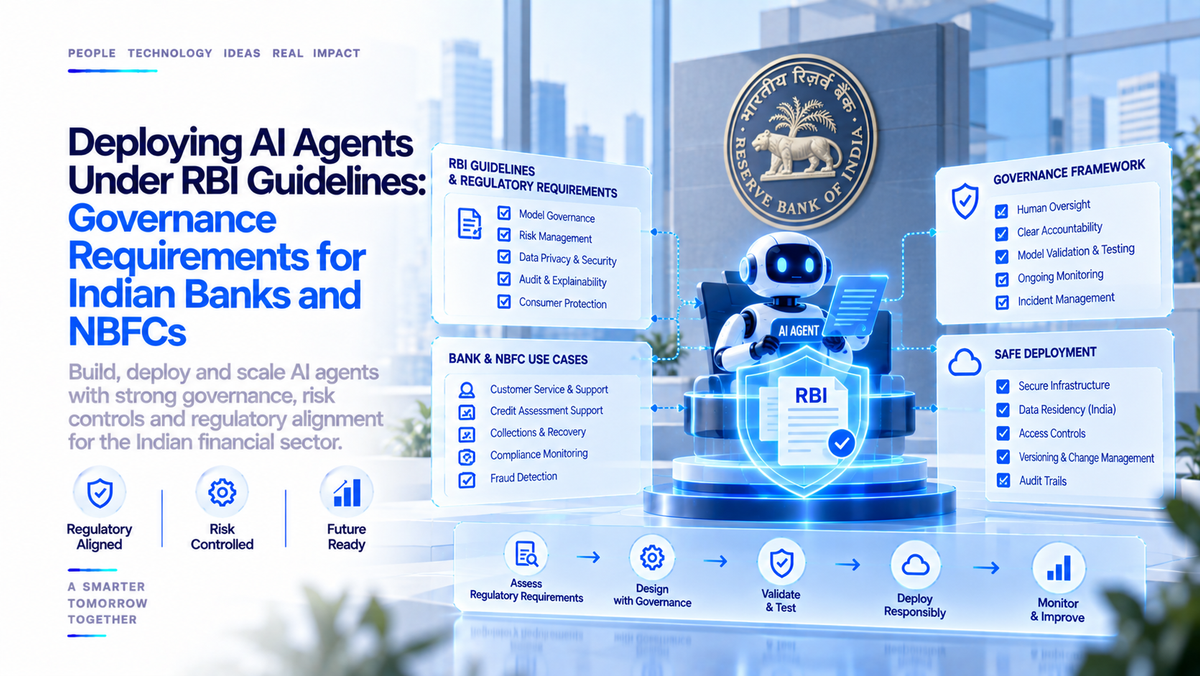
Source traceability is the difference-maker. A compliance AI system should always be able to answer "where did this information come from?", pointing back to approved source material. That's the gap between "the AI says this is required" and "the system identified this requirement from the specified regulatory source and highlighted the relevant section for review", the second being far more useful to professionals. The RBI's 2025 FREE-AI report proposes a responsible-AI framework around principles including trust, people-first design, fairness, accountability, understandability, and safety/resilience/sustainability, and recommends stronger AI governance, cybersecurity, audits, and board-approved AI policies for regulated entities, which the RBI governance guide covers in full.
Build a compliance agent by defining the workflow first (not the model), specifying approved sources, creating access controls, building retrieval and evidence mechanisms with source traceability, adding human review for high-impact interpretations, and monitoring accuracy, false positives, missed information, and escalations. The right approach: retrieve accurately, explain clearly, record everything, escalate when uncertain.
Frequently asked questions
What is agentic AI in banking compliance?+
AI agents that coordinate compliance workflows such as evidence gathering, regulatory monitoring, reporting preparation, and policy analysis.
Can AI interpret regulations automatically?+
It can assist with interpretation and summarisation, but teams should validate consequential interpretations against authoritative sources.
Can AI automate regulatory reporting?+
It can assist with data collection, validation, and report preparation, while appropriate review and approval remain essential.
Why are audit trails important for compliance AI?+
They provide visibility into what information was used, what actions occurred, and how a workflow progressed.
What is source traceability, and why does it matter?+
It links every answer back to approved source material, which is what makes compliance AI trustworthy and reviewable.
What are the main risks of compliance AI?+
Hallucinated or outdated regulatory information, incomplete evidence, data leakage, excessive permissions, and missing audit records.