

What AI Transformation Actually Costs in 2026, and Why Almost Everyone Budgets It Wrong
AI transformation in 2026 is no longer a single software purchase it is a business-wide investment spanning strategy, data, infrastructure, AI systems, integration, governance, talent, and ongoing adoption. This article breaks down what AI transformation actually costs, the hidden expenses most organizations overlook, and why traditional technology budgets often underestimate the true cost of moving AI from pilot to production.
Start with the finding that should govern the whole conversation.
McKinsey's July 2026 research found that while 62% of organisations have moved past experimentation into active deployment, 93% report exceeding their AI budgets.
Ninety-three percent. That is not a forecasting problem, it is a structural one. When almost everyone misses in the same direction, the error is in how the budget was built, not in how the project was run.
The infrastructure numbers are worse. Around 80 to 85% of enterprises miss their AI infrastructure forecasts by more than 25%, which means the budget was broken before the fiscal year began.
So the useful question is not what AI transformation costs. It is why the estimate is nearly always low, and what to put in the budget that most people leave out.
The ranges, with a caveat
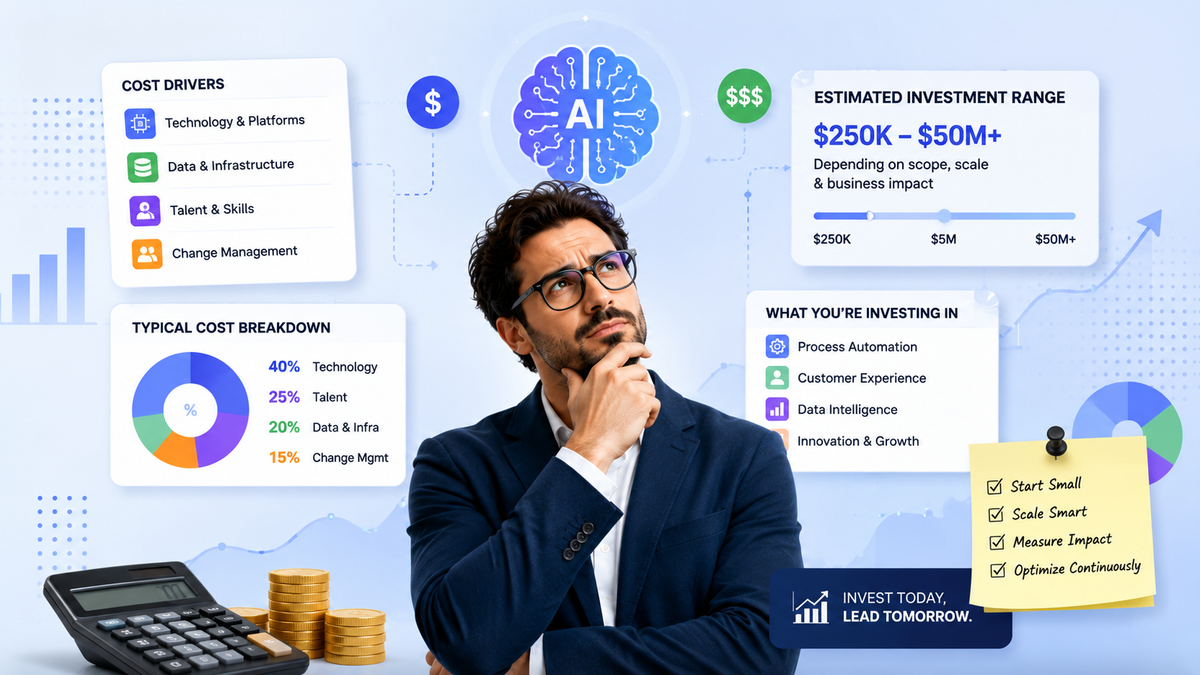
People want a number, so here are planning ranges. Treat them as bands for a board conversation, not quotes.
Strategy and readiness work typically runs from the low tens of thousands into six figures. This is diagnosis, use-case prioritisation, data assessment, architecture and a sequenced roadmap.
A pilot or proof of concept sits somewhere between fifty and two hundred fifty thousand dollars, depending on data condition and integration depth.
One production use case, properly integrated and governed, typically lands between one hundred fifty thousand and three quarters of a million.
Transforming several connected workflows moves into the half-million to two-million range.
Enterprise-wide transformation runs into the millions, and for context, around 35% of senior leaders expect to spend ten million dollars or more on AI in 2026.
Now the caveat that matters more than the ranges. These vary by an order of magnitude on data condition alone. Two companies with identical use cases and different data estates will get quotes that look like they are for different projects, because they are.
Where the money actually goes
The model is rarely the expensive part. Here is the breakdown that produces realistic numbers.
Strategy and readiness. Unglamorous and the highest-returning line in the budget, because it removes spend rather than adding it. A significant share of the value we deliver in this phase is scope we kill before anyone builds it. Killing a use case in week three costs a fraction of delivering it competently in month nine.
Data preparation. The line that breaks estimates. A chatbot looks cheap until you find the customer record living in four systems with three definitions of "active account." The cost then migrates from model work to data engineering, integration and access control, and it migrates upward.
Development and integration. The part everyone budgets for. The deeper AI reaches into core systems, the more this is architecture work rather than application work.
Infrastructure and consumption. This behaves unlike any software line your finance team has modelled. Token-based usage, hybrid SaaS and self-hosted, storage, vector databases, observability. It scales with usage rather than with seats, which is precisely why the forecasts miss.
Governance and security. Now the fastest-rising line in the AI budget, running at roughly 8 to 12% of total spend. In regulated sectors it goes higher. Budget it at the start, because retrofitting controls means rework.
Adoption. The most underfunded item, consistently. A system that works technically and that nobody uses has a return of zero, and the training line is usually the first thing cut when development overruns.
The pilot-to-production trap
This is where most overruns originate, and it is entirely predictable.
Your pilot serves two hundred people with a curated dataset and no permission model, because everyone testing it can see everything. Production serves twenty thousand people against live systems, needs role-aware retrieval, and gets used for things nobody designed for.
Those are not the same system at different scales. They frequently have different architectures. Deloitte research found only around 25% of organisations had moved even 40% of their pilots into production, and cost surprise is a large part of why.
The fix is to define the production state before the pilot begins: the integration surface, the permission model, the failure behaviour, the cost ceiling at full load, and who owns the thing on day one after launch. Then build the pilot as the first step toward that, rather than as a demo you will later try to promote.
Budget in unit economics, not project totals
A total project cost tells you almost nothing about whether it is working.
What tells you is cost per unit of work. Cost per interaction. Cost per document processed. Cost per case resolved. Hours removed or redeployed. Revenue per AI-enabled workflow.
Those numbers let you answer the only question that matters at scale: does each additional unit of usage create more value than it consumes? A system with attractive total costs and inverted unit economics will look fine for two quarters and then become the largest unexplained line in the IT budget.
This is also the discipline that recovers money. McKinsey found organisations that build the capability to optimise spend, improve accountability and redirect savings toward higher-value work could cut AI costs by 20 to 30%. That is a larger number than most vendor negotiations will ever produce.
The ROI picture, honestly
Two figures worth putting in front of any board considering this.
McKinsey found 88% of organisations use AI in at least one business function, while only 39% report any enterprise-level EBIT impact. Adoption is nearly universal. Measurable enterprise value is not.
And on timing: IDC and Microsoft research puts the median time to positive ROI at around 14 months, with an average return of $3.70 per dollar spent on generative AI. That is a real return with a real lag. If your business case assumes payback inside two quarters, it is wrong, and the programme will be judged a failure at the exact moment it starts working.
Only about 25% of AI initiatives delivered the ROI executives expected in 2025, and only around 16% reached enterprise-wide scale.
The pattern across all of this is consistent. The technology works. The budgeting, sequencing and measurement around it usually do not.
How to build the business case
Start from the process, not the tool.
The weak version: "we should implement an AI assistant for customer support."
The version that survives a CFO: "claim review currently takes an average of twenty minutes across ninety FTEs. We believe forty percent of that volume can be handled without human review at equivalent accuracy. That releases roughly X hours annually against a total cost of Y over eighteen months."
Then be complete about the Y. Implementation, integration, infrastructure at production load, licences, governance, training, change management, and ongoing operations. Most business cases include the first two and quietly omit the rest, which is a large part of the 93%.
Capture the baseline before you start. This is the step teams skip, and without it you can never prove anything afterwards. A return calculated retrospectively to justify a decision already made is a narrative, and everyone in the room knows it.
Staging beats approving
The most reliable way to control this spend is not tighter estimates. It is a smaller commitment.
- Diagnose: Find the high-value problems, assess whether your data and architecture can support them, define the measurable outcome. Modest cost, disproportionate effect on everything downstream.
- Validate: One or two focused pilots with stated success criteria and a defined kill condition. Agree in advance what the result means.
- Productionise: Integrate properly into workflows and systems, with governance designed in rather than bolted on.
- Scale: Expand what worked, with cost controls and monitoring in place before volume arrives.
- Transform: Redesign the process around what AI now makes possible, rather than adding AI to a process designed for humans.
Each stage funds the next on evidence. That is how you avoid committing eight figures to a thesis nobody has tested.
Ten questions to ask before signing anything
These separate a proposal to deliver software from a proposal to deliver an outcome.
- What business number is this designed to move, from what to what.
- What is included in this estimate?
- What costs appear only after go-live.
- How will consumption and infrastructure spend be monitored.
- What integrations are required and who builds them.
- Who owns this on day one after launch.
- How will adoption be measured?
- What happens if the pilot misses its target.
- How does the cost curve behave from two hundred users to twenty thousand.
- And which parts of this should use existing models rather than custom development.
That last one matters commercially. A partner who consistently recommends custom builds where an existing model would do is optimising their revenue, not your outcome.
The question underneath the question
"What does AI transformation cost" is the wrong question, and it produces the wrong answer even when answered accurately.
The right one is: which process are we changing, what does that process cost us today, what would it cost to change, and over what period. Answer that and the budget builds itself, defensibly, in terms a CFO can approve.
Organisations that treat AI as a software purchase focus on licences and development fees, and become part of the 93%. Organisations that treat it as an operating-model change focus on workflow economics, adoption and governance, and end up in the 39% that can point to an actual number.
If you are trying to build a business case that survives contact with your CFO, that is where our engagements usually start. Book an advisory session. We begin with your operating reality, not a technology recommendation.
Frequently Asked Questions
How much does AI transformation cost in 2026?
Anywhere from tens of thousands for a strategy engagement to millions for enterprise-wide change. Data condition drives the variance more than use-case complexity does.
Why do so many AI budgets overrun?
Because consumption costs scale with usage rather than seats, and because data preparation, governance and adoption are routinely underfunded. McKinsey found 93% of organisations exceed their AI budgets.
How long until AI pays back?
Median time to positive ROI is around 14 months. Business cases assuming payback within two quarters will judge the programme a failure just as it starts working.
What percentage of the budget should governance take?
Roughly 8 to 12% currently, and higher in regulated sectors. It is the fastest-growing line in enterprise AI budgets.
Can AI costs be reduced once running?
Yes, meaningfully. McKinsey estimates 20 to 30% savings are available through spend optimization and accountability, which usually beats renegotiating with vendors.
Should we budget for one big programme or several stages?
Stages. Fund diagnosis, then a validated pilot, then production, each on evidence from the last. It caps exposure and produces better decisions.
What is the most underfunded line item?
Adoption. A technically successful system that nobody uses returns nothing, and training is usually the first cut when development overruns.