

Best AI Consulting Firms for Enterprises in 2026: A Buyer's Shortlist
Choosing the right AI consulting partner can help enterprises move from AI experimentation to scalable business transformation. This buyer’s shortlist explores the **best AI consulting firms for enterprises in 2026**, covering their AI expertise, consulting capabilities, industry experience, and key factors enterprises should consider when selecting an AI consulting partner.
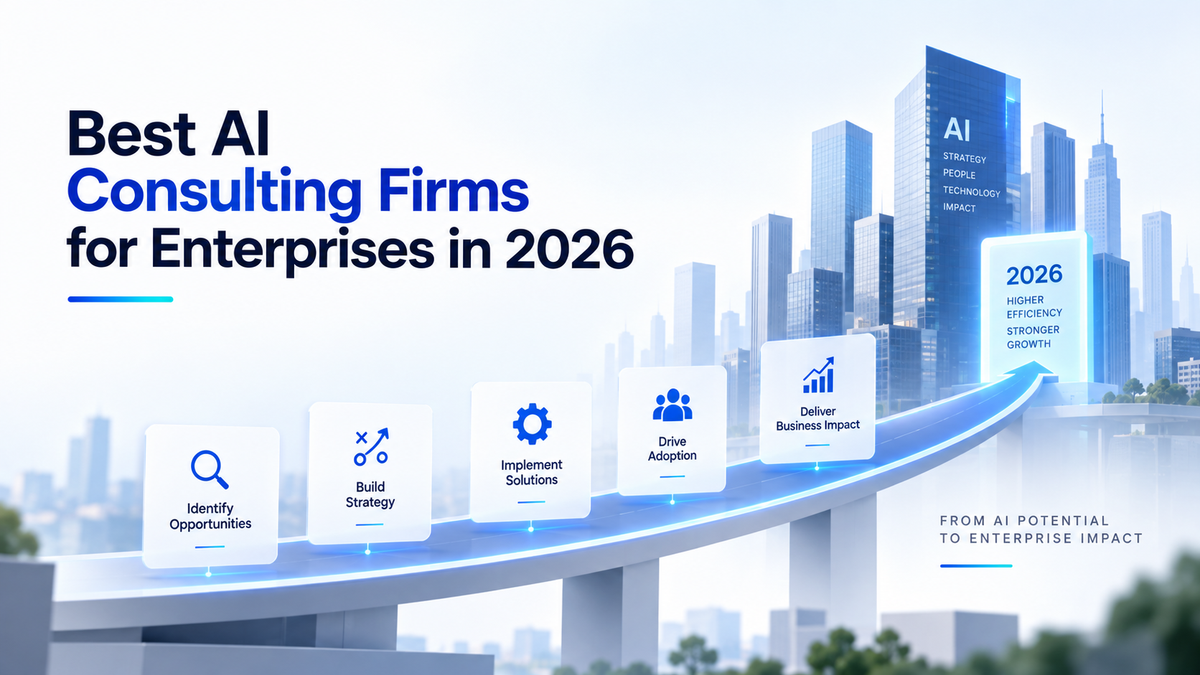
Enterprise AI is past the experimentation phase. In 2026, large organizations aren't debating whether AI will shape their business. The live questions are harder: where should AI be applied, which use cases deserve a budget, what has to change in the existing systems, and how will anyone measure the value afterwards?
Which is why choosing among the best AI consulting firms for enterprises has become a strategic decision, not a procurement exercise. Get it right and you move from scattered pilots to production systems that show up in the P&L. Get it wrong and you fund a very expensive demo library.
The work itself has also widened. Enterprise AI consulting today can span AI strategy, data readiness, enterprise architecture, governance, generative AI, AI agents, workflow automation, system integration and, the part everyone underfunds, employee adoption. The right partner carries you across all of it.
But let's be honest at the outset, because most listicles aren't: there is no single "best" firm for every enterprise. The right choice depends on your size, industry, technology environment, AI maturity, budget, regulatory exposure and what you're actually trying to transform. This shortlist is organized around fit, and it ends with the questions that matter more than any ranking.
What Does Enterprise AI Consulting Include?
At its core, the discipline combines business strategy with technology implementation, and a serious engagement can touch a long list: readiness and opportunity assessment, strategy and use-case prioritization, generative AI implementation, enterprise AI agents, workflow automation, data modernisation, governance and model risk, architecture, cloud and legacy integration, change management, and adoption measurement.
Why the list runs this long is worth one concrete example. Say you want an AI agent for customer service. The model is the easy part. The real project is integration with the CRM, the ticketing system, the knowledge base, authentication and analytics, plus deciding what the agent is allowed to do and who checks its work. Enterprise AI cannot be treated as another standalone software purchase, and firms that sell it that way leave you with a disconnected layer.
This wider view is how we've built our own practice at Applore: strategy and diagnosis, build-vs-buy decisions, model selection, risk and governance, data readiness, applied AI and agentic systems, and then adoption, because deployment without adoption is a cost, not a capability.
How to Evaluate Enterprise AI Consulting Firms
Before comparing names, define what you need from a partner across four capabilities.
AI strategy capability
A consulting firm should connect AI investment to business objectives, not trends. A useful strategy answers: which problems should AI solve, which use cases come first, what value is expected, what data is required, what technology must change, what risks exist, and how implementation should be sequenced. If the deliverable is a trends deck with technology recommendations, keep looking. This is the difference we unpacked in our guide to AI business transformation consulting: diagnosis before prescription, always.
Technical implementation capability
Strategy without execution is a beautifully bound cost. Probe for genuine depth across data engineering, APIs, cloud, machine learning, generative AI, retrieval systems, agents, application development, security, monitoring and DevOps. The tell is specificity: a real implementation partner can explain exactly how the AI solution will operate inside your existing environment, including the ugly parts.
Enterprise architecture expertise
AI initiatives are ruthless at exposing architectural weakness. Fragmented data, unreliable APIs, legacy applications that won't integrate, inconsistent identity controls, unclear data ownership, infrastructure that can't carry the workload. Every one of these surfaces in month two of an AI programme, which is why AI consulting should never be isolated from platform and architecture decisions. It's why our capability model deliberately connects technology strategy, platform and architecture (including target architecture roadmaps), and data, AI and automation as one practice rather than three departments.
AI governance
Enterprise AI raises governance questions most organizations haven't had to answer before. Who can access AI systems? What can models retrieve? Which decisions need human approval? How are outputs evaluated, what gets logged, and what happens when a model is confidently wrong? These questions get sharper the moment AI systems perform actions rather than just generate text, which is the territory we covered in AI agent governance: permissions, audit trails and board-grade model risk, designed in from the start.
Best AI Consulting Firms for Enterprises in 2026
Read this as a shortlist by capability and fit, not a universal ranking, because the "best" firm for a global bank and the best firm for a mid-market manufacturer are rarely the same name.
Accenture
The strong option for multinationals needing AI transformation at massive scale. Its advantage is breadth: AI consulting combined with cloud modernisation, data transformation, application modernization and very large delivery programmes under one roof. Best suited for global enterprises, multi-country implementations and genuinely complex technology environments.
McKinsey QuantumBlack
Most relevant when AI strategy has to connect with business transformation and advanced analytics at board level. Organisations that need executive-grade strategy and analytics-led transformation, and have the budget that implies, consider it first. Best suited for enterprise AI strategy, advanced analytics and C-suite programmes.
BCG X
Combines strategy, technology and product development, which makes it interesting for enterprises building AI-powered products or redesigning business models around AI rather than optimising existing operations. Best suited for AI products, business-model transformation and innovation mandates.
Deloitte
Particularly relevant where AI intersects with risk, compliance and governance, which makes it a natural consideration for regulated industries. Best suited for AI governance, financial services, risk and compliance-heavy enterprise transformation.
IBM Consulting
A strong choice for enterprises running complex, hybrid technology estates. Organisations juggling hybrid cloud, legacy systems and data platforms alongside AI ambitions benefit from its integrated technology heritage. Best suited for hybrid cloud, data and legacy modernisation, and enterprise architecture.
Capgemini
Another solid option where AI forms one strand of a larger digital transformation, integrated with cloud, data, application and operating-model change rather than run as an isolated initiative.
TCS
Suits enterprises that need large-scale technology delivery and global implementation capacity, particularly for multi-year programmes across complex IT environments where delivery scale is the binding constraint.
Infosys
A major transformation provider with capability across AI, cloud, data and enterprise technology, and a sensible consideration for organisations prioritising an implementation partner with global delivery reach.
Applore Technologies
We'll describe ourselves the way we'd want any firm on this list described: by fit.
Applore represents a more focused model: strategy-to-system, with the same senior people who diagnose the problem accountable for the system that ships. Our AI consulting practice starts from where AI fits in your operating model, identifies the opportunities worth funding, works through build-versus-buy honestly, addresses AI readiness, data and governance requirements, and then builds and embeds the solution, including enterprise AI agents with proper guardrails and human oversight.
The capability structure behind it covers Technology Strategy, Platform & Architecture, and Data, AI & Automation as one connected practice, which matters because, as noted above, AI programmes live or die on the architecture underneath them. And we treat adoption as part of the engagement, not the client's problem after handover: our methodology runs from diagnosing operating reality through definition, architecture and implementation to embedding the change, with success measured the way we've argued AI ROI should be measured, in operating impact rather than hours saved.
The honest fit: organisations that want senior-led AI strategy, applied and agentic AI, readiness and governance, platform modernisation and production implementation from one accountable team, and that would rather have a focused partner in the room than a programme office. If you need a 400-person multi-country rollout, one of the first three names is a better call, and we'll tell you so.
What Should Enterprises Ask Before Hiring an AI Consulting Firm?
Six Questions That Filter AI Consulting Firms Fast
- Can you show production AI implementations?
A prototype is not a production system. Look for firms with proven, real-world AI deployments. - Who will actually lead the engagement?
The senior partner in the sales meeting may not be the person managing the project months later. Confirm who will be involved day-to-day. - How do you measure AI ROI?
Reject answers that focus only on activity metrics. Look for measurable outcomes such as cost savings, productivity, revenue, efficiency, or customer experience. - How will the system integrate with our existing architecture?
AI shouldn't become another disconnected technology layer. Ask how the solution will work with your existing applications, data, APIs, and infrastructure. - What is your AI governance model?
Understand how the firm handles security, access controls, model evaluation, auditability, compliance, and human oversight. - What happens after deployment?
Ask about ongoing adoption, monitoring, optimization, and support. A partner without a post-deployment plan is selling you a launch—not a lasting AI capability.
The quality of these six answers predicts the engagement better than any brand name above.
How Much Does Enterprise AI Consulting Cost?
There's no single price, and any firm quoting one before understanding you is guessing. Cost varies with organisation size, business units in scope, number of use cases, data complexity, integration and security requirements, regulatory load, cloud infrastructure, build effort and ongoing support. A strategy assessment naturally costs a fraction of building and operating a production-grade AI platform.
The better question than "what's your rate?" is the one that reframes the whole purchase: what business problem will this investment solve, and how will we measure the result? A firm that answers that precisely is pricing an outcome. A firm that can't is pricing hours.
Conclusion
The best AI consulting firms for enterprises in 2026 aren't necessarily the ones with the largest teams. The right partner connects the whole chain: business strategy to data to architecture to AI to implementation to governance to adoption to ROI, without a handoff gap where value leaks out.
Global consultancies fit massive transformation programmes. Strategy houses fit executive decision-making mandates. Specialist firms fit organisations that want senior-led strategy and implementation from one accountable team. The deciding factor is fit, honestly assessed against what you're actually trying to change.
Because enterprise AI succeeds when technology changes how the organisation operates, not when another pilot gets launched. If the strategy-to-system model sounds like your fit, book a consultation and we'll walk you through a real production engagement, who led it, how it integrated, and what it changed, and let you judge us against the six questions above.
Frequently asked questions
What do enterprise AI consulting firms actually do?+
They combine strategy with implementation: assessing readiness, prioritising use cases, modernising data, designing architecture and governance, building generative AI and agentic systems, integrating them with existing platforms, and driving adoption and measurement.
How do I choose between a global consultancy and a specialist AI firm?+
By fit. Global firms suit multi-country, large-scale transformation programmes. Specialist firms suit organisations wanting senior-led strategy and production implementation from one accountable team, without a programme-office layer.
What should we check before hiring an AI consulting company?+
Production implementations (not prototypes), who actually leads the engagement, how they measure ROI, how the solution integrates with your architecture, their governance model, and their post-deployment adoption plan.
How much does enterprise AI consulting cost in 2026?+
It ranges widely with scope: a readiness or strategy assessment costs far less than building a production AI platform with integration, security and ongoing operation. Price the outcome and its measurement, not the hourly rate.
Why do enterprise AI projects fail even with good consultants?+
Most often because architecture and data foundations couldn't support production, governance was bolted on late, nobody owned the outcome after go-live, or adoption was left to chance. Firms that connect strategy, architecture and adoption avoid these traps by design.
What is a strategy-to-system AI consulting model?+
An approach where the same senior team diagnoses the operating problem, defines the strategy, designs the architecture, builds the system and embeds it, so accountability never changes hands between the deck and the deployment. It's the model Applore's practice is built on.