

Best AI Consulting Firms for Healthcare in 2026
AI is transforming healthcare across clinical operations, patient engagement, diagnostics, data management, and administrative workflows. However, successful adoption requires more than advanced technology it demands healthcare expertise, secure data practices, regulatory awareness, and a clear AI strategy. This guide explores the best AI consulting firms for healthcare in 2026 and the key capabilities healthcare organizations should evaluate when choosing an AI partner for scalable, responsible, and measurable transformation.
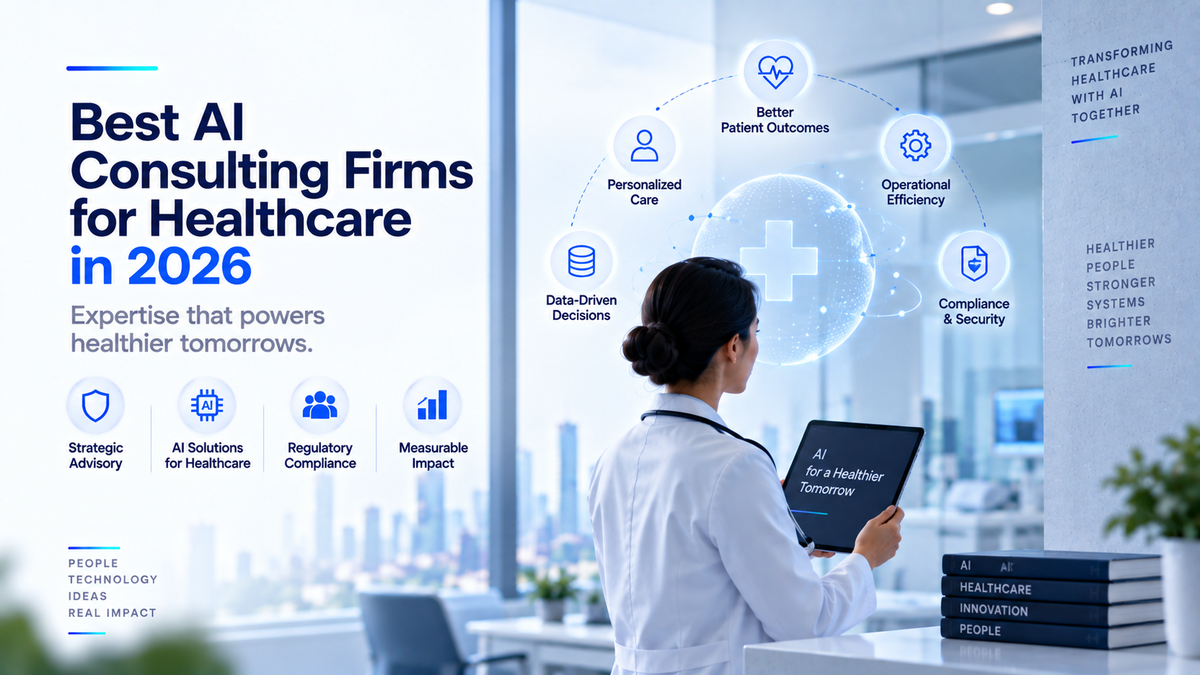
Healthcare has some of the strongest reasons to adopt AI, and some of the strongest reasons to be careful with it.
Healthcare organisations handle deeply sensitive information, complex workflows, heavily regulated environments, and decisions where accuracy can carry serious consequences. At the same time, they're buried in documentation, scheduling, administrative work, clinical information, and operational data.
That combination makes AI genuinely valuable across clinical documentation, patient engagement, administrative automation, claims processing, revenue cycle management, medical research, operational forecasting, healthcare analytics, drug discovery, and knowledge management. But choosing among the best AI consulting firms for healthcare takes more than lining up AI capabilities side by side. Healthcare organisations need partners who understand both the technology and the operating environment that technology will actually run inside.
How We Evaluated Healthcare AI Consulting Firms
The most useful criteria here are healthcare domain experience, AI engineering capability, data and integration expertise, security and governance, production delivery, the ability to support adoption, and scalability.
It's also worth remembering that healthcare AI varies enormously by use case. A hospital rolling out an internal documentation assistant sits in a very different risk category from a company building clinical decision support. The right partner has to understand that distinction instinctively, because it changes everything about how the system should be governed.
1. BCG / BCG X
BCG X is a strong option for healthcare organisations that want strategy fused with AI and technology execution. Its Healthcare Commercial AI offering brings together AI, patient analytics, and digital tools to strengthen healthcare commercial functions, spanning HCP engagement, patient analytics, next-best action, commercial optimisation, agentic AI, and omnichannel transformation.
BCG also frames its work around strategy, technology, measurement, and change management together, rather than treating AI as an isolated implementation. That makes it a natural fit where AI is one part of a much larger transformation.
Best for: Large healthcare, pharmaceutical, and medtech organisations pursuing enterprise-scale transformation.
2. Accenture
Accenture is a major option for healthcare organisations that need large-scale technology integration, and breadth is its real strength. Healthcare AI usually has to interact with electronic health records, patient systems, cloud platforms, data warehouses, CRM, and analytics platforms all at once.
Large technology integrators earn their keep when AI is part of a broader digital transformation rather than a single application. If your challenge is reshaping a sprawling estate, that implementation capacity matters.
Best for: Large health systems, payers, and life sciences organisations needing extensive implementation capacity.
3. McKinsey / QuantumBlack
QuantumBlack, McKinsey's AI arm, is a strong fit where healthcare AI runs straight into strategy, analytics, and operating-model change. It pairs McKinsey's healthcare and life-sciences advisory depth with hands-on data science and engineering, which suits organisations that want a defensible strategic direction and the analytical muscle to back it.
For payers, providers, and pharma tackling questions like where AI creates the most value across a system, and how to sequence it responsibly, this strategy-plus-data-science model lands well.
Best for: Healthcare organisations combining AI strategy with advanced analytics and operating-model change.
4. Optum
Optum brings something most consultancies can't: it lives inside healthcare operations every day, across payer, provider, and health-services work. That deep domain grounding makes it relevant where AI meets claims, care management, revenue cycle, and clinical operations at real scale.
For organisations that value a partner who already understands the mechanics of US healthcare workflows and data, rather than one learning them on your project, Optum's operational proximity is a genuine advantage.
Best for: Payers and providers applying AI to claims, care management, and revenue-cycle operations.
5. Innovaccer
Innovaccer is a healthcare-native data and AI platform company, which gives it an unusually specific fit. Its strength is unifying fragmented healthcare data and then layering AI on top for population health, care management, patient engagement, and analytics.
Where a big part of your problem is that clinical and operational data is scattered across systems, a healthcare-specialist data platform can be more valuable than a generalist integrator, because the data foundation is exactly where most healthcare AI stalls.
Best for: Health systems that need to unify healthcare data before scaling AI on top of it.
6. ZS
ZS is particularly relevant to healthcare and life sciences thanks to its long-standing focus on commercial strategy, analytics, and technology. It's a strong fit for pharmaceutical and life-sciences organisations applying AI across commercial operations, customer engagement, analytics, sales, marketing, and healthcare decision support.
If your priority is sharper commercial and customer decisions from better models, ZS's decision-analytics orientation fits neatly, especially on the pharma side.
Best for: Life sciences organisations with strong commercial analytics requirements.
7. Persistent Systems
Persistent Systems is a solid engineering-led option for healthcare and life-sciences organisations that need AI actually built and integrated, not just advised on. It pairs digital engineering, cloud, and data capability with a growing applied-AI practice, and it's comfortable working inside regulated, integration-heavy environments.
For a health-tech or provider organisation whose bottleneck is delivery capacity and system integration rather than strategy, that build-and-integrate focus lines up well.
Best for: Health-tech and healthcare enterprises needing engineering-led AI delivery and integration.
8. Applore Technologies
Applore offers a different kind of option for organisations that need AI strategy and engineering execution in the same partner. Its AI consulting practice focuses on identifying where AI fits the operating model, assessing data readiness and governance, defining value cases, and moving from strategy into applied AI systems.
Its broader technology practice spans applied AI, agentic systems, RAG, multimodal pipelines, forecasting, data infrastructure, cloud, security, and platform engineering. That's especially relevant for healthcare businesses that need a partner who can design and actually build a governed AI system rather than hand over a strategy document, and its build-versus-buy framing helps teams decide what to develop and what to adopt. That said, healthcare buyers should always assess any technology partner specifically against their own regulatory, privacy, clinical-risk, and data requirements.
Best for: Healthcare and health-tech organisations seeking an engineering-led AI implementation partner.
Where Healthcare AI Is Creating Opportunity
Administrative automation is often the strongest starting point. AI can assist with documentation, scheduling, claims, billing, referrals, correspondence, and information retrieval, delivering measurable efficiency gains without ever asking AI to make a clinical decision.
Patient engagement is another rich area, where AI can support appointment assistance, information retrieval, communication, personalised engagement, and care-navigation workflows, provided the implementation includes proper safeguards and escalation paths.
Healthcare analytics lets organisations analyse operational performance, patient journeys, demand, capacity, commercial performance, and population-level data.
Clinical support can help clinicians with information retrieval, summarisation, and decision support, and this is precisely where governance requirements ramp up sharply.
Life Sciences, pharma and biotech teams can apply AI to research, clinical trials, drug discovery, medical writing, commercial analytics, and HCP engagement. BCG's healthcare AI work is a good illustration of how AI is increasingly woven into patient analytics, commercial processes, and healthcare workflows rather than bolted on as standalone tools.
The Healthcare AI Buying Checklist
Before you choose an AI consulting company, work through a few pointed questions. Does the partner genuinely understand healthcare data, given how much sensitive information needs careful handling and controls? Can the system integrate with your existing platforms, since a standalone AI tool has limited value if it can't fit the ecosystem around it? How are AI outputs validated, remembering that healthcare AI needs far stronger validation than most general enterprise apps?
Then ask what happens when the AI is uncertain, because there must be a clear human escalation path. Ask how access is controlled, since not every user should reach every dataset or capability. Ask whether there's an audit trail, so you can always reconstruct what happened and why. Ask who owns the system, because technology ownership and handover should be defined before implementation, not after. And ask how adoption is measured, because deployment isn't success. Track whether people actually use the system and whether real operational outcomes improve.
Start With the Lowest-Risk, Highest-Value Workflow
Healthcare organisations don't need to open with their most ambitious AI initiative. Starting smaller is often the smarter strategic move. A sensible sequence runs from internal knowledge retrieval, into administrative workflow automation, into operational decision support, and only then into more advanced AI applications.
That progression builds organisational confidence while giving your governance and technical capabilities time to mature. It also generates the evidence you'll need to justify each bigger step, which is exactly what keeps healthcare AI moving instead of stalling after a flashy pilot.
Why AI Governance Matters More in Healthcare
A healthcare AI implementation has to account for privacy, data security, access control, bias, model performance, human oversight, auditability, regulatory requirements, and patient safety. The precise requirements shift by use case and jurisdiction, but the principle holds steady: healthcare AI cannot be treated like an ordinary consumer application. The stakes, and the scrutiny, are simply higher.
Conclusion
The best AI consulting firm for healthcare isn't necessarily the one with the biggest AI practice. It's the partner that matches your healthcare domain, technology environment, risk profile, data maturity, transformation stage, and implementation needs.
BCG X may suit large strategic healthcare transformations. Accenture can fit large technology modernisation. McKinsey/QuantumBlack works where strategy and advanced analytics meet. Optum and Innovaccer bring deep healthcare-native operations and data. ZS is especially relevant to life sciences, and Persistent Systems to engineering-led delivery. And Applore can be the call when you want a more execution-oriented blend of AI strategy, architecture, engineering, and adoption.
So healthcare leaders should really ask one question: can this partner safely turn our highest-value AI opportunity into a production system that people actually use? That's a far better definition of "best" than brand size alone.
Frequently asked questions
What are the best AI consulting firms for healthcare in 2026?+
Leading options include BCG/BCG X, Accenture, McKinsey/QuantumBlack, Optum, Innovaccer, ZS, and Persistent Systems, plus execution-focused specialists such as Applore.
How is AI used in healthcare?+
AI supports administrative automation, healthcare analytics, patient engagement, clinical documentation, research, operational forecasting, and selected clinical-support applications.
What should hospitals look for in an AI consulting company?+
Healthcare experience, data security, governance, integration, AI validation, human oversight, and proven production-delivery capability.
Is AI safe for healthcare?+
It can be, when it's deployed with the right security, validation, governance, monitoring, and human oversight built into the system from the outset.
What are the easiest healthcare AI use cases to start with?+
Administrative and knowledge-management workflows are usually far easier and safer starting points than high-risk autonomous clinical decision-making.
Should healthcare organisations build or buy AI?+
It depends on the use case, strategic importance, data requirements, integration complexity, regulatory considerations, and total cost of ownership.