How to deploy Generative AI Products in production
Applore helps enterprises design, build, and adopt Generative AI Products that integrate into live operations without disrupting daily production.
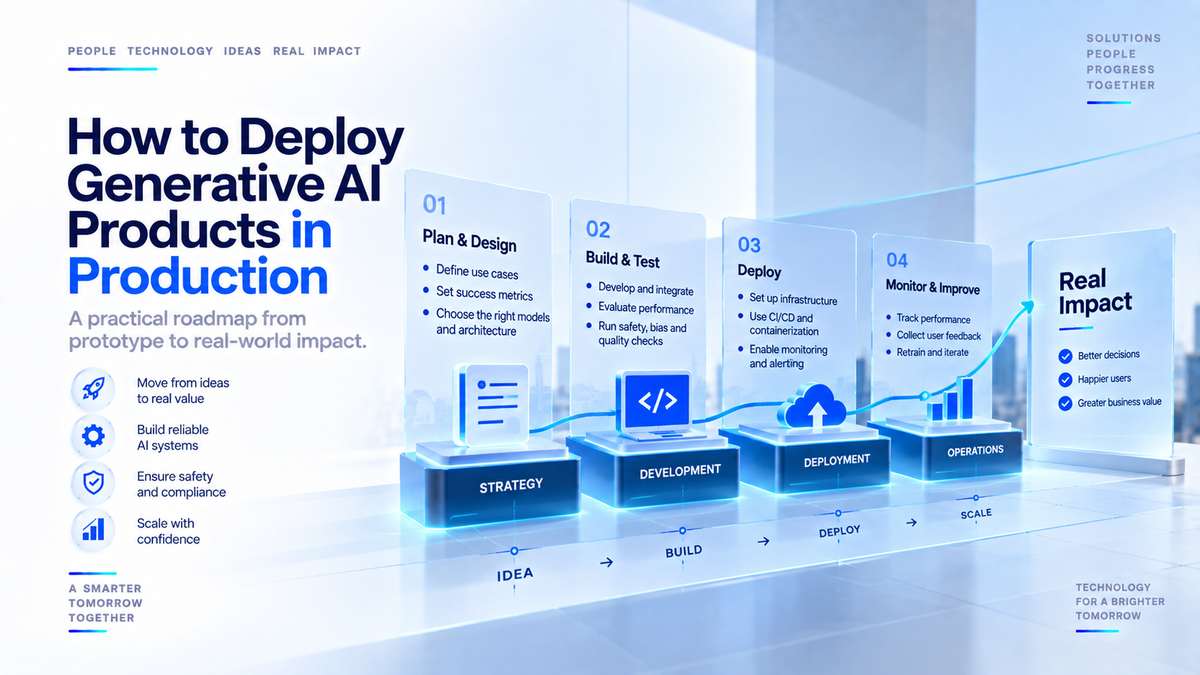
To successfully deploy Generative AI Products in an enterprise environment, organizations must move beyond isolated sandboxes and re-architect their underlying business systems around the technology. True production readiness requires mapping your operational reality, building robust data pipelines, establishing strict guardrails, and designing for user adoption. Success is measured not by the novelty of the model, but by sustained operating impact.
Who these systems are built for
Enterprise-grade AI is not for organizations looking for quick marketing wins or superficial chatbots. It is built for organizations where technology directly affects daily performance where a system failure or a hallucinated data point has immediate financial, operational, or reputational consequences.
Consider multi-plant manufacturing operations spanning over a hundred countries, where maintenance ops historically ran on manual tracking, offline coordination, and fragmented ticket management. In environments of this scale, introducing an unvetted model can halt production lines and cost millions. Similarly, in financial services, wealth management, and insurance, AI systems must operate within strict regulatory guardrails, managing model risk, data security, and auditability without sacrificing execution speed.
For enterprises operating across these complex environments, the transition from a prototype to a live system is where most initiatives fail. It is one thing to run a sandbox demo; it is entirely another to deploy a system that handles real-world transaction volumes, regulatory constraints, and messy legacy data. If you are struggling to bridge this gap, understanding the mechanics of scaling AI solutions is the first step toward building systems that actually compound value over time.
Generative AI Products: How Enterprises Can Move from Pilots to Production
Most companies attempt to adopt AI by pasting it onto the margins of their existing workflows. At Applore, we do not simply consult on AI; we architect organizations that compound from it. Our process is built on a structured approach that prioritizes clarity before technology. We arrive before the brief is written to map your operating model, decision flow, and north-star economics. This ensures the technology fits the system it lives inside, rather than forcing your business to bend around a rigid tool.
To move Generative AI Products from a pilot phase into active production, we execute a disciplined, four-phase methodology:
- Diagnose the Operating Reality: We map how decisions actually flow through your organization. We look at the manual workarounds, the offline spreadsheets, and the fragmented databases that define your daily operations.
- Define Direction: We establish clear, measurable operating metrics. We do not measure success by story points, decks, or deliverables; we measure it by actual operating change, such as reduced cycle times or automated task assignments.
- Architect the System: We design integrated systems, not isolated features. Optimizing one surface should not compromise another. We build the integrated stack—data, models, services, and user interfaces ensuring it can absorb the AI, regulation, and topological shifts we cannot yet see in three years.
- Implement and Adopt: Most technology programs fail at handover. We embed adoption from day one through change design, frontline enablement, and instrumentation, staying until your in-house team can ship faster than we did.
This discipline is maintained by a studio of two hundred operators across Noida, Delaware, and London. For twelve years, we have brought together backend, frontend, platform, mobile, data, and machine learning engineers to ship systems on our architects' line. We assign a named delivery owner to every program providing one clear point of contact from strategy to adoption. We embed with your team, disagree well when necessary, ship the system, and remain available to support the platform six quarters later.
Integrating Generative AI Products with Enterprise Systems
To make AI useful, it must be deeply integrated into the software your teams use every day. Our team brings deep applied AI capabilities across web, mobile, and platform engineering to ensure your models are connected to live business data. Whether we are deploying bespoke systems or leveraging our productized operating engines like DealerOS, FieldOS, or StoreOS, we ensure you own the software, the source code, and the intellectual property.
Our productized platforms began as bespoke builds for clients facing complex operational challenges:
- DealerOS: Originally built for JK Tyre's massive dealer network, this platform allows dealers to order against live credit, check scheme pricing, and file warranty claims directly from their phones.
- FieldOS: Developed for Kohler's field sales teams, this application manages beat plans, geo check-ins, and offline order capture, supported by a manager dashboard that automates monthly reviews.
- StoreOS: A showroom application that captures walk-in leads, displays catalogs and real-time pricing, and schedules automated follow-ups for sales associates.
- Virtual PMO: An operating system for real estate development that digitizes every stage of construction from land acquisition to post-handover, compiling daily progress reports across fifteen verticals.
When we integrate Generative AI Products into these platforms or your existing enterprise resource planning (ERP) systems, we assess your database versions, interfaces, and data quality before writing a single line of code. We write source access and IP assignment directly into our contracts, ensuring that the software we build belongs entirely to your business.
A Practical Checklist for Production Readiness
Before deploying any generative AI system to your broader workforce or customer base, run through this operational checklist to ensure stability, safety, and adoption:
- Map the Decision Flow: Document exactly how decisions are made in the current manual workflow. Ensure the AI system mimics or optimizes this flow rather than disrupting it.
- Assess Data Quality and Versioning: Verify that your ERP, CRM, or custom databases have clean, structured APIs. Address any data latency or synchronization issues before connecting your models.
- Establish Guardrails and Evals: Implement strict input/output filtering, prompt evaluations, and human-in-the-loop protocols to prevent hallucinations and protect sensitive customer data.
- Run a Representative Pilot: Deploy the system to a small, representative user group operating alongside your legacy processes. Measure adoption rates, error frequencies, and actual operating costs before scaling.
- Plan for Architectural Adaptability: Design your infrastructure to be model-agnostic. The underlying LLMs will change; your core system architecture must be able to swap models without requiring a complete rebuild.
- Secure IP and Source Code Ownership: Ensure your contracts guarantee full ownership of the custom code, orchestration layers, and proprietary data pipelines powering your AI products.
Ship Systems That Compound Value
We build systems that scale with you. If you are ready to move past slides, pilot purgatory, and temporary software rentals, let's talk about mapping your operational reality and building Generative AI Products that run reliably in production. Our senior systems thinkers are ready to help you design, execute, and adopt technology built for the long arc.
Frequently asked questions
What is the difference between an AI pilot and a production-grade Generative AI Product?+
An AI pilot is typically an isolated proof-of-concept designed to test a model's basic capabilities in a sandbox environment. A production-grade Generative AI Product is integrated directly into your core enterprise systems, connected to live data pipelines, protected by security guardrails, and designed for daily operational use by your frontline teams.
How does Applore handle intellectual property and source code ownership?+
We assign full source code access and intellectual property ownership to our clients upon agreed payment terms. This is written directly into our contracts, ensuring you own the software you run every day without per-seat licensing fees or rented roadmaps.
What is Applore's approach to integrating AI with legacy ERP and CRM systems?+
We assess your ERP or CRM version, interfaces, and data quality before promising an integration. Our plans explicitly name the connector work and any vendor dependencies, ensuring we do not disrupt your ongoing production lines during deployment.
Why do most enterprise AI transformation programs fail at the handover stage?+
Most programs fail because they focus entirely on technology rather than operational reality. Without early instrumentation, change design, executive alignment, and frontline enablement, internal teams struggle to adopt and maintain the new systems once the external consultants depart.
How does Applore ensure data security and regulatory compliance in financial services?+
We design our systems to meet strict regulatory expectations, model risk guidelines, and data security standards. We select the smallest technology stack that holds the operational load and clears compliance audits, ensuring complete auditability and governance.
What industries does Applore primarily serve with its AI and product engineering services?+
We serve organizations where technology directly impacts performance. This includes multi-plant manufacturing, financial services, complex retail and dealer networks, and large-scale real estate development.
What does it mean to re-architect a business around AI?+
Instead of adding AI as an isolated feature on top of old workflows, re-architecting means diagnosing how your business runs, redesigning decision flows, and building integrated systems where data and AI models are native to your core operating infrastructure.