

Digital Transformation for Mid-Market Companies: Where Enterprise Playbooks Break
Digital transformation can be challenging for mid-market companies that lack the resources and scale of large enterprises. This guide explores why traditional enterprise transformation strategies often fall short and how mid-market businesses can create practical technology roadmaps that align with their goals, resources, and growth plans.
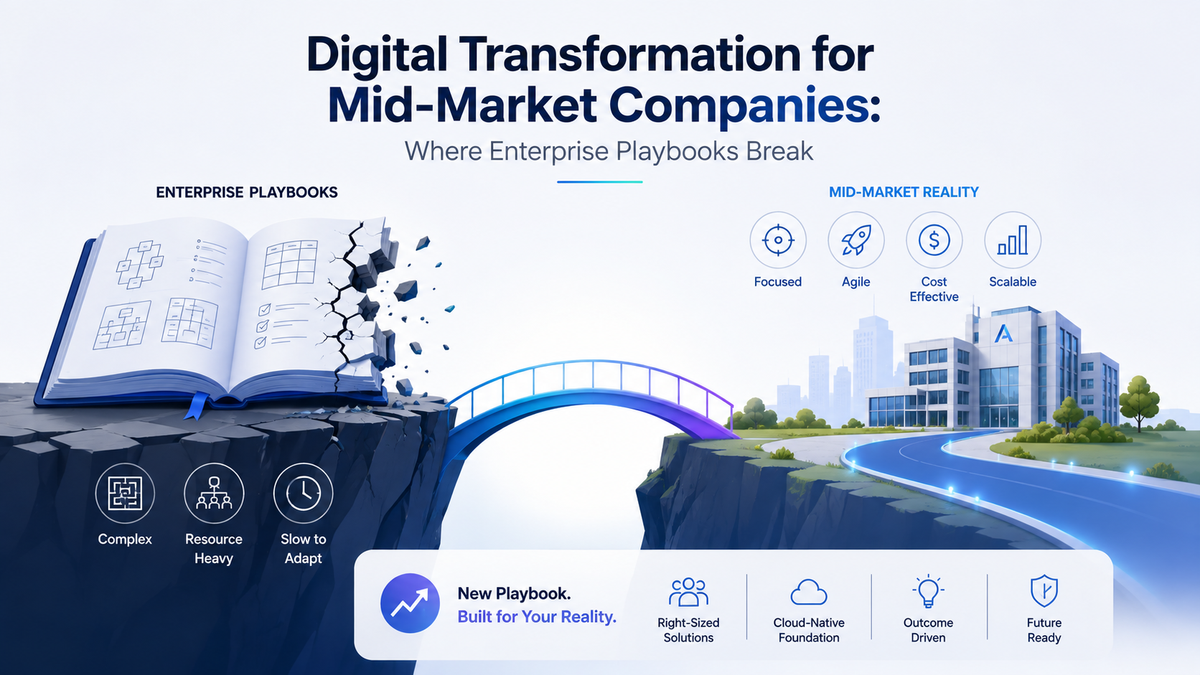
Mid-market companies are often told to transform like enterprises.
- Build a transformation office.
- Create a three-year technology roadmap.
- Move to the cloud.
- Modernise the application estate.
- Create a data lake.
- Deploy AI.
- Establish governance committees.
- Launch multiple workstreams.
- Hire specialist teams.
- The problem?
- Many mid-market organisations do not operate like large enterprises.
- They do not have unlimited budgets.
- They may not have hundreds of engineers.
- Their technology teams may report directly to business leadership.
- A few systems may run a surprisingly large part of the business.
- And the same people responsible for strategy may also be responsible for delivery.
- That makes digital transformation fundamentally different.
The question for a mid-market organisation is not:
"How do we replicate an enterprise transformation programme?"
It is:
"How do we make technology a stronger operating advantage without creating enterprise-level complexity before we need it?"
Applore explicitly identifies mid-market businesses as a distinct group it serves, describing them as organisations with multi-team and multi-product complexity. Its approach focuses on understanding operating reality, defining direction, architecting systems and implementing change rather than applying technology recommendations in isolation. That distinction is critical.
Why Enterprise Playbooks Don't Always Work
Large enterprises have structural characteristics that mid-market organisations may not share.
They often have:
- Large technology departments
- Dedicated architecture functions
- Multiple specialised teams
- Large transformation budgets
- Mature governance structures
- Complex compliance requirements
- Established procurement processes
- Dedicated programme management offices
Those structures can make certain transformation approaches viable. But copying them into a mid-market organisation can introduce unnecessary overhead.
A mid-market company may spend six months defining the transformation programme before implementing anything. By then, the business problem may have changed.
The Mid-Market Advantage
The mid-market has something large enterprises often struggle to achieve:
speed.
Decision-making can be closer to the business.
Leadership can see operational problems directly.
Technology teams can work closely with users.
The organisation can often change processes without navigating layers of governance.
This is a significant advantage.
Digital transformation should preserve that speed rather than bury it under enterprise-style processes.
Start With Operating Friction
A successful mid-market transformation should begin with operational friction.
Ask:
Where are employees losing time?
Where do customers experience delays?
Where are teams manually moving information?
Where do decisions depend on spreadsheets?
Where do departments use disconnected systems?
Where is management working with incomplete data?
Where does growth create operational stress?
Where does technology prevent the organisation from scaling?
These questions are more valuable than asking which technologies are currently fashionable.
Don't Transform Everything
One of the biggest transformation mistakes is treating the entire technology estate as a transformation project.
It doesn't need to be.
A better strategy is to identify the few capabilities that have the greatest impact on business performance.
For example:
A growing distributor may need better inventory visibility.
A financial services company may need stronger onboarding and workflow automation.
A SaaS company may need improved product analytics.
A manufacturing company may need integrated plant and maintenance systems.
A multi-location business may need a unified operational platform.
The transformation should begin there.
Build a Business Case Before a Technology Programme
Mid-market transformation needs financial discipline.
Before approving a major initiative, leadership should understand:
- What problem is being solved?
- Who experiences the problem?
- What does the problem cost today?
- What changes after implementation?
- What is the expected financial impact?
- What risks are introduced?
- What capabilities are created for future initiatives?
This does not require an elaborate financial model.
It requires clarity.
Applore's methodology explicitly frames transformation around diagnosing operating reality, defining direction and framing ROI hypotheses before moving into execution.
That is particularly useful for mid-market companies because every major technology investment competes for limited organisational attention.
Modernisation Without a Massive Rewrite
Mid-market companies often have a dangerous assumption:
"If we want modern technology, we need to replace everything."
Not necessarily.
A better approach may involve:
- API-enabling legacy applications
- Replacing specific modules
- Moving selected workloads to the cloud
- Automating manual processes
- Consolidating duplicate tools
- Introducing a modern data layer
- Building new digital capabilities around existing systems
- Gradually retiring legacy components
This reduces transformation risk.
It also allows the business to keep operating while the technology evolves.
The Business Cannot Stop for Transformation
This is where mid-market transformation differs significantly from theoretical architecture exercises.
The company still needs to:
- Sell
- Serve customers
- Ship products
- Collect payments
- Manage employees
- Maintain operations
- Meet regulatory obligations
Transformation happens alongside those activities.
Therefore, implementation needs to account for business continuity.
An architecture decision that is technically elegant but operationally disruptive may be the wrong decision.
Applore's case studies illustrate this principle. For example, its work with JK Tyre involved rebuilding maintenance operations across multiple manufacturing facilities without disrupting production, while its Kohler engagement combined CRM and ERP capabilities into a field-sales platform delivered in 20 weeks.
The Technology Stack Should Become Simpler
Digital transformation is sometimes associated with adding technology.
But mid-market organisations often benefit more from reducing complexity.
They may have:
- Multiple CRM systems
- Several analytics tools
- Different communication platforms
- Separate workflow tools
- Multiple databases
- Duplicated SaaS subscriptions
- Custom applications built for individual departments
The transformation opportunity may therefore be consolidation.
- Fewer systems.
- Cleaner integrations.
- Clearer ownership.
- Better data.
- Simpler workflows.
The best technology architecture is not necessarily the one with the most components.
It is the one that allows the organisation to operate effectively.
Cloud Is an Enabler, Not a Strategy
Moving workloads to the cloud can create significant benefits.
But cloud migration alone is not digital transformation.
If a poorly designed application is moved from an on-premises server to a cloud environment without changing how the business operates, the organisation has achieved infrastructure migration.
Not transformation.
Cloud becomes strategically valuable when it enables:
- Faster product development
- Elastic capacity
- Better resilience
- Improved data access
- Faster experimentation
- Better automation
- Modern application architecture
The business outcome should determine the cloud strategy.
AI Changes the Transformation Conversation
AI has added another layer to digital transformation.
Mid-market companies now have access to capabilities that previously required significant infrastructure and specialist teams.
But AI should not become another technology programme disconnected from business priorities.
The first question should be:
Where can AI improve a measurable business outcome?
Potential areas include:
- Customer support
- Sales operations
- Document processing
- Knowledge retrieval
- Internal workflows
- Forecasting
- Quality control
- Finance operations
- Employee productivity
But AI initiatives still depend on data, workflow design, governance and adoption.
Applore's AI readiness guidance makes this distinction clearly: AI readiness is not about owning the newest technology; it requires clarity around the problem, information, workflow placement, risks and measurement of value.
That principle is especially important for mid-market organisations.
Don't Build an Enterprise Data Platform Before You Have Data Problems
Data transformation is another area where enterprise playbooks can become excessive.
A mid-market organisation may be encouraged to build a sophisticated data architecture before understanding which decisions actually need better data.
A better approach is to start with decisions.
Which decisions are currently slow?
Which decisions depend on unreliable information?
Where do teams need data they cannot access?
Which reports are manually assembled?
Once these problems are understood, the appropriate data architecture becomes easier to define.
Sometimes that means a modern data warehouse.
Sometimes it means better APIs.
Sometimes it means cleaning master data.
Sometimes it means replacing spreadsheets.
The architecture should follow the operating problem.
Create a Lightweight Transformation Office
Mid-market companies may benefit from transformation governance.
But they rarely need an enormous programme bureaucracy.
A lightweight structure can be enough.
For each major initiative, define:
- Executive sponsor
- Business owner
- Technology owner
- Expected outcome
- Key dependencies
- Investment
- Timeline
- Success metrics
- Major risks
This creates accountability without creating excessive process.
Transformation Requires Adoption
A system can be technically successful and still fail commercially.
Employees may not use it.
Managers may continue using spreadsheets.
Customers may not adopt a digital channel.
Teams may create workarounds.
That is why transformation should include adoption from the beginning.
Applore's Plan → Execute → Adopt framework treats adoption as a distinct part of transformation rather than assuming that deployment automatically creates change.
For mid-market organisations, this is particularly important because a single workflow may involve a large proportion of the organisation.
If adoption fails, the business impact can be immediate.
Build for the Next Stage of Growth
The goal of mid-market transformation is not to become an enterprise overnight.
It is to create systems that support the next stage of growth.
A company moving from ₹100 crore to ₹500 crore may need a different architecture from a company moving from ₹500 crore to ₹2,000 crore.
The right technology investment therefore depends on where the business is going.
Ask:
What will break if we double?
What will become expensive if we triple?
Which processes depend on manual coordination?
Which systems cannot support additional products or locations?
Where will data complexity increase?
Where will customer expectations change?
These questions help create a transformation roadmap that is both practical and forward-looking.
Avoid the "Everything Is Priority" Problem
Transformation programmes often fail because too many initiatives are labelled strategic.
If everything is urgent, nothing is sequenced.
A practical prioritisation approach can consider:
Business impact: How strongly will the initiative improve revenue, cost, customer experience or risk?
Feasibility: Can the organisation realistically deliver it?
Dependency value: Does the initiative unlock future capabilities?
Risk reduction: Does it eliminate a major technology or operational risk?
Time to value: How quickly can the organisation see measurable impact?
This makes prioritisation more objective.
A Better Mid-Market Transformation Sequence
A practical transformation can often follow a pattern like:
- Diagnose: Understand operating friction, technology constraints, data issues and business priorities.
- Define: Establish the target capabilities and investment thesis.
- Stabilise: Address the technology risks that could undermine transformation.
- Modernise: Upgrade the highest-value systems and workflows.
- Integrate: Create reliable connections between core systems and data.
- Automate: Remove repetitive manual work.
- Scale: Use the new foundation to support growth, analytics and AI.
The exact sequence will vary. The important thing is that each stage creates a foundation for the next.
Transformation Should Compound
This is perhaps the most important principle.
A good transformation should make the next transformation easier.
If the organisation introduces a reliable integration architecture, future applications can connect faster.
If it establishes better data governance, future AI initiatives become easier.
If it builds reusable platform capabilities, new products can launch faster.
If it creates clear technology ownership, future programmes require less coordination.
This is what makes transformation compounds.
The organisation is not simply completing projects.
It is building an operating system for future change.
Conclusion
Mid-market digital transformation does not need to look like enterprise transformation.
In fact, copying an enterprise playbook can introduce exactly the complexity a mid-market organisation is trying to eliminate.
The better approach is to start with the business.
Understand the operating friction.
Define the few capabilities that matter most.
Create a practical technology strategy.
Modernise incrementally.
Use cloud, data and AI where they create measurable value.
Keep governance lightweight.
And make adoption part of the transformation rather than an afterthought.
The goal is not to build the biggest technology environment.
It is to build a technology environment that allows the business to move faster.
For a mid-market company, that can become a significant competitive advantage.
Because transformation is not ultimately about becoming more like an enterprise.
It is about becoming better at being the business you are trying to become.
Frequently asked questions
What is mid-market digital transformation?+
Mid-market digital transformation is the process of improving how a growing business operates through technology, data, automation, modern platforms and better digital processes. It typically focuses on practical business outcomes rather than large-scale enterprise transformation programmes.
Why do enterprise transformation strategies often fail for mid-market companies?+
Enterprise strategies can introduce excessive governance, long timelines, specialised teams and unnecessary complexity. Mid-market organisations often need a more focused approach that connects technology investments directly to business priorities.
Where should a mid-market company start its digital transformation?+
Start by identifying operational friction. Look for manual processes, disconnected systems, poor data visibility, customer experience problems, scalability constraints and technology bottlenecks.
Does digital transformation require replacing legacy systems?+
No. Legacy systems can sometimes be modernised, integrated, stabilised or gradually retired. Replacing everything at once is often unnecessarily risky.
Should mid-market companies move everything to the cloud?+
Not necessarily. Cloud adoption should be based on business and technical requirements. The objective should be improved scalability, resilience, speed, flexibility or economics rather than cloud migration for its own sake.
How can AI fit into a mid-market digital transformation strategy?+
AI can be introduced around specific high-value use cases such as customer support, document processing, knowledge management, forecasting and workflow automation. The use case should come first, followed by assessment of data, architecture, governance, risk and adoption requirements.