

Enterprise Agentic AI Platforms for Automation in 2026: A CTO's Buying Guide
Enterprise agentic AI is moving beyond chatbots and copilots in 2026, enabling businesses to automate complex, multi-step workflows. This guide compares 10 enterprise agentic AI platforms based on automation capabilities, integrations, orchestration, scalability, security, governance, and real-world use cases to help CTOs and CIOs choose the right platform for their enterprise.
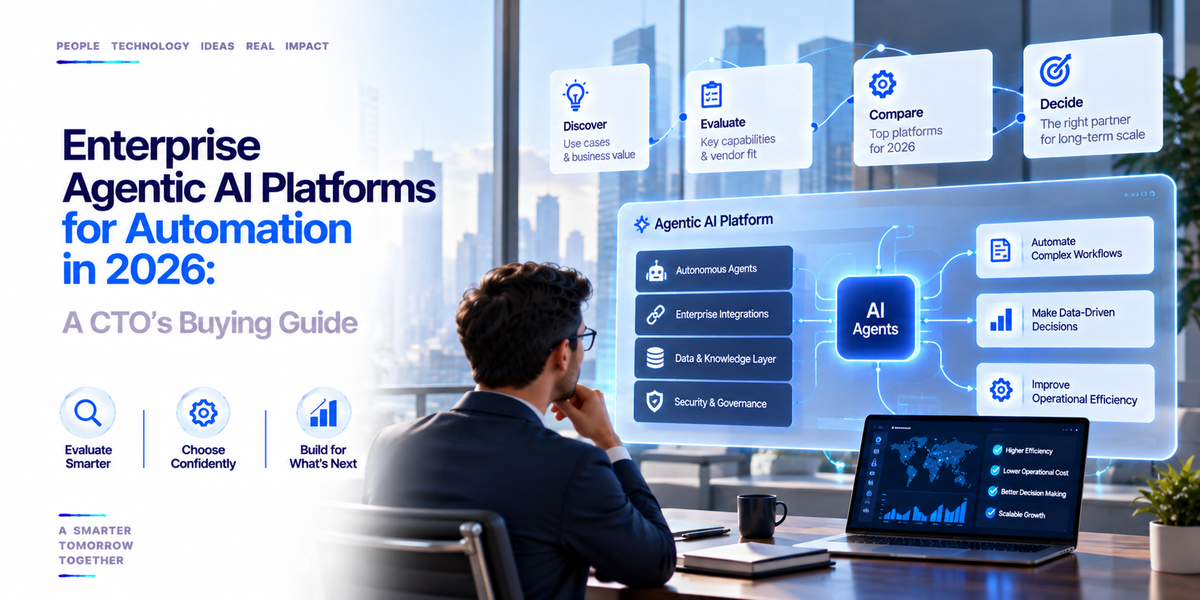
Picture the vendor demo. An AI agent reads a supplier invoice, spots a mismatch, drafts an email and updates the ERP in about forty seconds. Everyone nods. Then someone from security asks, "Which identity did it use to write to the ERP?" and the room goes quiet.
That quiet moment is the real buying decision. In 2026, the question for CTOs isn't which model sounds smartest. It's which platform can take good reasoning and turn it into reliable work inside your CRM, ERP, ticketing tools, identity systems and the legacy applications nobody wants to touch.
This guide walks through ten enterprise agentic AI platforms for automation, who each one tends to suit, and how to test them before you sign anything. If you want the deeper architectural criteria first, our breakdown of the best agentic AI platforms in 2026 covers them in detail.
What actually makes a platform "agentic"?
A chatbot answers a question. An agent works toward a goal.
Ask a chatbot which invoices are overdue and you get a list. Give the same task to an agent and it can pull the outstanding invoices, check payment history, decide which accounts need a nudge, draft the message, update the CRM, hand the odd cases to someone in finance, and log everything it did.
That only works if the platform provides far more than a language model: tool access, permissions, workflow logic, monitoring, evaluation and a clean way to escalate to a human. It's why an enterprise agentic AI platform is better thought of as an architectural layer than as one more AI app.
Why Traditional Automation Hits a Wall
Classic automation is great when the process is tidy. Invoice arrives, fields validated, amount checked, approval routed, ERP updated.
Real life is messier. The invoice comes in an odd format. A supplier changes their bank details. The purchase order doesn't match. An approval is missing. A policy demands extra verification. Rule-based flows break or pile up exceptions in someone's inbox.
Agents can reason through those situations, choose the right tool, fetch more context and decide whether to continue or ask for help. The architecture that makes this safe isn't "automation plus AI." It's data, models, agents, tools, workflows, governance and human oversight working together.
Ten platforms worth shortlisting
There's no league table here, because the "best" platform depends on the systems you already run. Think of this as a map of where each one is strongest.
1. Microsoft Copilot Studio
If your business lives in Microsoft 365, Teams and Power Platform, this is the natural starting point. You can build agents that combine enterprise knowledge, connectors, workflows and APIs, then deploy them where employees already work. Governance features such as data loss prevention, audit logging and Entra identity integration matter a lot in large organisations.
Best fit: Microsoft-centric companies extending existing Power Platform and Dynamics investments.
2. Salesforce Agentforce
Agentforce is built around customer-facing work: sales, service, marketing and commerce. Its strength is proximity to customer data. With MuleSoft in the picture, agents can also reach systems outside Salesforce.
Best fit: Companies where Salesforce is the system of record and customer processes are the automation priority.
3. ServiceNow AI Platform
ServiceNow approaches agents from the workflow side. Its AI Agent Orchestrator coordinates multiple agents across complex processes, and AI Control Tower provides oversight. On October 6, 2026, it also announced AI Workflow Factory, which links process discovery, development and execution into one loop. (Its companion Autonomous Engineer is in early access.)
Best fit: Large organisations that already run IT, HR or service operations on ServiceNow.
4. Google Cloud Gemini Enterprise Agent Platform
Announced in April 2026 at Google Cloud Next, this is the evolution of Vertex AI. It brings model selection, agent building, orchestration, governance and security into one place, with a low-code Agent Studio and access to more than 200 models through Model Garden.
Best fit: Engineering-led teams that want architectural control and sit close to their data and ML stack.
5. Amazon Bedrock AgentCore
AgentCore is infrastructure for people who prefer to build. It handles the runtime, identity, gateway-based tool access, policy, memory and observability for agents on AWS. Because it can enforce policy outside the agent itself, security teams tend to like it.
Best fit: AWS-first organisations building custom agentic applications.
6.IBM Watsonx Orchestrate
IBM's angle is governance at scale. In June 2026 it introduced the Agentic Control Plane, a central place to operate, govern and scale agents, including ones built elsewhere. That matters when you expect hundreds of agents rather than a handful.
Best fit: Regulated or very large enterprises that care as much about oversight as capability.
7. UiPath Maestro
UiPath comes from the RPA world, and that's its advantage. Maestro orchestrates agents, robots, APIs, documents and people in one process. Most enterprises won't rip out existing automation, so a bridge between old and new is genuinely useful.
Best fit: Companies with a big RPA estate and heavy back-office processes.
8. SAP Joule Studio
Joule Studio lets teams build agents and workflows grounded in SAP business data and processes, while connecting to non-SAP systems too. The real edge is context: the agent works close to the business objects it needs to understand.
Best fit: SAP-heavy finance, procurement, supply chain, HR and manufacturing operations.
9. Oracle AI Agent Studio
Oracle's studio is designed for building, validating and deploying agents and multi-agent workflows inside Fusion Cloud Applications. Approvals, business objects and application data are already within reach.
Best fit: Oracle Fusion customers automating ERP, finance, HR and supply chain.
10. Workato Agent Studio
Workato grew up in integration, and its agent layer inherits that breadth. It suits organisations whose work is spread across many SaaS tools rather than one vendor's suite.
Best fit: Mixed application landscapes where agents need to cross system boundaries.
Some Questions to Ask Every Vendor
Feature checklists look similar across vendors. These questions don't.
1. How does it connect to our systems?
Ask about ERP, CRM, internal APIs and legacy applications, plus support for MCP or A2A. An agent that can't reach your systems is just an expensive chatbot.
2. How does it handle multi-step work?
Real processes involve triggers, retrieval, decisions, actions, validation and escalation. For complex ones, you may need several specialised agents working inside a controlled workflow.
3. What can the agent access, and who approves risky actions?
You should be able to say which identity the agent uses, what it may do, who signs off high-risk steps, and how you'd revoke access or switch an agent off. Governance belongs in the design phase, not in the post-incident review.
4. Where do humans stay in charge?
A sensible model uses tiers. Low-risk actions run automatically. Medium-risk ones are prepared by the agent and approved by a person. High-risk decisions stay human, with the agent assisting.
5. Can we see what happened?
You need traces: which tools were used, what was decided, where it failed, how long it took, what it cost and whether someone had to step in. If a vendor can't show you the audit trail for a single agent action in under a minute, keep looking.
6. Will it hold up under load?
A proof of concept might handle a hundred requests. Production might mean millions. Check concurrency, latency, retries, long-running state, disaster recovery, rate limits and cost controls.
Run a 30-day bake-off, not a bake-sale of demos
Demos are designed to impress. A short, structured pilot is designed to teach you something.
Pick one workflow that's high-volume, low-risk and easy to measure. Our guide on where agentic AI pays off (and where it doesn't) explains how to score candidates. Decide in advance what "good" looks like: accuracy, time saved, exceptions caught. Run the agent in shadow mode alongside your current process, review the traces, then move a small slice into live use only if the evidence supports it.
The difference between a demo agent and one a business can depend on is mostly reliability engineering, which we unpack in putting AI agents into production for enterprise workflows.
Buy, build, or combine?
For most enterprises the honest answer is "a bit of each." A typical setup pairs the system of record you already have with a platform agent for reasoning, an integration layer for connectivity, custom engineering for workflows unique to your business, and a governance layer over the whole thing.
Trying to force every process into one vendor's world usually backfires. A useful rule is to buy commodity capability, and build where your differentiation actually lives. Our build vs buy framework for AI walks through that decision.
Where Applore Technologies fits
Choosing a platform is the easy half. Making it work inside a real operating model is the hard half.
At Applore, we don't start with a tool. We start with how your organisation actually runs: where decisions slow down, where handoffs fail, and where an agent would genuinely help. That's the thinking behind our approach, and it's the same discipline we used when rebuilding maintenance operations across nine plants for JK Tyre without interrupting production, which delivered 65% faster task assignment and 70% less manual reporting.
From there, our agentic AI services cover tool and API design, guardrails, evaluation suites, observability and human escalation, so agents move real work instead of slides. If you're still deciding where AI belongs in your business, our AI consulting team can help you map that out before you commit a budget.
Conclusion
The market is shifting from "can this AI answer?" to "can it reliably do the work?" The best platform isn't the one with the flashiest demo or the longest model list. It's the one that fits your architecture, connects to the systems where work happens, gives you the control your risk profile demands, and can grow from a pilot into something dependable.
Not sure which platform fits your stack, or whether you're ready for one? Book an advisory session with Applore and we'll help you shortlist, test and scale with confidence.
Frequently asked questions
What are enterprise agentic AI platforms?+
They're platforms that provide the tools, orchestration, integrations and governance needed to build and run AI agents inside real business systems. Unlike chatbots, agents can plan multi-step work, take actions across applications and escalate to humans when needed.
How is agentic AI different from RPA or traditional automation?+
Traditional automation follows fixed rules and works best on predictable inputs. Agentic AI can reason about messy situations, choose tools and adapt. In practice, many enterprises combine the two, using RPA and workflows for stable steps and agents for judgment-heavy ones.
Which agentic AI platform is best for my enterprise?+
It depends mostly on your existing stack. Microsoft-heavy companies often start with Copilot Studio, Salesforce users with Agentforce, ServiceNow users with its AI Platform, and so on. Integration depth, governance and your team's engineering capacity should decide it, not the demo.
How do you keep autonomous agents secure and compliant?+
Give agents scoped identities and least-privilege access, enforce policies outside the model, require human approval for high-risk actions, and log every step. Build these controls before production, not after the first incident.
Should we buy a platform or build custom agents?+
Most organisations do both. Buy platform capability for commodity needs and build custom agents where your processes are unique or your competitive edge lives.
How do we measure whether an agentic pilot is working?+
Track outcomes you defined upfront: accuracy against your current process, time saved, exceptions handled correctly, how often humans had to step in, and cost per task. Running the agent in shadow mode first gives you honest evidence before it touches live work.