AI Agents in Insurance Claims Processing: A Controls-First Design
Discover how AI agents can streamline insurance claims processing by automating document review, data extraction, claim validation, and workflow coordination. Learn how a controls-first approach can improve processing efficiency while maintaining explainability, auditability, compliance, data security, and human oversight for complex or high-impact claims.
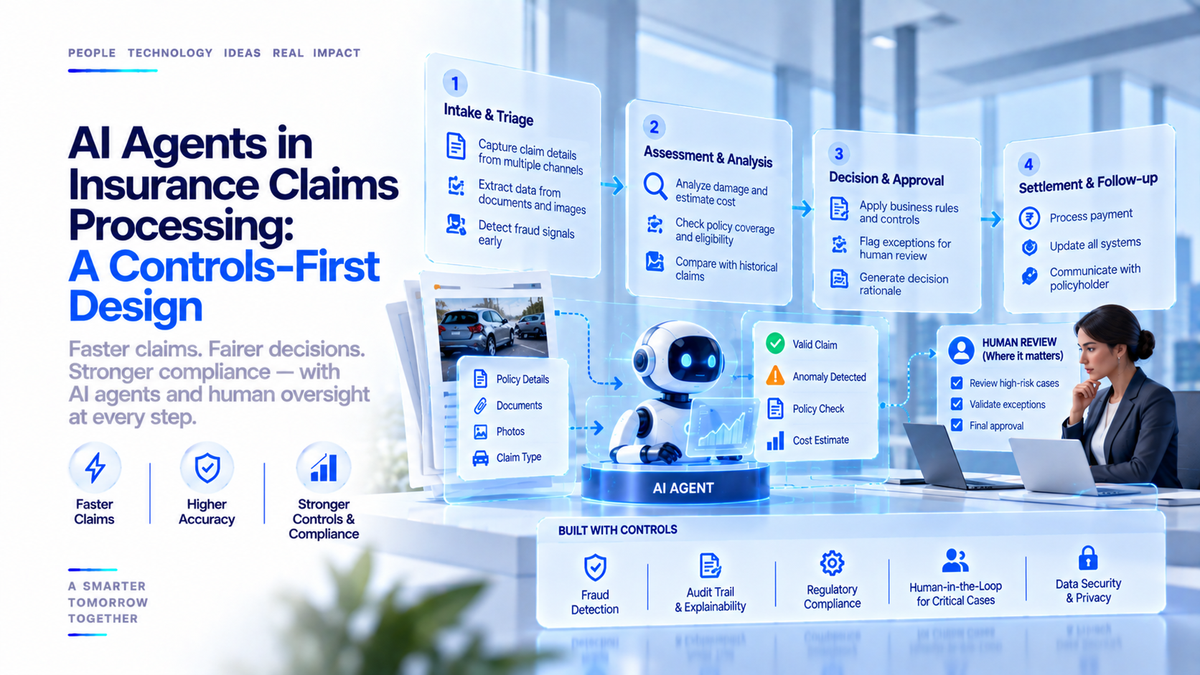
Insurance claims processing combines heavy document volumes, rules, customer interactions, and operational decisions. A single claim can require policy verification, document collection, damage assessment, classification, fraud checks, eligibility review, communication, and approval or escalation.
That makes claims a natural candidate for AI-assisted automation, but claims are consequential: a poorly designed system can delay legitimate claims, wrongly flag customers, or produce inconsistent outcomes. So AI agents for insurance claims should be designed controls-first, the same discipline the agentic AI in finance hub applies across financial services.
What a claims agent does, and how triage and documents work
An agent can coordinate receiving claim information, extracting documents, classifying claims, checking completeness, retrieving policy information, identifying inconsistencies, preparing summaries, routing claims, requesting missing documents, and assisting adjusters, with its role scaled to claim complexity and risk.
On triage, not every claim needs the same investigation, so AI can sort claims into routine (complete information, standard conditions), review (some human validation needed), complex (specialist assessment), and potential anomaly (further investigation), helping teams allocate attention.
On documents, claims generate large volumes, and AI can extract information from forms, invoices, photographs, medical documents where applicable, repair estimates, policy documents, and correspondence, then organise it into a structured claim file, cutting the manual effort of searching across everything.
Fraud flagging, straight-through processing, and human review
On fraud, AI can surface patterns worth investigating, inconsistent dates, unusual claim frequency, contradictory information, duplicate documentation, unusual transaction patterns, but flagging is not proof, and the AI should identify cases for investigation, never automatically brand customers as fraudulent without review. Some simple claims may suit straight-through processing: where policy eligibility is clear, documentation is complete, the amount is within defined limits, validation passes, and no unusual indicators appear, the workflow can proceed with minimal intervention, while more complex claims follow a human-review path, creating a risk-based operating model.
Human review becomes important when evidence conflicts, the claim is unusually large, fraud indicators appear, policy interpretation is complex, customer circumstances need judgment, or the AI has low confidence, and the system should make escalation easy rather than forcing the agent onward, consistent with Applore's emphasis on graceful human escalation in enterprise AI agent design.
Controls, customer experience, and rollout
Important controls include input controls (validate documents and incoming information), data controls (restrict access to only what's required), decision controls (define which decisions need humans), output validation (don't let unsupported outputs trigger consequential actions), auditability (record decisions and actions), and monitoring (track errors, drift, and unusual behaviour). Done well, automation actually improves customer experience, instead of generic messages, the agent can give clear status: claim received, document missing, assessment underway, human review required, decision completed, so customers get visibility without chasing the insurer.
Measure average claim processing time, first-contact resolution, manual review rate, document-processing time, exception rate, claim leakage, complaints, and fraud investigation efficiency, better claims operations, not maximum automation. Implement narrowly: pick one claims category, map the workflow, identify repetitive tasks, define claim-risk categories, integrate policy and claims systems, build document processing, add decision controls, launch with human review, evaluate, and expand selectively. The strongest model is controls-first: AI processes information, rules enforce boundaries, humans handle exceptions.
Frequently asked questions
What can AI agents automate in insurance claims?+
Document processing, claim classification, triage, policy information retrieval, customer communication, and case preparation.
Can AI automatically approve insurance claims?+
Some low-risk, clearly defined claims may suit higher automation, subject to the insurer's policies and applicable requirements.
Can AI detect insurance fraud?+
It can flag patterns for investigation, but a fraud flag should never be treated as proof of fraud without review.
Why is human review important in claims of AI?+
It provides judgment for complex, disputed, unusual, or high-impact claims where automation shouldn't decide alone.
What does controls-first mean for claims AI?+
AI processes information, rules enforce boundaries, and humans handle exceptions, with validation on any consequential action.
How should claims of AI be measured?+
Processing time, first-contact resolution, manual review rate, exception rate, claim leakage, complaints, and fraud efficiency.