

Best Digital Transformation Consulting Firms in 2026
Digital transformation consulting firms help businesses modernize technology, streamline operations, improve customer experiences, and adapt to changing digital demands. This guide explores the best digital transformation consulting firms in 2026, covering their expertise, technology capabilities, industry experience, and key factors businesses should consider when choosing a digital transformation consulting partner.
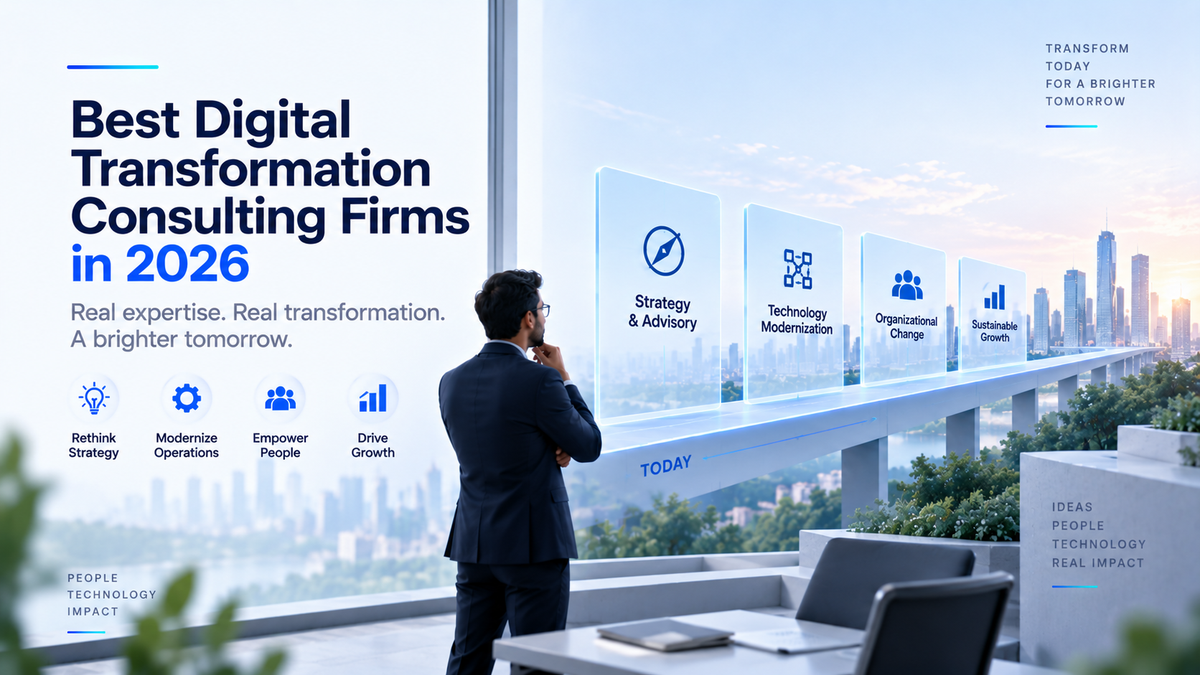
"Digital transformation" is the oldest promise in enterprise consulting, and in 2026 it means something different from what most companies bought a decade ago.
The first wave digitised processes: paper to forms, forms to workflows, servers to cloud. Most large organisations have done that, or at least paid for it. The current wave is harder, because AI has moved the goalposts. Transformation now means re-architecting how the business operates, its systems, data, decisions and workflows, so that intelligence can run through it, not just software.
That shift changes what to look for in a partner. The firms that were excellent at lifting applications to the cloud aren't automatically the firms that can redesign a claims process around an AI agent, and the strategy houses that can diagnose the operating model aren't automatically the ones who can build what they recommend.
So here's the honest, fit-based comparison of the best digital transformation consulting firms in 2026, with the same rule we've applied across our companion shortlists for AI consulting for enterprises, growth-stage SMEs, the Indian market and AI strategy firms: no universal ranking, and we describe ourselves with the same candour as everyone else.
What Digital Transformation Consulting Covers in 2026
A serious engagement now spans four connected layers, and firms differ most in how many they genuinely own.
The operating layer: diagnosing how the business actually runs, where value leaks, which processes deserve redesign rather than digitisation. The technology layer: legacy modernization, platform and architecture decisions, cloud, integration, security, and the sequencing work of a target architecture roadmap so a multi-year change doesn't break the business paying for it. The intelligence layer: data platforms, applied AI, agentic systems and workflow automation, which is where transformation and AI business transformation consulting have effectively merged. The adoption layer: the organisational change, training, governance and measurement that decide whether any of it shows up in the P&L.
Keep those four layers in mind as you read the list, because "we do digital transformation" can mean owning all four or subcontracting three.
Best Digital Transformation Consulting Firms in 2026
1. Accenture
Still the default consideration for very large, multi-country transformation, combining strategy, cloud, data, application modernisation and enormous delivery capacity under one roof. Best for: global enterprises running complex, multi-year programmes across many geographies and systems.
2. McKinsey & Company
Most relevant when transformation is fundamentally a business-model and operating-model question that technology serves, and when the board needs strategy carrying institutional weight. Best for: C-suite transformation strategy and analytics-led change at the top of the house.
3. BCG
Strong where transformation connects strategy, technology and new digital products, particularly for organisations reinventing what they sell, not just how they run. Best for: business-model reinvention and digital product builds.
4. Deloitte
The natural shortlist entry where transformation is entangled with risk, regulatory change, controls and organisational redesign. Best for: regulated industries and governance-heavy programmes.
5. IBM Consulting
Most useful when the binding constraint is the existing estate: hybrid cloud, mainframes, complex data platforms and deep legacy modernization needs. Best for: technology-heavy transformation anchored in modernisation.
6. Capgemini
A solid fit for integrated programmes spanning cloud, applications, data and digital processes at scale, delivered through a large global engineering base. Best for: broad, multi-stream transformation delivery.
7. TCS
Relevant where sheer delivery scale across a sprawling enterprise environment is the decisive requirement, over multi-year horizons. Best for: very large implementation programmes and long-standing enterprise relationships.
8. Infosys
A major transformation provider with breadth across AI, cloud, data and enterprise technology, suited to organisations prioritising implementation reach. Best for: large enterprises and mid-market companies scaling into enterprise environments.
9. Applore Technologies
Our own entry, by fit. Applore runs a strategy-to-system model: the same senior team that diagnoses your operating reality designs the architecture, builds the systems and stays accountable through adoption. The practice connects technology strategy, platform architecture, and data, AI and automation as one capability, which matters in 2026 because the transformation problem and the AI problem are now the same problem: AI readiness, agentic AI, enterprise AI agents with real guardrails, AI workflow automation, and governance designed in rather than bolted on, with results measured beyond hours saved.
Best for: enterprises, GCCs and growth-stage companies that want transformation led by senior practitioners who also ship, without a programme-office layer. Honest limits: for a 400-person multi-country rollout, the first name on this list is the better call, and we'll say so in the first meeting.
How AI Changed What "Transformation" Means
Worth pausing on, because it's the biggest evaluation shift since the cloud era.
A decade ago, transformation success meant systems migrated and processes digitised. In 2026, digitising a bad process just makes it fail faster and cheaper. The question has become: where should decisions move into systems, and what has to be true, in data, architecture, governance and skills, for that to work?
That's why AI digital transformation isn't a separate service line; it's the current definition of the work. And it's why the evaluation bar has risen: a partner now needs to hold the operating diagnosis, the architecture, the AI build and the adoption in one accountable arc, because the seams between those four layers are exactly where transformation value has always leaked. If you want the full method for testing a firm against that bar, our 30-day playbook for evaluating a consulting partner runs the process week by week.
Big Firm vs Focused Firm: The Transformation Version
The trade runs the same as in AI consulting, sharpened by transformation's timescale.
Global majors bring scale, industry depth, delivery armies and the ability to staff twelve workstreams on Monday. The costs at anything below mega-programme size: heavier structures, slower cycles, and the pattern where the partner who sold the vision hands delivery to a rotating bench, which over a three-year programme means your transformation is led by people who weren't in the room when it was designed.
Focused, senior-led firms bring continuity, speed and direct accountability across the whole arc, at the cost of smaller capacity and narrower geographic reach. Over a multi-year change, that continuity compounds: the person who made the architecture call in month two is still answerable for it in month twenty.
The deciding question: does your transformation starve without scale, or without senior continuity? Answer that honestly and the tier picks itself.
What to Check Before Hiring Any Firm on This List
Five checks, each cheap to run.
Ask about a transformation failure: Ask the firm to share a transformation they consider a failure and what they learned from it. Confident firms should be willing to discuss what went wrong.
Meet the actual delivery team: Meet the people who would be responsible for month twelve, not just the senior team involved in month one.
Ask how they sequence the transformation: Look for answers that explain dependencies, foundational work and business milestones rather than vague promises to run everything in parallel.
Ask where AI fits: Find out whether AI is simply bolted on as a separate workstream or integrated into the organization's architecture and operating model from the beginning.
Ask how success is measured after go-live: Look for owned operating metrics and measurable business outcomes, rather than a completion certificate marking the end of the project.
Conclusion
The right choice depends on the organisation's transformation problem. For businesses evaluating digital transformation consulting companies in 2026, the most important question isn't "which consulting firm is the biggest?" It's "which partner can understand our operating reality, design the right transformation path and help us implement it without disrupting the business?"
That's what turns digital transformation from a technology project into lasting business change. Scale buys capacity; understanding buys outcomes, and transformation is judged entirely on outcomes.
If the strategy-to-system model fits your problem, book a consultation. Bring your messiest operating reality, and we'll tell you in the first meeting what we'd sequence first, what we'd leave alone, and, if the honest answer is that you need a bigger machine than ours, which name above to call.
Frequently asked questions
What do digital transformation consulting firms actually do in 2026?+
They diagnose how the business operates, redesign processes and operating models, modernise legacy technology and architecture, build data and AI capability into workflows, and drive the adoption and measurement that turn the change into business results.
How is digital transformation different now from five years ago?+
Earlier transformations digitised existing processes and moved infrastructure to the cloud. In 2026 it centres on AI: deciding where judgement moves into systems, and rebuilding data, architecture and governance so that intelligence runs through operations rather than sitting beside them.
Which firm type fits which transformation problem?+
Global majors fit multi-country, multi-year mega-programmes. Strategy houses fit board-level operating-model questions. IT majors fit the delivery scale. Senior-led strategy-to-system firms fit organisations that need the diagnosis, architecture, build and adoption held by one accountable team.
How do we avoid a transformation programme that stalls?+
Sequence by dependency rather than enthusiasm, anchor phases to business milestones, avoid big-bang cutovers, keep senior continuity in the partner team, and measure operating outcomes after go-live rather than declaring victory at deployment.
Where does legacy modernization fit into digital transformation?+
Usually as the foundation phase: a transformation built on systems that can't serve the data or host the workloads fails in month two. A target architecture roadmap decides what to modernise, wrap, migrate or retire, and in what order.
How should digital transformation success be measured?+
In operating and commercial terms: cycle time, cost per transaction, time to launch, revenue enabled, risk reduced and adoption sustained. Migration counts and go-live dates are milestones, not results.