

Target Architecture Roadmaps: Sequencing a Multi-Year Replatform Without Breaking the Business
A multi-year replatforming initiative requires more than a modern technology stack—it requires a clear sequence that protects business continuity while creating a path for long-term growth. This guide explains how to build a target architecture roadmap, prioritize modernization initiatives, manage dependencies, and phase transformation without disrupting critical operations.
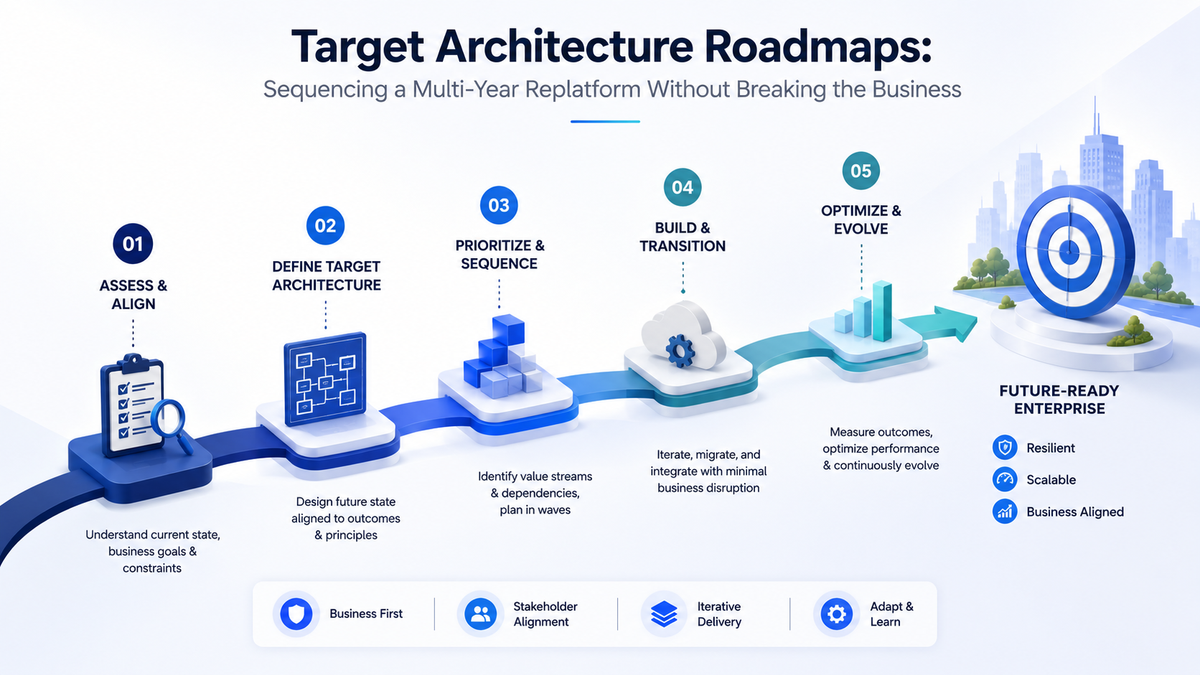
We've never seen a multi-year transformation fail because someone couldn't draw a good architecture diagram. Diagrams are the easy part.
They fail because nobody could decide what should change first, what could wait, what had to stay stable, and how each technology decision would land on the business around it. Eighteen months in, three workstreams are half-finished, the legacy system everyone wanted dead is still carrying production traffic, and the board is asking what the money bought.
That's why a target architecture roadmap is more than a technical document. For organisations wrestling with legacy applications, fragmented platforms, mounting technical debt or data scattered across disconnected systems, the roadmap is the bridge between the architecture team and the business. It answers a deceptively simple question: how do we get from the environment we have to the architecture we need, without putting today's revenue at risk while we do it?
The answer is almost never one migration. It's a sequence of controlled changes spread across years, and the sequence is where the value lives.
That's how our Platform & Architecture practice at Applore approaches it: understand the operating reality first, then recommend technology. A target architecture that ignores how an organisation actually runs can look excellent on paper and still fail in production. We've inherited a few of those.
What Is a Target Architecture Roadmap?
A target architecture roadmap defines the journey from your current technology environment to a future-state architecture. It connects four things: the current state, the target state, business priorities, and a sequenced implementation plan.
The distinction that matters is this. The architecture describes where you want to arrive. The roadmap explains how you'll get there.
An enterprise might decide it eventually wants a cloud-native platform, event-driven integration, a modern data layer, API-led connectivity and modular business services. That's a target architecture, and a reasonable one. But "we'll modernise everything over the next three years" is not a roadmap. A real roadmap commits to sequencing. Which system moves first? Which dependencies get untangled before anything else can. Which workloads migrate, which applications retire, where platform investment goes, and, crucially, what stays untouched until later. Above all: what business value each stage delivers, so the programme survives its second budget cycle.
Why Multi-Year Replatforming Is Different
A short project can be managed around a fixed scope. A multi-year replatform can't, because the world refuses to hold still while you work.
Business priorities will shift. Regulations will appear. Cloud pricing will move. AI capability will evolve faster than any plan written today can anticipate. Teams will reorganise. Products will launch. An acquisition might drop an entirely different technology stack into your lap mid-programme. We've watched a client's two-year plan absorb all of those at once.
So a five-year plan shouldn't pretend to predict every technical decision five years out. It should set direction with enough flexibility to adapt. The goal isn't a fixed checklist. The goal is a sequence of decisions that makes future decisions easier. That's probably the single most useful principle in enterprise architecture right now.
Start With the Business, Not the Technology
The most common mistake in replatforming programmes is starting from a technology announcement. "We need to move to the cloud." "We need microservices." "We need to replace the legacy ERP." "We need a modern data platform."
All of these may end up being valid decisions. None of them is a business outcome.
The stronger opening question is: where is the current environment stopping the business from performing? Maybe customer onboarding takes two weeks because five systems need manual updates. Maybe sales can't get reliable inventory numbers. Maybe every product launch needs months of integration work. Maybe compliance reporting runs on spreadsheets and prayer. Maybe one core application is so fragile that teams have quietly agreed never to touch it. Maybe you can't introduce AI because the operational data it needs is fragmented across systems that don't talk. That last one is the most common trigger we see now, and it's why an AI readiness assessment so often turns into an architecture conversation.
Frame it this way and technology becomes the response to an operating problem rather than the objective. That reframing changes everything downstream, including how you'll measure success.
Establish the Current-State Architecture
Before defining where you're going, you need an honest picture of where you are, and honest is the operative word. Most application inventories flatter the environment.
A useful current-state assessment covers six layers. Applications: which support critical processes, which are duplicated, which are approaching end-of-life, which are so customised that upgrading means rebuilding. Data: where critical business data actually lives, who owns it, how it moves, where the quality problems cluster. Integration: what runs through APIs, what still depends on nightly batch files, where humans are the integration layer, which interfaces would hurt most if they failed tonight. Infrastructure: what's on-premises, what's in cloud, whether costs track usage or just accumulate. Security and resilience: which systems carry material risk, what happens when a critical service fails, how fast you'd detect it and recover. And people: which teams own which platforms, where ownership is unclear, and which systems depend on two individuals who could resign next month.
That last one gets skipped constantly, and it's often the finding that reshapes the whole roadmap. If your most critical system is understood by two people, that's an architectural risk, whatever the diagram says. It's the same discipline we apply in technical due diligence for M&A, pointed inward.
Define the Target Architecture Around Capabilities
The target state shouldn't be a shopping list of technologies. "We will use platform X and framework Y" is a procurement decision wearing an architecture costume.
Start with capabilities instead. Scalable customer management. Real-time operational visibility. API-based integration. Centralised identity. Reliable data access. Automated workflows. Observability. Self-service analytics. AI-ready data foundations that can eventually support the kind of enterprise AI agents most boards are now asking about.
Then evaluate technology choices against those capabilities. This keeps the architecture from becoming a vendor-driven exercise, and it makes the roadmap communicable to people who sign cheques. A CFO doesn't care which framework implements a service. They care whether the transformation cuts operating cost, speeds the business up or takes risk off the table. Speak in capabilities and you can hold both conversations with one document.
The Importance of Sequencing
Here's the part most roadmaps get wrong, and it's the part that matters most. The destination is usually the least valuable page. The sequence is the product.
Say you want to modernise a core customer platform. The obvious move is rebuilding the customer application first, because it's visible and everyone's excited about it. But identity management is fragmented. Customer data is inconsistent. Downstream systems still read the legacy database directly. There's no reliable integration layer. Rebuild the front end first and you get a modern-looking application bolted to an outdated backend: all of the cost, little of the benefit, and a demo that ages badly.
The better sequence usually looks something like: identity and access foundations first, then critical data quality, then an integration layer, then separating the high-value business capabilities, then modernising priority workloads, migrating traffic incrementally, retiring legacy components, and finally optimising the new platform. The exact order depends on the organisation. The principle doesn't: dependencies drive sequencing, not organisational enthusiasm. The loudest stakeholders system going first is how programmes die. We've written separately about legacy system modernization and the upgrade-without-breaking problem at the single-system level; the roadmap is the same discipline at portfolio scale.
Build Around Business Milestones
A multi-year programme becomes far easier to run when every phase ends in an outcome someone outside IT can recognise.
Not "Q2: API migration" but "Q2: customer onboarding runs through the new integration layer." Not "Phase 3: cloud migration" but "Phase 3: priority workloads run on scalable infrastructure with defined reliability and cost controls."
The rewording sounds cosmetic. It isn't. It shifts every governance conversation from activity to impact, which is how funding survives leadership changes and budget reviews. It's also how we measure our own engagements at Applore: our Plan → Execute → Adopt framework ties diagnosis and architecture to adoption and measurable operating impact, because a delivered system nobody adopted is just expensive shelfware with a launch date.
Avoid the "Big Bang" Migration
The larger the system, the more dangerous it is to combine new architecture, new infrastructure, new processes, new data models, new teams and new integrations into one release. Each is a variable. Multiply six variables in a single weekend cutover and you've built an experiment you can't debug.
Incremental migration creates learning. Move one capability, measure it, discover the dependency nobody documented, adjust the next stage. Counterintuitively, this often ends up faster than the big bang, because it slashes the cost of being wrong, and on a multi-year programme you will be wrong about something.
Architecture Roadmaps Need Governance
A roadmap without governance decays into a wish list, usually within two quarters.
As the transformation runs, someone has to keep answering: is this decision still valid? Has a dependency shifted? Has business priority moved? Are we quietly creating new technical debt in the name of removing old debt? Is the target still right? Are teams following the agreed standards? Are the promised benefits actually landing?
So governance is continuous, not a one-time approval gate. This matters most in large organisations where product teams decide independently. The point isn't to control every technical choice; that kills velocity and morale together. It's to control the choices with long-term architectural consequences and let everything else move fast. Many mid-sized companies lack a leader senior enough to hold that line, which is exactly the gap our CTO-as-a-Service engagements exist to fill.
Measure the Roadmap by Business Outcomes
Track the technical metrics, certainly: availability, deployment frequency, infrastructure cost, incident rate, recovery time, integration failure rate, API adoption, data quality, migration progress. They tell you whether the machine is being built properly.
But leadership should also track time to launch new products, customer onboarding time, operating cost, revenue enablement, employee productivity, customer experience and compliance risk. Those tell you whether the machine was worth building. A replatform succeeds when the new architecture changes how the organisation operates, not when the old servers get switched off. We've made the same argument about measuring AI agent ROI beyond hours saved; the discipline is identical.
When Should an Organisation Replatform?
Replatform when the environment creates structural limits, not when the stack merely feels old. The honest signals: technology is blocking product growth. Core applications resist change. Integration costs keep climbing. Infrastructure gets more expensive to keep alive each year. Critical systems sit on technology their vendors have abandoned. Teams spend more time maintaining than building. Data fragmentation is blocking the AI roadmap. Security and compliance are getting harder to satisfy. New capabilities take quarters to launch when competitors ship in weeks.
And even then, not every legacy system needs replacing. Some should be stabilised. Some are wrapped with APIs. Some rehosted. Some retired outright. A strong roadmap makes those calls explicitly, system by system, instead of defaulting to "replace everything," which is the most expensive sentence in enterprise IT.
The Roadmap Should Create Optionality
The best target architecture doesn't just fix today's problem. It buys options for tomorrow.
A modular integration layer makes the next application swap cheaper. A governed data foundation opens AI use cases you haven't specified yet. Centralised observability lifts resilience across every platform at once. A clear operating model makes engineering teams easier to scale. This is why architecture deserves to be treated as a long-term business capability, not an IT diagram that gets framed and forgotten.
Conclusion
A multi-year replatform is not a technology replacement exercise. It's a controlled change in how an organisation operates.
The target architecture sets direction. The roadmap sets a sequence. Governance protects the direction. Business outcomes justify the spend. And adoption decides whether any of it sticks.
Organisations that treat architecture as a static end-state drown in complexity. Organisations that treat it as a sequence of deliberate decisions modernise without betting the business on a single cutover weekend.
So if you're planning application modernization, platform modernization or a broader digital transformation strategy, don't open with "what technology should we buy?" Open with "what needs to change in how our business operates, and what architecture lets that change compound?"
That's where a useful target architecture roadmap begins. If you want a second pair of eyes on yours, or a current-state assessment before you commit the budget, that's exactly what our Platform & Architecture practice does. Book a consultation and we'll tell you what we'd sequence first, and what we'd leave alone.
Frequently asked questions
What is a target architecture roadmap?+
It defines the path from an organisation's current technology environment to its desired future-state architecture, connecting architecture decisions with business priorities, dependencies, sequencing and milestones.
How long should a target architecture roadmap cover?+
Several years for major transformations, but detailed commitments should be strongest near-term. Later phases should set direction while staying flexible as conditions change.
What is the difference between a target architecture and an architecture roadmap?+
The target architecture describes the desired future state. The roadmap explains how the organisation moves from the current state to that future state through sequenced initiatives.
Should every legacy application be replaced during replatforming?+
No. Depending on business criticality, technical risk, cost and strategic value, a legacy application may be modernised, wrapped with APIs, migrated, stabilised or retired.
How can organisations reduce the risk of a multi-year replatform?+
Incremental migration, dependency mapping, business milestones, continuous architecture governance, clear ownership and outcome-based measurement. Never combine too many major changes into one migration event.
How does a target architecture support digital transformation?+
It creates the technical foundation to change processes, integrate systems, improve data access, introduce automation and scale new digital capabilities without repeatedly rebuilding the base.