
How to Measure AI Agent ROI: Metrics Beyond "Hours Saved"
Measuring AI agent ROI requires more than counting the hours saved by automation. This blog explores the metrics enterprises should use to evaluate AI agent performance, including cost savings, productivity gains, accuracy, revenue impact, customer outcomes, scalability, and risk reduction. Learn how to build a practical ROI framework that connects AI agent investments to measurable business value.

"How many hours did the AI save?"
It's the first question almost every organization asks after deploying an AI agent. It's also one of the least complete ways to measure whether the thing was worth building.
Hours saved tell you a task got faster. They don't tell you whether the business got better. An employee saves two hours a day because an agent now prepares their reports. Sounds valuable. But then what? Do those hours become more customer work, more transactions processed, faster response times, fewer errors, avoided hires? Or do they quietly evaporate into the workday with nothing changing on any P&L line?
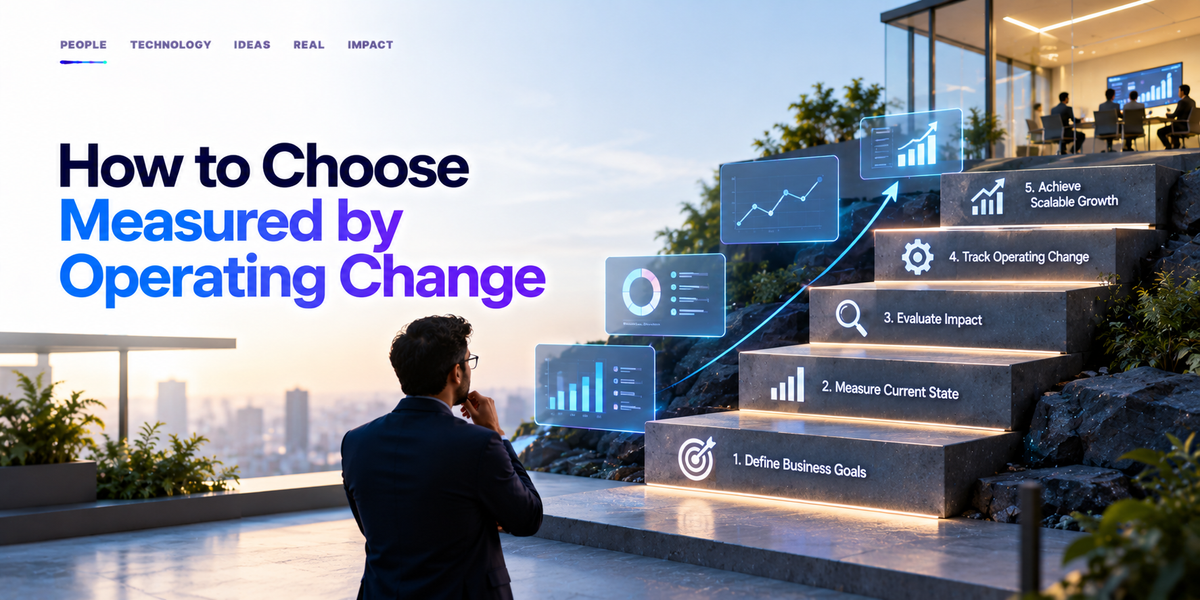
That gap between time saved and value created is where real AI agent ROI lives, and after measuring these deployments across dozens of client engagements at Applore, we hold ourselves to the same standard we're about to hand you: measure the operating change, not the deployment. This guide gives you the full framework, the metrics that matter beyond hours saved, the traps that inflate pilot results, a working scorecard and a formula that survives CFO scrutiny.
Why "hours saved" flatters every project
Take a support agent that cuts average handling time from ten minutes to six. A 40% improvement, straight onto the success slide.
Now look closer. If demand is unchanged and employees simply spend less time on the same work, the financial benefit is thin. If the freed capacity lets the business handle 30% more customers without adding headcount, the value is real and large. And if the faster handling comes with more escalations, more errors or unhappier customers, that headline number is actively hiding a problem.
Same 40%, three completely different business stories. Which is why serious measurement runs across six dimensions at once: efficiency, capacity, quality, revenue, risk and adoption. The mix varies by workflow; the principle doesn't.
No baseline, no business case
The most common measurement failure happens before launch: nobody documents the starting point. Before the agent goes live, capture the existing process: average processing time, cost per transaction, error and rework rates, volume handled, response times, escalation rates, team capacity and service-level compliance.
Then the business case becomes a clean three-part statement: current state, expected change, actual change. Without that baseline, teams end up comparing the agent to a remembered version of the old process, and memory is generous. This is also why baselining is built into the discovery phase whenever we're building enterprise AI agents for clients; measurement designed after launch is measurement designed to flatter.
Capacity released beats hours saved
Here's the upgrade that changes most ROI conversations. An operations team spends 1,000 hours a month on report preparation and reconciliation; an agent removes 300 of them. The first metric is 300 hours saved. The metric that matters is: where did those 300 hours go?
Four scenarios, four very different values. The capacity gets absorbed by existing work, more customer requests handled with the same team: genuine operational value. The capacity supports growth, volume rises without proportional hiring: strong economic value, often the strongest. Employees redirect the time to analysis, customer engagement and problem-solving: harder to measure, still significant. Or, scenario four, nothing changes and the time simply disappears: the productivity gain existed on paper and nowhere else.
Track the destination of the capacity, not just its release. That single discipline separates ROI stories from ROI.
Track cost per outcome, not tasks completed
Shift the unit of measurement from activity to outcomes. Not "how many tasks did the agent complete?" but "what does each successful outcome now cost?" Cost per resolved support case. Per processed invoice. Per qualified lead. Per completed service request. Per reviewed document.
This makes the before-and-after comparison honest. An agent that increases the volume of interactions without reducing the cost per successful outcome is generating activity, not value, and cost-per-outcome is the metric that catches it.
Quality rides alongside productivity, always
Automation can make a process faster and worse at the same time, and it happens more often than success decks admit. So quality metrics travel with every productivity metric: error rate, rework rate, escalation rate, exception rate, complaints, first-pass accuracy, human correction rate.
If an agent halves processing time and doubles the error rate, you haven't improved the process. You've relocated the work from processing to correction and added a delay. The question a strong business case answers is "did we make this faster and better?", never just "faster?"
The override rate is a diagnostic, not a scoreboard
Human intervention isn't failure; it's often exactly what good governance requires, as we've argued in depth on AI agent governance. But the rate carries a signal. An agent whose recommendations get overridden 2% of the time across 10,000 cases is probably performing well for a low-risk workflow. One overridden 35% of the time isn't reliable enough yet, whatever its demo looked like.
The real value comes from categorizing the overrides: incorrect recommendation, missing information, policy exception, edge case, human preference, safety requirement, system limitation. That breakdown is your improvement roadmap, handed to you by your own users, for free.
Adoption is not deployment, and usage is not value
An agent can be technically excellent and operationally irrelevant, because deployment doesn't mean anyone uses it. Measure active users, repeat usage, workflow adoption, completion and drop-off rates, and the percentage of eligible workflows actually running through the agent.
Then go one level deeper, because usage alone still proves nothing: an employee can invoke an agent daily without performing any better. The chain worth measuring is adoption, then behaviour change, then operational outcome. Only the full chain is evidence.
Cycle time: the clearest metric most teams skip
For any multi-step process, measure elapsed time from start to completion: customer request to resolution, invoice receipt to approval, lead creation to qualification, issue detection to maintenance response.
Cycle time matters because in most enterprises the bottleneck was never one person's task speed. It's the waiting between teams and systems, the handoffs where work sits in queues. Agents that coordinate those handoffs collapse cycle times in ways that task-level metrics completely miss, and cycle time is where that value becomes visible.
Exceptions, revenue and customers
The cost of exceptions: Most processes have a small number of hard cases consuming disproportionate attention. An agent that cleanly processes 95% of routine cases and routes the difficult 5% to specialists isn't just automating; it's concentrating human expertise where it's genuinely needed. Track cost and time per exception: fewer unnecessary escalations plus better-handled genuine ones equals a changed operating model.
Revenue impact, where relevant: Not every agent should be revenue-measured, but sales, marketing and customer-success agents should: lead conversion, sales-cycle length, pipeline velocity, retention, revenue per employee. And keep the distinction sharp: an AI sales agent that generates more emails is not necessarily valuable; one that helps convert more qualified opportunities is. Choosing workflows where that distinction favours you is half the game, which is exactly the selection problem we cover in our guide to agentic AI use cases for enterprises.
Customer outcomes: Customer-facing agents need customer metrics: first-response time, first-contact resolution, satisfaction, complaint rate, self-service completion, customer effort. A faster automated interaction is not automatically a better one. If customers repeat themselves because the agent drops context, you've cut internal workload by raising customer effort, and that trade eventually shows up in retention, with interest.
Count risk reduction as real money
Some agent value is prevention, and prevention is chronically under-counted because nothing visible happens. An agent that detects policy violations, flags unusual transactions, checks compliance requirements and maintains audit records creates financial value through avoiding operational losses, fraud, rework, security incidents, regulatory penalties and customer disputes.
Put a risk-adjusted value on this work. It's harder to estimate than labour savings, and it's frequently larger.
Include the full cost, or the ROI is fiction
The benefit side of AI ROI gets celebrated; the cost side gets abbreviated to the API bill. The true cost includes model usage, infrastructure, integration, data engineering, security, monitoring, governance, maintenance, human review, change management, training, testing and support.
An agent that looks cheap at prototype stage can cost multiples more at enterprise scale, and this total-cost-of-ownership discipline is the same one that should drive your build versus buy decision for AI agents in the first place. Calculate ROI on total cost of ownership or don't call it ROI.
The scorecard, the worked example and the timeline
The scorecard: Combine seven dimensions so no single flattering number declares victory: efficiency (processing time, cost per transaction), capacity (additional workload handled, avoided hiring), quality (errors, rework, corrections), customer (response time, satisfaction, retention), revenue (conversion, revenue influenced), risk (exceptions caught, losses avoided) and adoption (active users, workflow coverage).
A worked example: An enterprise deploys an invoice-processing agent. Before: 20,000 invoices monthly, 8 minutes average processing, 4% exceptions, 6% rework, a 10-person team. After: same volume, 4 minutes, 3% exceptions, 3% rework, same team. The headline is the halved processing time, but the stronger story is faster and cleaner simultaneously. Then volume grows to 28,000 invoices without equivalent hiring, and the economic value stops being arguable. That's why measurement continues after launch instead of ending at the case study.
The timeline: ROI isn't calculated once, because the agent, its usage, model costs and workflows all keep moving. Measure in stages: at 30 days, is it working reliably? At 60 to 90 days, are users adopting it? In six months, will the operating model change? In twelve months, is the impact sustainable? Staged measurement is also your defence against the classic mistake of extrapolating a hand-held pilot into an enterprise forecast.
The formula, done properly
The basic shape is familiar: AI Agent ROI = (Business Value Generated Total AI Cost) ÷ Total AI Cost. The work is in defining business value honestly: capacity value plus revenue impact plus cost reduction plus risk reduction plus quality improvement.
And the weighting is contextual. For a customer-service agent, retention and resolution speed may outweigh direct labour savings. For a finance agent, error reduction and control improvement lead. For a manufacturing agent, downtime avoided is the headline. Fit the formula to the workflow, not the workflow to the formula.
The only question that ultimately matters
Strip everything above away and the strongest measurement conversation is one question: what is now different about the business because this agent exists?
Maybe the company handles more volume with the same team. Maybe customers get answers in minutes instead of hours. Maybe maintenance catches problems before they stop production. Maybe compliance catches exceptions before they become incidents. Those are operating changes, and operating change is where AI becomes economically meaningful.
The trap to avoid is productivity without an outcome: automation that frees time nobody redeploys. Trace the full chain, automation to capacity to behaviour to business outcome, and the further your measurement travels along it, the more your ROI number means. Before scaling any agent, ask the ten hard questions: what problem are we solving, what was the baseline, which metric moved, did quality hold, where did the capacity go, did customer outcomes change, did revenue or cost move, did risk exposure change, what's the total cost of ownership, and is it sustainable? If those can't be answered, you're measuring AI activity, not AI value.
Conclusion
The next phase of enterprise AI won't be won by whoever deploys the most agents. It'll be won by organisations that know which agents create measurable business value and which just create more technology. So measure beyond hours saved: cycle time, capacity, quality, customer outcomes, revenue, risk, adoption, and above all, what actually changed in the operating model. An agent should earn the right to scale through evidence, and when the evidence shows a workflow became faster, better, more scalable and more reliable, you don't have an AI success story. You have a business case.
If you want that evidence for your own deployments, talk to Applore. We build enterprise AI agents with baselines, scorecards and staged measurement designed in from day one, and we'll run this framework against agents you've already shipped to show you which ones are earning their keep and which are just keeping busy. One honest measurement review beats a year of optimistic dashboards.
Frequently asked questions
What is AI agent ROI?+
The business value an agent creates compared with the total cost of designing, deploying, operating, governing and maintaining it, including operational, financial, customer, quality and risk outcomes.
Is hours saved a good AI ROI metric?+
Useful but incomplete. What matters is where the released capacity goes: if it supports more revenue, more workload, better service or avoided hiring, it becomes financially meaningful.
What are the most important AI agent ROI metrics?+
Cost per outcome, capacity released, cycle time, error and rework rates, customer satisfaction, conversion and revenue impact, risk reduction, adoption, human override rate and total cost of ownership.
How do you calculate AI agent ROI?+
(Business Value Generated − Total AI Cost) ÷ Total AI Cost, where business value covers capacity, revenue, cost reduction, quality and risk reduction as fits the workflow.
How long does it take to measure AI agent ROI?+
Operational indicators show within 30 to 90 days; meaningful financial and strategic impact typically needs six to twelve months depending on volume and workflow.
How can enterprises avoid overstating AI ROI?+
Document a baseline first, count full costs including human review, track quality alongside productivity, verify where capacity actually went, and measure across multiple periods rather than extrapolating pilot results.