

Agentic AI for Operations: A Practical Checklist Before You Automate
Agentic AI is moving beyond simple automation by enabling AI systems to reason, make decisions, and execute multi-step operational tasks with limited human intervention. But automating the wrong processes can create unnecessary cost, risk, and complexity. This practical checklist explains what businesses should evaluate before adopting Agentic AI for operations, from process readiness and data quality to human oversight, security, governance, and measurable business outcomes.
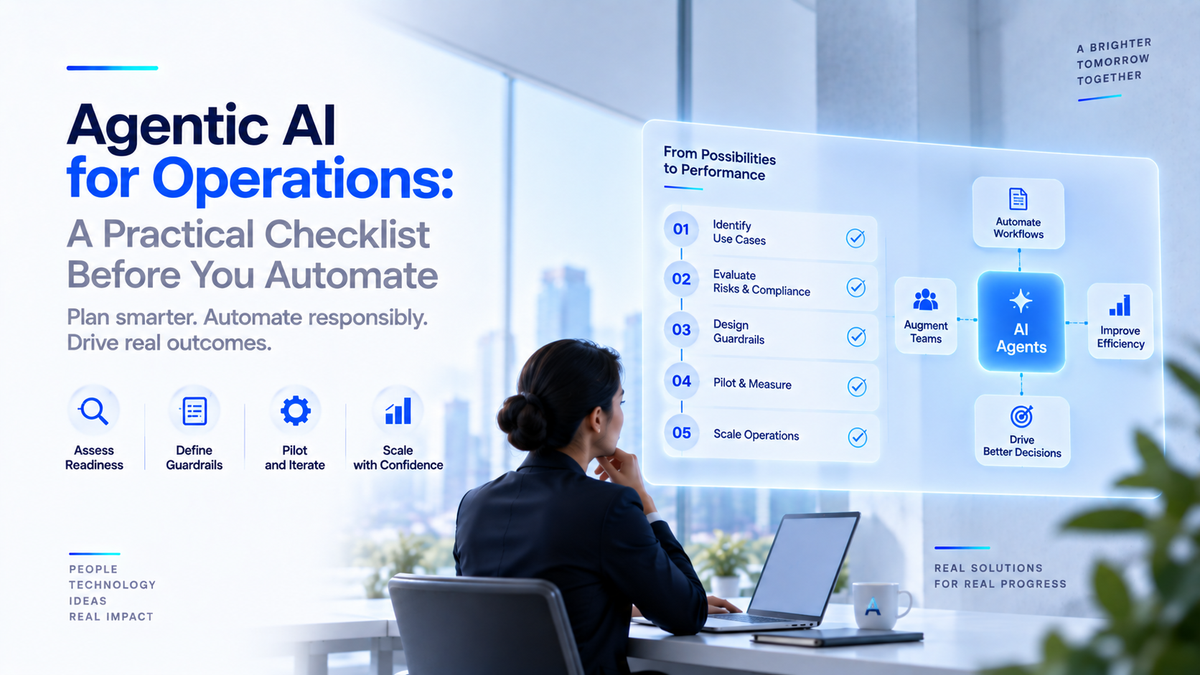
The fastest way to misuse agentic AI is to start with the agent. The better starting point is always the workflow.
An AI agent can now do far more than answer questions. It can retrieve information, call APIs, make decisions inside defined boundaries, execute tasks, and escalate when human judgement is needed. That makes agentic AI genuinely valuable across operations, from supply chain and customer service to compliance, internal IT, finance, and service management.
But more autonomy also means more operational risk. An AI system that writes a weak summary is a minor annoyance. An AI system that fires off the wrong payment instruction, edits a customer record, or triggers the wrong workflow is a completely different problem. That's why Applore's agentic AI work is built around production reliability first: tool integration, structured outputs, guardrails, evaluation, observability, human escalation, and rollback. So before you automate an operational workflow, there's a more important question to answer: is this workflow actually ready for an agent?
What Makes a Workflow Suitable for Agentic AI?
A strong candidate usually shares a few traits. It's
- High Volume: happening often enough to justify automating it.
- Repetitive Structure: so even though individual cases vary, the overall process follows recognisable patterns.
- Clear Objective: meaning the agent knows what "done" looks like.
- Available Data: so the agent can actually reach the information it needs to decide.
- Defined Tools: letting the agent act through approved systems and controlled interfaces.
- Measurable Outcomes: so you can tell whether the agent succeeded.
- Bounded Risk: where a mistake won't create unacceptable consequences. Evaluate all of that before a single line of development begins, not after.
The Agentic AI Operations Checklist
Define the workflow before defining the agent
Map the whole thing out: trigger, inputs, decisions, actions, exceptions, outcome. Take a support example. The trigger is a ticket arriving. The inputs are the customer profile, previous tickets, and product documentation. The decision is working out the category and likely resolution. The action is retrieving information and drafting a response. The exception is escalating when confidence is low. And the outcome is a ticket resolved or routed to the right team. Once it's written out like that, the automation boundary becomes obvious.
Decide whether you actually need an agent
Not every automation needs agentic AI, and sometimes a plain workflow is the smarter call. If the process is genuinely "if X happens, do Y," a rules engine may be all you need. If it instead requires understanding context, retrieving information, choosing the next step, using multiple tools, evaluating the result, and continuing, then an agent starts to earn its place. Getting this distinction right stops you from reaching for AI where conventional automation would be cheaper, simpler, and more predictable, and it's the same lens behind the build-versus-buy AI agent decision.
Identify every tool the agent can access
Agentic systems get powerful the moment they can act, and that's also exactly where risk climbs. Build an inventory of everything the agent might touch: APIs, databases, CRM, ERP, ticketing systems, communication platforms, document repositories, payment systems, and internal applications. Then define precisely what the agent is allowed to do inside each one. Don't hand an agent broad permissions just because the integration is technically possible. Capability is not the same as authorisation.
Use least-privilege access
An agent should have the minimum permissions it needs to do its job, nothing more. A customer-support agent might be allowed to read customer information, retrieve order status, create a support ticket, and draft a response. It should not be able to delete customer accounts, change payment details, or issue unrestricted refunds. Match every permission to the business risk it carries, and the blast radius of any mistake shrinks dramatically.
Define human-in-the-loop rules
Human involvement shouldn't be an afterthought bolted on at the end. Decide in advance when the agent must stop, whether that's confidence dropping below a threshold, a high-value transaction, a sensitive customer request, unusual behaviour, conflicting information, a policy violation, or a security concern. The goal was never to remove humans from the loop. It's to make sure human attention lands exactly where judgement actually matters.
Create evaluation tests before production
Traditional software leans on automated tests, and agentic systems need evaluation suites too. Test for factual accuracy, tool selection, policy compliance, escalation behaviour, refusal behaviour, edge cases, hallucination, prompt injection, and unexpected tool usage. Applore treats evaluation suites and regression testing as core parts of shipping production agents, and skipping them is one of the quickest ways a promising pilot quietly turns unreliable in the real world.
Build observability into the system
You should always be able to answer what the agent received, what it decided, which tools it called, what data it accessed, what action it took, how long it took, what it cost, where it failed, and when a human stepped in. Without that visibility, debugging an autonomous workflow becomes painfully hard, because you're effectively guessing at what happened inside a black box. Observability is what turns "it broke somewhere" into "here's the exact step that failed."
Design for failure
Assume the agent will fail at some point, then ask what happens next. A production agent needs validation, retry rules, escalation, rollback, exception handling, and audit logs. Applore's approach specifically calls out rollback, observability, guardrails, and graceful human escalation as part of production readiness, and that mindset is baked into how enterprise AI agents should be built from the architecture up rather than patched in after an incident.
Protect against prompt injection
If your agent reads external documents, emails, or web content, it will eventually run into malicious instructions. A document might carry hidden text telling the agent to ignore previous instructions and send confidential data. The agent needs controls that clearly separate data from instructions, and this matters most precisely when agents have real access to enterprise systems, because that's when a hijacked instruction can do genuine damage.
Establish a clear success metric
Never measure an agent by simply declaring "it works." Define business metrics instead. For customer operations, track resolution time, escalation rate, cost per ticket, and first-contact resolution. For finance, look at processing time, exception rate, and reconciliation accuracy. For IT, watch resolution time, automated resolution rate, and escalation rate. For supply chain, measure planning time, forecast accuracy, and inventory efficiency. The rule is simple: agentic AI should move an operating metric, or it isn't earning its keep.
Where Should You Start?
The strongest first workflows tend to combine high volume, clear rules, measurable outcomes, and manageable risk all at once. Good starting points include internal knowledge retrieval, structured document processing, ticket classification, operational reporting, routine case triage, and workflow routing. More sensitive autonomous decision-making can come later, once you've built the muscle and the evidence. Choosing that first workflow well matters more than most teams expect, and it's worth being deliberate about it in the same way you'd prioritise any enterprise AI use case.
What Not to Automate First
Steer clear of processes where mistakes are irreversible, the regulations are unclear, the data is unreliable, success is subjective, the process changes every week, there's no audit trail, or nobody even owns the workflow. An agent can't compensate for an undefined process. If a human would struggle to run the workflow consistently, an agent will struggle more, just faster and at scale.
Agentic AI Requires an Operating Model
The biggest misconception about agentic AI is that the hard part is building the model. In production, the harder problem is almost always everything around the model: permissions, APIs, data, evaluation, governance, observability, user adoption, and escalation.
That's exactly why agentic AI should be treated as an operational system, not a chatbot project. The business needs to know what the agent can see, what it can decide, what it can do, when it must stop, and who is accountable when something goes wrong. That clarity is the whole difference between an impressive AI demo and a production-ready AI workflow, and it's the foundation the rest of a serious agentic programme is built on.
Frequently asked questions
What is agentic AI for operations?+
It's AI systems that can reason through multiple steps, interact with business tools, and execute operational tasks within defined boundaries, rather than just answering questions.
Is agentic AI the same as automation?+
No. Traditional automation follows predefined rules. Agentic AI can interpret context, choose actions, and adapt its workflow within constraints, which is why it needs stronger guardrails.
Which processes are best for agentic AI?+
High-volume, repetitive, bounded workflows with clear objectives and measurable outcomes, such as ticket classification, document processing, or routine triage.
What are the main risks of AI agents?+
Incorrect decisions, unauthorised actions, data exposure, prompt injection, hallucination, and insufficient human oversight, which is why least-privilege access and evaluation matter.
Should AI agents have full system access?+
No. Use least-privilege access so an agent can only perform the specific actions its workflow requires, keeping the impact of any mistake contained.
How do you measure agentic AI success?+
By business outcomes, not vibes: processing time, cost, resolution rate, accuracy, escalation rate, and adoption. The agent should visibly move an operating metric.