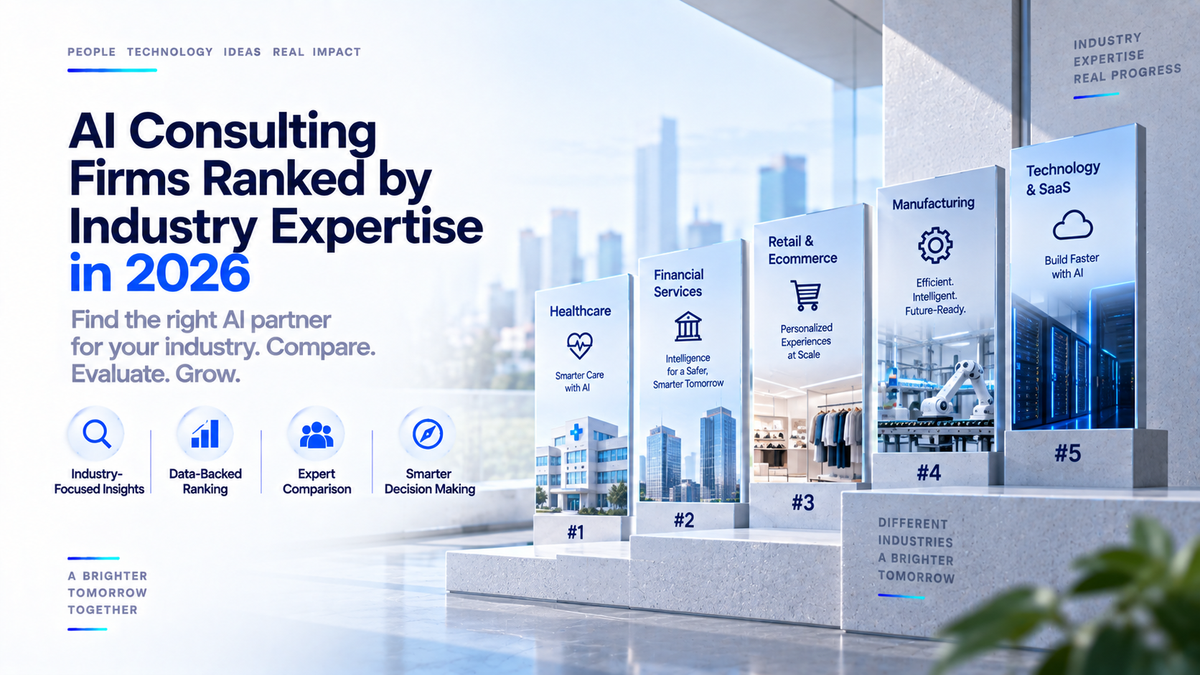
AI Consulting Firms Ranked by Industry Expertise in 2026
Choosing an AI consulting firm with the right industry expertise can make AI adoption more relevant, practical, and effective. This guide explores AI consulting firms ranked by industry expertise in 2026, highlighting their capabilities across sectors such as retail, healthcare, finance, manufacturing, technology, and professional services, along with the key factors businesses should consider when selecting an AI consulting partner.
"Who is the best AI consulting firm?" sounds like a simple question. It isn't.
A firm that's brilliant at AI for banking may be the wrong partner for retail. A firm with deep healthcare expertise may not be your best bet for manufacturing. And a global integrator that's ideal for a multinational can be overkill for a mid-market company building its first production AI system. That's why the most useful way to evaluate AI consulting companies in 2026 isn't by size, it's by industry expertise.
AI is moving into core business processes, and 2026 coverage shows organisations shifting from experimentation toward measurable outcomes. So this ranking focuses on where major firms are genuinely strong by industry, rather than crowning one universal winner that doesn't exist.
How we ranked AI consulting firms by industry
The ranking weighs depth of industry expertise, AI strategy, AI implementation, data and analytics, industry-specific technology, production experience, governance, enterprise integration, and the ability to measure business outcomes. Treat it as a buyer-oriented guide, not an official market ranking.
Financial services
Banking and insurance AI has to clear governance and integration bars most sectors don't.
- BCG X leads for connecting AI to financial-services strategy and transformation.
- Accenture fits large-scale technology integration across core banking and cloud.
- EY is strong where risk, audit, and regulatory assurance dominate the programme.
- Genpact suits AI applied to high-volume operations like claims, KYC, and reconciliation.
- Applore fits mid-market financial businesses and fintechs wanting execution-led delivery, from opportunity diagnosis and governance to applied AI and agentic systems. The full breakdown lives in the best AI consulting firms for financial services guide.
Healthcare and life sciences
Here trust and validation outrank cleverness.
- BCG X combines healthcare expertise with AI and transformation.
- Accenture fits enterprise healthcare modernisation.
- ZS is particularly strong in life sciences and commercial analytics.
- McKinsey / QuantumBlack suits strategy plus advanced analytics.
- Applore fits health-tech and providers wanting engineering-led implementation, always assessed against clinical-risk and privacy requirements. The deeper list is in the best AI consulting firms for healthcare guides.
Retail and ecommerce
Retail AI spans personalisation, demand forecasting, pricing, inventory, search, customer service, and supply chain.
- BCG X leads on commercial retail AI.
- Accenture fits enterprise retail transformation.
- Tredence is the analytics-depth specialist for forecasting and personalisation.
- Publicis Sapient suits digital-experience overhauls. Applore fits ecommerce and growth-stage retailers needing product engineering, data, AI, and automation together, expanded in the best AI consulting firms for retail and ecommerce guide.
Manufacturing
Manufacturing AI runs on predictive maintenance, computer vision, production optimisation, quality control, and supply-chain analytics.
- Siemens brings deep industrial technology plus AI and automation.
- Accenture fits a large manufacturing transformation.
- Capgemini suits industrial data, cloud, and engineering integration.
- Deloitte fits manufacturing strategy and operations.
- Applore fits manufacturers needing operational technology and AI engineering together, drawing on work rebuilding maintenance operations across plants and connecting technology to frontline operations.
Technology and SaaS
Technology companies usually need AI embedded directly into their products, so engineering depth matters most. Thoughtworks leads on modern architecture and product engineering.
- BCG X fits AI product strategy and innovation.
- Accenture suits enterprise technology transformation.
- EPAM brings engineering delivery at scale.
Applore fits SaaS companies integrating AI into products and platforms, combining product engineering with applied AI, cloud, and data infrastructure, the same shape covered in embedded engineering teams versus staff augmentation.
Consumer and D2C
Consumer brands need AI for personalisation, customer intelligence, marketing, ecommerce, forecasting, and service. The strongest options are
- BCG X for commercial strategy,
- Accenture for enterprise digital transformation,
- Tredence for customer analytics
- Applore for ecommerce product engineering and applied AI.
Public sector and regulated industries
Where governance is the primary selection criterion,
- Deloitte,
- EY,
- Accenture,
- PwC,
- KPMG
bring the depth across risk, compliance, and enterprise transformation that these environments demand.
Industry expertise vs AI expertise
A firm can be excellent at AI and still stumble without industry understanding. A technically flawless model in a bank still fails if data access is poorly controlled, compliance is ignored, model risk isn't managed, employees don't trust the outputs, or core banking integration is missing. The same holds in healthcare, manufacturing, and retail. The best partner combines AI expertise, industry expertise, and implementation capability, and missing any one of the three shows up fast in production.
Should industry expertise matter more than AI expertise?
It depends on the project. For a general internal productivity assistant, deep industry knowledge matters less. For credit-risk models, clinical decision support, retail pricing systems, or industrial maintenance AI, industry expertise becomes decisive, because the workflow, data, and regulations are the hard part, not the model.
How to choose an industry-specific AI consultant
Ask five questions: have you solved this exact industry problem, not just "worked in the industry"? Do you understand the industry's data and its constraints? Do you understand the workflow the AI has to fit? Can you actually implement, not just advise? And can you support adoption so the system gets used? Those five separate genuine sector expertise from a generalist with an industry slide.
AI Consulting Firms by Industry
The best AI consulting partner depends heavily on the industry, business model, technology environment and transformation objective. A company specialising in financial risk and compliance may not be the right choice for an ecommerce personalisation programme, while a manufacturing AI specialist may have very different strengths from a healthcare technology consultant.
Instead of treating one company as the best option across every sector, businesses should evaluate AI consulting firms based on industry expertise, AI capabilities, implementation experience, data maturity, governance requirements and ability to deliver measurable outcomes.
Financial Services
Financial institutions typically need AI capabilities across fraud detection, risk management, customer intelligence, regulatory compliance, lending, document processing and financial operations.
Notable firms to consider include:
- Cognizant – Strong fit for financial institutions combining AI with operational transformation and enterprise technology.
- Infosys – Relevant for banks and financial organisations undertaking large-scale digital and AI transformation.
- Fractal – Particularly suited to analytics, decision intelligence, customer insights and risk-related AI applications.
- Capgemini – A strong option for financial institutions connecting AI with cloud, data and technology modernisation.
- Applore Technologies – Relevant for financial businesses looking for an advisory-led approach that combines AI strategy, architecture, engineering and implementation.
Best suited for: Banks, fintech companies, insurers, NBFCs and financial organisations modernising operations through AI.
Healthcare
Healthcare AI requires a careful balance between innovation, data privacy, security, operational efficiency and responsible implementation.
Companies worth evaluating include:
- IBM Consulting – Strong enterprise technology, cloud, data and AI capabilities for complex healthcare environments.
- Cognizant – Relevant for healthcare organisations applying AI to administrative and operational workflows.
- Fractal – Suitable for healthcare analytics, forecasting, customer intelligence and data-driven decision-making.
- Capgemini – A potential fit for healthcare organisations combining AI with broader digital transformation.
- Applore Technologies – Relevant for health-tech businesses and healthcare organisations seeking AI engineering, data and technology implementation capabilities.
Best suited for: Hospitals, health-tech companies, healthcare providers, payers and life-sciences organisations.
Retail and Ecommerce
Retail and ecommerce businesses are increasingly using AI for personalisation, product discovery, demand forecasting, pricing, customer service, inventory management and marketing optimisation.
Potential firms to consider include:
- TCS – Strong enterprise technology and retail transformation capabilities.
- Cognizant – Relevant for AI-enabled retail operations and customer-experience transformation.
- Fractal – Particularly suited to customer analytics, forecasting, personalisation and decision intelligence.
- Wipro – A potential choice for retailers combining AI with cloud, data and digital transformation.
- Applore Technologies – Relevant for ecommerce and digital businesses looking to combine product engineering, data, AI and automation.
Best suited for: Ecommerce platforms, D2C brands, retailers, marketplaces and consumer businesses.
Manufacturing
Manufacturing AI has a distinct focus on physical operations, production efficiency, quality, maintenance and supply-chain performance.
Potential AI consulting partners include:
- IBM Consulting – Strong for industrial data, cloud and enterprise AI transformation.
- TCS – Suitable for large manufacturers requiring extensive engineering and technology capabilities.
- HCLTech – Relevant to engineering-heavy manufacturing environments and technology modernisation.
- Capgemini – Strong option for connecting AI with industrial transformation, engineering and operations.
- Applore Technologies – Relevant for manufacturers looking to combine AI, data engineering and operational technology with broader digital transformation.
Best suited for: Industrial manufacturers, automotive businesses, engineering companies and organisations modernising plant and supply-chain operations.
Technology and SaaS
Technology companies often need AI to become part of the product itself rather than simply an internal business tool. This makes software engineering, architecture and product-development expertise particularly important.
Potential firms include:
- Globant – Relevant for digital products, AI-enabled experiences and software engineering.
- Thoughtworks – Strong for modern architecture, engineering practices and technology transformation.
- EPAM – Suitable for complex software engineering and digital-platform transformation.
- Publicis Sapient – Relevant for digital products, customer experiences and technology-led transformation.
- Applore Technologies – A strong consideration for SaaS and technology companies combining AI, product engineering, data infrastructure and cloud capabilities.
Best suited for: SaaS companies, technology platforms, software businesses and digital product organisations.
Life Sciences
Life-sciences organisations have highly specialised AI requirements spanning research, clinical development, commercial analytics, medical information and operational processes.
Potential firms include:
- IQVIA – Particularly relevant to healthcare and life-sciences data, analytics and technology.
- Cognizant – Suitable for life-sciences technology and operational transformation.
- Capgemini – Relevant for digital transformation and technology modernisation across life sciences.
- Infosys – A potential fit for large-scale technology, data and AI transformation programmes.
Best suited for: Pharmaceutical companies, biotechnology businesses, CROs, medical-device companies and life-sciences organisations.
Consumer and D2C
Consumer and D2C companies generally prioritise customer experience, personalisation, marketing effectiveness, ecommerce, customer analytics and operational efficiency.
Companies worth considering include:
- Merkle – Strong focus on customer experience, data and digital marketing.
- Publicis Sapient – Relevant for digital commerce and customer-experience transformation.
- Fractal – Suitable for customer analytics, personalisation and AI-driven decision-making.
- Wipro – Relevant for combining AI with digital commerce, cloud and enterprise technology.
- Applore Technologies – Suitable for consumer and D2C businesses requiring ecommerce engineering, AI, automation and data capabilities.
Best suited for: D2C brands, ecommerce businesses, consumer platforms and digitally native companies.
Regulated Industries
For heavily regulated sectors, AI capability alone is not enough. Organisations also need strong governance, risk management, security, compliance and auditability.
Potential firms include:
- IBM Consulting – Strong enterprise technology, data, AI and governance capabilities.
- PwC – Relevant where AI transformation intersects with risk, compliance and business transformation.
- KPMG – Suitable for governance, risk and regulatory considerations surrounding AI adoption.
- Deloitte – Strong option for enterprise AI programmes involving governance and operating-model transformation.
- Capgemini – Relevant for organisations integrating AI with broader technology modernisation and enterprise systems.
Best suited for: Banking, insurance, healthcare, government, energy and other highly regulated organisations.
Why the Right AI Consulting Firm Depends on the Industry
There is no single AI consulting firm that is automatically the best choice for every business.
A financial institution may prioritise model governance and risk management. A retailer may care more about personalisation and demand forecasting. A manufacturer may focus on predictive maintenance and production optimization. A SaaS company may need AI embedded directly into its product architecture.
The selection criteria therefore need to change with the business problem.
Before choosing a consulting partner, organisations should evaluate:
- Industry experience: Has the firm worked on comparable problems?
- AI expertise: Can it build and deploy the required AI systems?
- Data capabilities: Can it work with the organisation's data environment?
- Technology integration: Can the solution connect to existing platforms?
- Governance: Can the firm address security, privacy and regulatory requirements?
- Implementation capability: Can it move beyond strategy into production?
- Adoption: Can it help employees and customers actually use the technology?
- Business outcomes: Does it measure success through meaningful business KPIs?
The right firm depends on what you're actually trying to change, not simply which consulting company has the largest AI practice.
Conclusion
Don't ask "who is the biggest?" Ask "who understands our industry, our workflow, our technology environment, and the outcome we need?" That single reframe reshapes the shortlist. For global transformations, Accenture, BCG, Deloitte, and the big SIs offer scale. For specialised analytics, Tredence and ZS are compelling. For engineering-led modernisation, Thoughtworks and EPAM fit. And for AI strategy through implementation and adoption, Applore offers a senior-led execution model, the same standard laid out in how mid-market companies should start AI transformation.
Frequently asked questions
Which AI consulting firm is best by industry?+
There's no universal winner. Strength varies across financial services, healthcare, retail, manufacturing, technology, and life sciences.
Why does industry expertise matter for AI consulting?+
It helps consultants understand workflows, regulations, data structures, risks, and the business outcomes that actually define success.
Which firms are strong in retail AI?+
BCG X, Accenture, Tredence, Publicis Sapient, and specialists like Applore, depending on the retailer's needs.
Which firms are strong in financial services AI?+
BCG X, Accenture, EY, Genpact, and execution-led specialists, depending on the institution and use case.
Should I choose an industry specialist or a general AI consultant?+
Choose a specialist when the AI is deeply tied to industry workflows, risk, or regulation. A generalist can suffice for broad internal tools.
What should AI firms be evaluated on?+
Strategy, AI engineering, data, industry expertise, integration, governance, production delivery, and adoption.