

How Mid-Market Companies Should Start AI Transformation in 2026
Mid-market companies entering AI transformation in 2026 need more than isolated AI tools or experimental pilots. The real opportunity lies in identifying high-impact business processes, building a practical AI roadmap, preparing the right data and technology foundation, and scaling successful use cases across teams. This guide explains how mid-market businesses can start AI transformation strategically, manage costs and risks, and turn AI investments into measurable business outcomes.
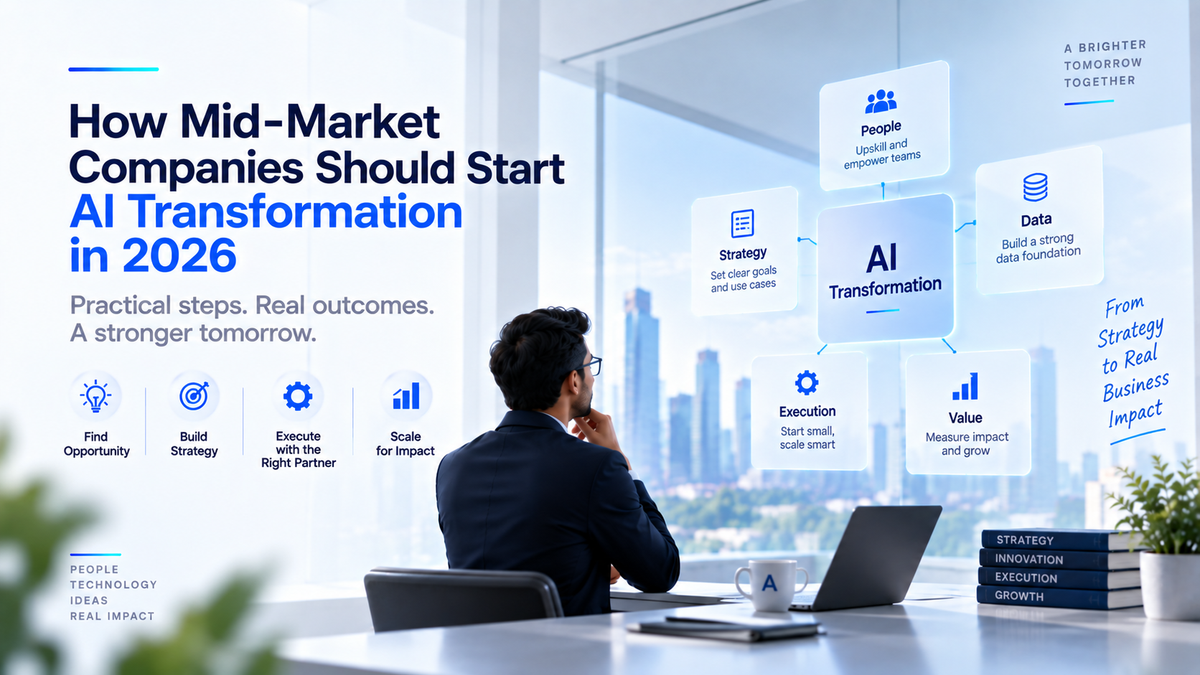
AI transformation stopped being the exclusive turf of global enterprises with huge tech budgets and dedicated AI teams a while ago. In 2026, mid-market companies are asking a far more practical question: where do we actually start?
That question matters, because AI transformation was never just about buying a tool, deploying a chatbot, or handing employees a generative AI login. For a mid-market business, it can touch operating processes, data architecture, technology investments, workforce responsibilities, governance, customer experience, and the way leadership makes decisions.
The tricky part is that mid-market companies sit awkwardly between two extremes. They're too complex to treat AI as an isolated productivity experiment, yet they often lack the resources, data teams, and transformation offices a large multinational can throw at the problem. That's exactly why sequencing matters so much. A successful AI transformation for a mid-market company should start with the business problem, not the technology, which mirrors how Applore approaches AI business transformation consulting: understand the operating reality first, set a defensible direction, architect the systems, execute against measurable goals, and only then drive adoption.
Why Mid-Market AI Transformation Is Different
A mid-market company might have hundreds or thousands of employees, several products, multiple business functions, and years of accumulated technology debt. It probably already runs CRM software, ERP systems, cloud infrastructure, customer databases, a pile of spreadsheets and manual workflows, legacy applications, fragmented reporting, several SaaS tools, and an internal engineering team.
So the problem usually isn't a lack of technology. It's a lack of connected technology and usable data. That's why bolting an AI model onto an existing process so often disappoints. If customer information is scattered across systems, an AI assistant can't conjure a reliable single view of the customer. If your approval process is broken, automating it just makes a bad process run faster. And if employees don't trust the system, adoption stays low no matter how good the model is. Real transformation has to work across three layers at once: business value, technology and data foundations, and adoption and operating change.
Step 1: Start With Business Problems, Not AI Tools
One of the biggest mistakes companies make is opening with "where can we use AI?" A far stronger question is "where is the business losing time, money, capacity, or decision quality?"
Look hard at workflows that are repetitive, high-volume, rules-driven, data-heavy, slowed by manual handoffs, dependent on hunting through multiple systems, expensive to run, or difficult to scale. In customer operations, AI can help with ticket classification, drafting responses, knowledge retrieval, and prioritising service. In finance, it can support invoice processing, reconciliation, analysis, exception spotting, and reporting. In sales, it can summarise accounts, surface opportunities, prepare proposals, and recommend next actions. In operations, it can help with forecasting, scheduling, exception management, and automation. And for internal knowledge, AI-powered search can help employees find information buried across policies, documents, and internal systems. The goal isn't to list as many use cases as possible. It's to find the smallest number capable of producing measurable business value, which is the same discipline behind sizing agentic AI use cases for enterprises.
Step 2: Conduct an AI Readiness Assessment
Before you invest in an implementation roadmap, understand where you actually stand. A proper AI readiness assessment should cover at least five areas.
Data readiness: asks where your critical data lives, whether it's structured or unstructured, whether it's accessible, whether it's duplicated, whether it can be trusted, and who owns it, because AI leans heavily on the quality and accessibility of the information underneath it.
Technology readiness: means reviewing your application architecture, APIs, cloud infrastructure, integration capabilities, identity management, security controls, observability, and existing data platforms.
Process readiness: is about mapping the real workflow first, from input to decision to action to exception to human intervention to outcome, so you can see where AI should assist, where it should automate, and where it should stay out of the loop.
Governance readiness: covers the questions AI raises around privacy, security, model risk, data access, explainability, accountability, and auditability, and these should be designed before production, not after an incident.
People's readiness: asks whether employees understand the system's purpose, know how to use it, trust its outputs, know when to override it, and understand how their responsibilities are changing. Adoption is an operating-model problem as much as a technical one.
Step 3: Prioritise AI Use Cases With a Scoring Model
Instead of picking use cases on enthusiasm, run each candidate through a simple scoring framework. Score it on business value (how much money, time, or capacity it could create), frequency (how often the process happens), data availability (whether reliable data exists), complexity (whether it can realistically be built), risk (what happens if the AI is wrong), adoption (whether employees will actually use it), and integration (whether it can connect to your existing systems).
A customer-service summarisation workflow tends to score highly. An autonomous system making high-stakes financial decisions with no human review usually scores poorly as a first project. The best first project isn't necessarily the most impressive one. It's the one that creates evidence that AI can work inside your organisation, and that framing sits at the heart of the build-versus-buy AI decision.
Step 4: Build the Minimum Viable AI System
Once you've chosen a use case, resist the urge to attempt a company-wide transformation overnight. Build one focused production system instead.
So rather than "we need an AI-powered enterprise knowledge platform," start with "we need an AI assistant that can retrieve and summarise approved internal operational documents for the support team." That narrower scope gives you measurable boundaries. You can track response time, accuracy, employee usage, escalation rate, resolution time, and cost per interaction, and that evidence is what unlocks the next investment. It's also a cleaner path to production, much like the steps in building enterprise AI agents.
Step 5: Don't Ignore the Data and Platform Layer
Generative AI grabs most of the attention, but the architecture underneath decides whether it can scale. A production AI system may need data pipelines, APIs, vector databases, retrieval systems, identity controls, model orchestration, monitoring, evaluation frameworks, application interfaces, and cloud infrastructure.
Applore's broader technology capability deliberately spans data infrastructure, applied AI, platform engineering, cloud and DevOps, and security and compliance, precisely because AI transformation rarely stays an "AI project." Sooner or later it becomes a technology architecture project, and pretending otherwise is how pilots stall on the way to production.
Step 6: Establish AI Governance Early
Mid-market businesses sometimes assume governance is only for banks and governments. That's changing fast. Good AI governance should define what data AI can access, which models may be used, which decisions require human approval, how outputs are evaluated, how prompts and responses are logged, how sensitive information is protected, how model changes are tested, and who owns AI risk. This gets especially important the moment AI shifts from generating information to taking actions, which is exactly where AI agent governance earns its keep.
Step 7: Design Adoption Into the Transformation
A technically flawless AI system can still be a business failure if nobody uses it. So instead of launching the technology and then scrambling to organise training, design adoption from day one. Identify the affected teams, the workflow changes, the new responsibilities, the training needs, the success metrics, the executive sponsor, and the feedback mechanisms up front. Applore treats adoption as a distinct part of its transformation method, sitting alongside planning and execution, and that's particularly relevant in mid-market organisations where a single workflow can ripple across several departments at once.
What the First 6 to 12 Months Could Look Like
A practical roadmap tends to move in phases. In months one and two you diagnose, running the readiness assessment, a technology audit, a data assessment, workflow mapping, and business-value identification. In months three and four you prioritise, ranking use cases, establishing governance, selecting the technology architecture, defining KPIs, and building the business case. In months five to seven you build, developing the first system, integrating the required data, setting up evaluation, introducing security controls, and running controlled production testing.
In months eight to ten you adopt, training users, measuring usage, redesigning workflows, collecting feedback, and improving performance. And in months eleven and twelve you scale, expanding the use cases that worked, reusing the architecture, establishing an AI operating model, and identifying the next automation opportunities. The sequence matters far more than trying to do everything at once, and getting it right is what keeps the whole programme measurable, right down to the ROI metrics that prove AI is working.
Common AI Transformation Mistakes Mid-Market Companies Should Avoid
A few traps come up again and again. Starting with a flashy AI demo, when a demo is not a production system. Buying before diagnosing, when a shiny new platform can't solve an undefined business problem. Treating data as an afterthought, when poor data quietly produces unreliable AI. Automating high-risk workflows first, instead of starting with bounded processes where mistakes are manageable. Ignoring integration, when AI actually needs to work inside existing workflows. Measuring model performance but not business performance, when cost, time, revenue, and adoption matter just as much as accuracy. And treating adoption as training, when people really need workflow redesign, incentives, and confidence, not just a one-off workshop.
The Right AI Transformation Strategy for 2026
For mid-market companies, AI transformation shouldn't mean "become an AI company." It should mean using AI to become a better-operated company. The most effective path is usually diagnose, then prioritise, then architect, then build, then adopt, then scale. That approach stops AI from becoming yet another disconnected technology initiative, and it builds a foundation for future systems instead of forcing every new use case to start from zero.
Applore's AI consulting practice follows a similar philosophy, combining opportunity diagnosis, build-versus-buy decisions, model selection, governance, applied AI, adoption instrumentation, and handover. For most mid-market organisations, that blend of strategy and execution turns out to be far more valuable than simply picking the newest AI model on the market.
Frequently asked questions
What is AI transformation for mid-market companies?+
It's integrating AI into business processes, technology systems, and operating models to improve measurable outcomes like efficiency, revenue, decision-making, or customer experience, rather than just adopting a single tool.
Where should a mid-market company start with AI?+
Start with an AI readiness assessment and identify high-value, manageable workflows, rather than rolling AI out across the whole organisation at once.
How much does AI transformation cost?+
It varies widely with data readiness, integration complexity, the use cases chosen, and the infrastructure required. A focused pilot is usually a smarter starting point than budgeting for an undefined enterprise-wide programme.
Should companies build or buy AI solutions?+
It depends on differentiation, risk, integration needs, existing capabilities, and total cost of ownership. Standard capabilities are often better bought, while strategically differentiating workflows may justify custom builds.
Why do AI projects fail?+
Usually because of unclear business objectives, poor data, weak integration, inadequate governance, and low employee adoption, rather than the model itself.
Can an AI consulting company help with implementation?+
Yes. The strongest engagements combine strategy, architecture, engineering, governance, and adoption, rather than stopping at a slide deck of recommendations.