

Embedded Engineering Teams vs Staff Augmentation: What Actually Ships
Embedded engineering teams and staff augmentation can both help companies expand their technology capabilities, but they are built for different delivery needs. The key question is not simply how many engineers you can add it is what those engineers actually help you ship. This guide explores the differences between the two models, including ownership, collaboration, technical expertise, delivery speed, and when each approach makes sense for modern product and engineering teams.
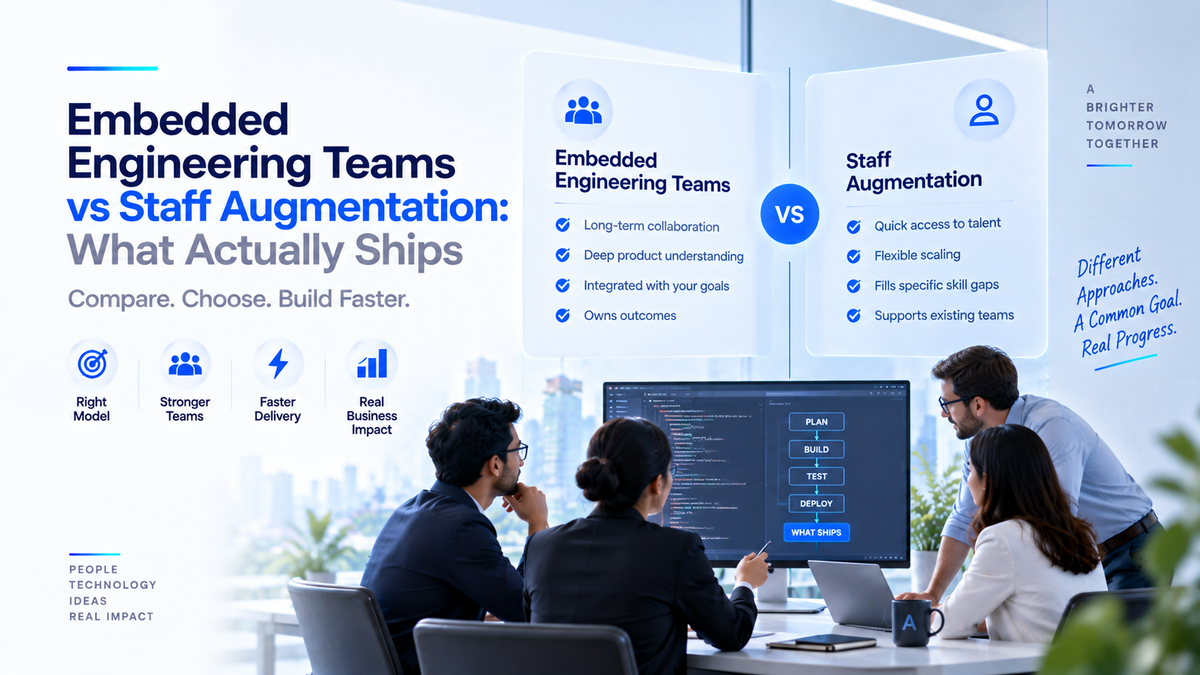
Engineering capacity is easy to buy. Engineering outcomes are much harder. That one distinction sits right at the centre of the embedded engineering teams vs staff augmentation debate.
On paper, the two models look almost identical. A company needs more developers, engineers, or technical specialists, so it brings external talent into the delivery organisation. But the operating model underneath can be completely different. Traditional staff augmentation mostly gives you more people. An embedded engineering team is built to give you more delivery capacity, with ownership, structure, and engineering leadership attached.
That gap matters most when the goal isn't simply to grow headcount, but to actually ship a product, modernise a platform, or land a full technology programme. Applore builds its embedded model around senior engineering pods that join an organisation's existing rituals and tech environment while staying accountable for outcomes, not logged hours.
What Is Staff Augmentation?
Staff augmentation is essentially a capacity model. A business spots a skills gap and brings in external professionals to fill it, say three backend developers, two React engineers, one DevOps engineer, and a QA specialist.
The internal organisation usually keeps managing priorities, architecture, task assignment, delivery management, code quality, performance management, and the technical decisions. The external professionals simply add execution capacity. This works extremely well when the internal organisation already has strong engineering leadership. Problems start when a company expects external engineers to solve organisational or delivery problems it never fixed internally, because that was never what the model was designed to do.
What Is an Embedded Engineering Team?
An embedded engineering team works differently. Instead of supplying individual people, the provider supplies a coordinated engineering unit. A typical pod might include senior engineers, a technical lead, frontend and backend specialists, DevOps or platform expertise, QA capability, and delivery coordination.
That team plugs into the client's product roadmap, engineering rituals, technology stack, communication systems, code review process, and deployment practices. The real difference is accountability. The question stops being "how many developers did we add?" and becomes "what did the team actually ship?"
Staff Augmentation vs Embedded Engineering Teams
Here's the contrast in plain terms. With staff augmentation, the primary value is additional capacity, management is usually client-led, the structure is individual resources, technical leadership stays internal, accountability tends to be task-based, ramp-up happens resource by resource, knowledge transfer is client-dependent, and delivery follows the client's existing process; it fits short-term skill gaps best. With an embedded engineering team, the value is capacity plus delivery ownership, management is shared or pod-led, the structure is a coordinated team, technical leadership is included inside the pod, accountability is outcome-oriented, ramp-up is team-based, knowledge transfer is designed into the engagement, and there's a shared engineering cadence; it fits product or platform delivery best.
Neither model is universally better. The right choice depends on your organisation's maturity and what you're actually trying to achieve.
When Staff Augmentation Makes Sense
Staff augmentation is often the smarter option when you already have strong engineering leadership. If your CTO, VP of Engineering, or engineering managers already own clear architecture, a groomed backlog, and solid delivery processes, adding specialists is straightforward.
It also fits when you need a specific skill temporarily, like a Kubernetes migration, mobile development, cloud security, data engineering, or performance optimization, where you only need that skill for a defined window. It works when you have a predictable backlog, since well-defined tickets let extra engineers lift throughput cleanly. And it suits teams that want maximum internal control, keeping direct hands on the day-to-day engineering process.
When Embedded Engineering Teams Make More Sense
Embedded teams get attractive the moment the problem is broader than headcount. If you need to ship a complete product, from discovery through architecture, development, testing, and deployment, a coordinated team usually beats a handful of isolated individuals. If your internal team is overloaded, knowing exactly what to do but lacking the capacity to execute, a pod fills that gap without adding management drag.
They also make sense when you need technical leadership the organisation currently lacks, since a pod can bring architecture and engineering judgment alongside execution, in the same spirit as a CTO-as-a-service arrangement. And they help when you need to move quickly, because a pre-assembled team cuts the time it takes to recruit, onboard, and coordinate multiple individual contractors. Applore describes its embedded pods as senior engineers plus an embedded lead, working within the client's stack and rituals and built to ramp fast.
The Real Difference: Who Owns the Outcome?
This is the single most important question to ask. Picture a company launching a new SaaS platform.
With staff augmentation, it might receive two backend developers, a frontend developer, and a QA engineer. The internal product manager defines requirements, the internal architect defines the system, the internal engineering manager runs the developers, and the external provider simply supplies the people. With an embedded engineering team, the provider is instead responsible for a defined delivery scope, and the team can participate in technical discovery, architecture, implementation, quality, DevOps, documentation, and handover. That difference isn't just contractual. It changes the entire delivery system, and it maps closely to how you decide who owns what when teams collide.
What Actually Ships?
This is where companies should really evaluate an engineering partner. Don't just ask "how many engineers can you provide?" Ask what they've shipped, who owned architecture, how quickly the team reached production, who managed technical debt, what happened after launch, how knowledge was transferred, who was accountable when delivery slipped, and what metrics defined success.
A CV tells you what someone has worked on. A delivery model tells you how the organisation will actually ship. Those are very different signals, and only one of them predicts your outcome.
The Hidden Cost of Staff Augmentation
Staff augmentation often looks cheaper because companies compare hourly rates. But the true cost includes coordination. Drop five external engineers into a company and someone still has to onboard them, explain the architecture, assign work, review code, resolve conflicts, manage dependencies, coordinate releases, and maintain documentation.
If your internal engineering leadership is already stretched, that extra capacity can quietly generate extra management overhead. It's sometimes called the coordination tax, and it's easy to underestimate. An embedded team tries to shrink that tax by bringing its own internal structure and leadership, so the load doesn't all land on your managers.
The Hidden Risk of Embedded Teams
Embedded engineering isn't automatically superior, either. The main risk is ending up with a team that looks autonomous but doesn't really understand your business. A good embedded model needs a few things to work.
It needs clear ownership, so both sides know exactly who owns what. It needs strong technical integration, so the external team works inside your real architecture rather than a parallel one, which matters enormously during a legacy system modernization. It needs shared rituals, so standups, planning, retrospectives, and reviews don't fork into two separate processes. It needs documentation, so knowledge doesn't walk out the door when the engagement ends. And it needs a real handover, so the client becomes more capable, not permanently dependent. Applore explicitly positions clean handover as part of its embedded engineering offering.
How to Choose Between the Two Models
The shortcut is simple. Use staff augmentation when you need people. Use embedded engineering when you need a team to deliver an outcome.
In practice, lean toward staff augmentation if your architecture is already defined, your product roadmap is mature, you have internal technical leadership, your tasks are clearly scoped, and you mainly need extra capacity. Lean toward embedded engineering if you need a complete product or platform shipped, your internal capacity is constrained, you need senior technical leadership, your architecture is still evolving (as it usually is during a multi-year replatform), multiple engineering disciplines have to coordinate, and delivery speed genuinely matters.
What to Ask an Engineering Partner
Before you sign anything, run through these. Who owns delivery, because a vague answer is a warning sign? Who owns architecture, so the responsibility is explicit? How is success measured, ideally in production outcomes rather than utilisation? What happens when priorities change, since real products shift constantly? How is knowledge transferred, so you avoid permanent dependency? What happens after launch, covering support, documentation, and transition? Can you meet the technical lead, because you should know who's actually leading the work? And what does the first 30 days look like, which quickly reveals whether the provider has a real operating model or is improvising.
The Best Model Is the One That Matches the Problem
Staff augmentation isn't bad. It solves a specific problem: capacity. Embedded engineering solves a broader one: capacity plus coordinated execution. The real mistake is buying one while quietly expecting the other.
If you already know exactly what needs to be built and just need more hands, staff augmentation may be exactly right. If you need a team that can walk into an existing environment, understand the architecture, execute against a roadmap, and eventually hand over a working system, an embedded model is usually more effective. That's the distinction Applore draws with its embedded engineering approach: a senior pod, integrated into the client's environment, focused on outcomes and handover rather than rented headcount, and often paired with AI business transformation consulting when the delivery goal is bigger than a single build
Frequently asked questions
What is the difference between embedded engineering and staff augmentation?+
Staff augmentation mainly provides individual resources, while an embedded engineering team provides coordinated technical capacity with team structure and delivery accountability built in.
Is embedded engineering more expensive than staff augmentation?+
The rate may look higher, but total cost should include management, coordination, delivery speed, and quality, not just the hourly number.
When should a company use staff augmentation?+
When internal engineering leadership and architecture are already in place and you just need temporary specialist capacity for a defined period.
When should a company choose an embedded engineering team?+
When you need a coordinated group to deliver a product, platform, or defined engineering outcome, especially if internal capacity or leadership is thin.
Can embedded engineers work with an internal team?+
Yes. A strong embedded model is designed to integrate with your existing teams, tech stack, and engineering rituals rather than run in parallel.
Who owns the code in an embedded engineering model?+
It should be defined explicitly in the contract, but a well-designed engagement supports client ownership and a clean handover at the end.