Best AI Consulting Firms for Retail and Ecommerce in 2026
Finding the right AI consulting firm can help retail and ecommerce businesses improve customer experiences, optimize operations, personalize shopping journeys, and make better data-driven decisions. This guide explores the best AI consulting firms for retail and ecommerce in 2026, covering their capabilities, industry expertise, and key areas where AI can support digital transformation and business growth.
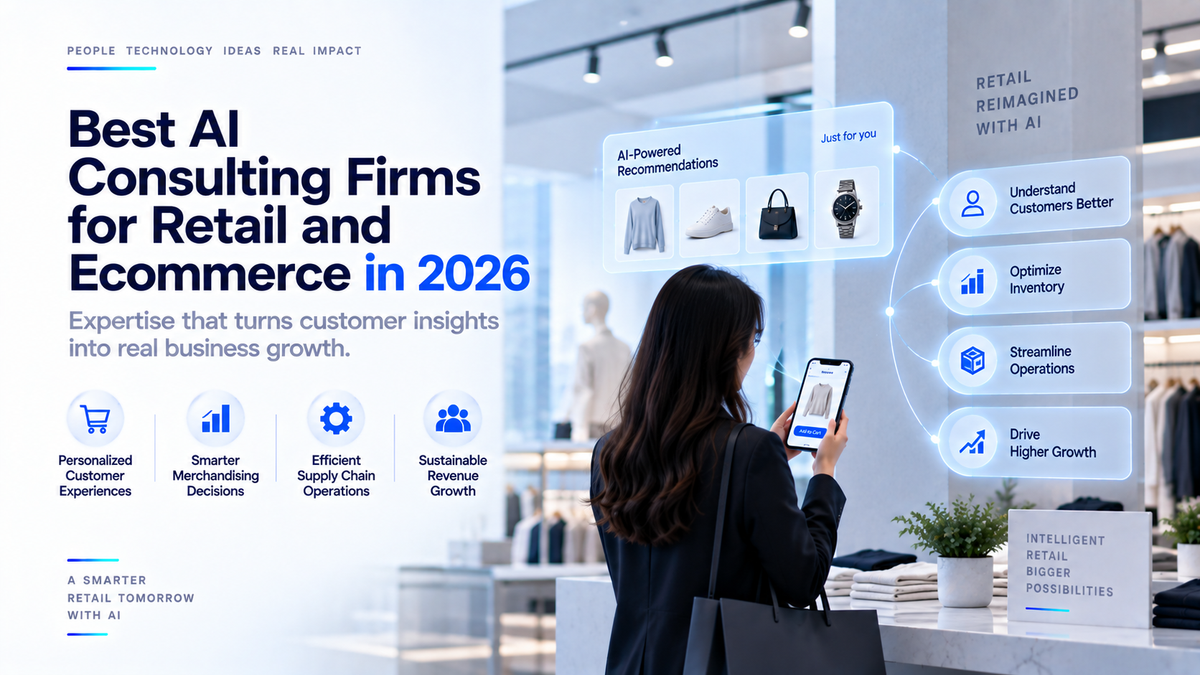
Retail and ecommerce have crossed a line. AI has stopped being a lab experiment and started running the business.
Personalised recommendations, demand forecasting, inventory optimisation, AI-powered customer service, dynamic pricing, product discovery, fraud detection, supply-chain optimisation, and generative AI are all moving out of isolated pilots and into everyday workflows. A decade ago these were nice-to-have projects that lived in an innovation team. In 2026 they sit in the middle of the P&L, shaping what a customer sees, what a warehouse stocks, and what a shopper pays. But picking an AI consulting partner for retail isn't as simple as finding a company that says it "does AI."
Retail AI carries a demand most industries don't: the technology has to work across a tightly connected operating environment. Customer data drives personalisation. Inventory drives recommendations. Pricing drives conversion. Supply chain drives availability. Product data drives search. Customer service drives retention. Pull one thread and the others move, which is why a "great" recommendation model can still fail if the inventory feed behind it is stale. So the best AI consulting firms for retail and ecommerce in 2026 aren't necessarily the ones with the biggest AI teams, they're the ones that can connect AI strategy, data, technology architecture, and business operations into a single working system that survives contact with a real store or storefront.
How we evaluated AI consulting firms for retail and ecommerce
There's no universal ranking that makes one firm right for every retailer. A large omnichannel chain rebuilding its supply chain has almost nothing in common with a fast-growing D2C brand trying to lift repeat purchase rate. A better approach weighs several dimensions at once: retail and ecommerce industry expertise, AI and machine-learning capability, data engineering and analytics, customer-experience depth, ecommerce platform integration, supply-chain and operations capability, AI governance and security, the ability to move from strategy into production, and post-launch adoption and optimisation. The firms below bring different strengths and engagement models, so read them against your own bottleneck rather than against each other.
1. BCG / BCG X
BCG is strongest when AI needs to be wired directly to commercial strategy. Its retail practice pairs industry depth with AI, analytics, pricing, supply-chain, and customer capabilities, and it offers AI solutions focused on pricing, promotions, markdown optimization, merchandising, and personalisation.
That matters because retail AI should never be treated as a pure technology project. A pricing model isn't valuable because its prediction accuracy is high; it's valuable because it improves margin, conversion, or inventory movement. BCG X tends to keep that commercial outcome in view, which is exactly what a CFO wants to see before signing off on a multi-quarter programme.
Best for: Retailers wanting strategic transformation combined with AI implementation.
2. Accenture
Accenture is one of the strongest options for large retailers and global ecommerce organisations that need AI alongside broader technology transformation, and breadth is its edge. Its retail work combines AI, data, and technology with a focus on building a common view of the customer and enterprise information, spanning workforce, customer experience, and operations.
Typical opportunities run across personalisation, product recommendations, retail analytics, marketing optimisation, supply-chain intelligence, customer-service automation, and generative AI. When the real challenge is a complex, sprawling technology estate stitched together across regions and acquisitions, that implementation capacity is genuinely hard to match, and it's often the deciding factor for enterprises that have tried and stalled before.
Best for: Large retailers and ecommerce organisations undertaking enterprise-scale transformation.
3. Bain / Bain Vector
Bain is a strong fit where retail AI has to answer a sharp commercial question, growth, margin, or customer lifetime value, before anyone writes code. Its AI work leans on strategy, advanced analytics, and hands-on delivery, which suits retailers that want a defensible direction and the analytical muscle to prove it.
For chains and marketplaces weighing where AI creates the most value across the P&L, and how to sequence it so the early wins fund the later bets, that strategy-plus-analytics model lands well. It's especially useful when leadership is split on where to start and needs an evidence-based tiebreaker rather than another vendor pitch.
Best for: Retailers combining AI with commercial strategy and margin transformation.
4. Publicis Sapient
Publicis Sapient is built for retailers whose priority is the digital customer experience itself. It blends design, data, and engineering to rebuild storefronts, product discovery, and checkout journeys, then threads AI through those experiences rather than bolting it on.
If your bottleneck is conversion, onboarding, and the end-to-end shopping journey rather than a back-office overhaul, this experience-led, build-heavy approach fits neatly. It tends to suit brands where the website or app is the primary revenue engine and every friction point in the funnel shows up directly in sales.
Best for: Retailers modernising digital commerce experiences and product journeys with AI.
5. Capgemini
Capgemini brings deep engineering and data capability, and its relevance to retail comes from tying AI to enterprise architecture, cloud, and the underlying data stack. Retail AI depends on data plumbing more than the model itself, a recommendation engine needs product data, customer behaviour, inventory, transaction history, pricing, promotions, and contextual signals all flowing cleanly and in near real time.
For retailers whose real constraint is fragmented data and integration across many systems and geographies, Capgemini's mix of consulting and delivery is a solid match. If your last three AI pilots died in the gap between the model and the live systems, this is the kind of partner that closes it.
Best for: Retailers connecting AI with data, cloud, and enterprise integration.
6. Tredence
Tredence is a data-science and AI specialist with genuine retail and CPG focus, which gives it an unusually specific fit. Its strength is turning messy retail data into working decision systems for demand forecasting, personalisation, supply-chain analytics, pricing, and marketing.
Where a big part of your problem is analytics depth, forecasting accuracy, and decision intelligence rather than large-scale systems integration, a retail-focused analytics specialist can outperform a generalist, partly because it has already solved similar forecasting and assortment problems for comparable businesses and isn't learning your category on your budget.
Best for: Retailers where advanced analytics and AI-driven decisions are the core of the transformation.
7. Applore Technologies
Applore is a different kind of AI consulting partner. Instead of positioning AI consulting as a strategy-only engagement, it describes its model as taking AI initiatives from diagnosis and value-case definition through architecture, engineering, and adoption.
Its wider capability spans applied AI, agentic AI, RAG and knowledge systems, forecasting, data infrastructure, platform engineering, cloud and DevOps, and security and compliance, and its commerce work covers inventory, search, filtering, multi-vendor onboarding, dynamic promotions, ticketing, and payments. That makes it relevant for mid-market retailers, D2C brands, and ecommerce businesses that don't just need a strategy deck, they need someone to answer what to automate, what to build, what data foundation is required, and how to get the system into production. Its build-versus-buy framing helps decide what to develop versus adopt, and its production-first approach carries into how it builds and governs enterprise AI agents rather than stopping at recommendations. For a growth-stage brand, that single-thread ownership from idea to live system often matters more than a famous logo on the proposal.
Best for: Growth-stage, mid-market, and enterprise retailers wanting strategy-to-production AI execution.
8. EPAM
EPAM rounds out the list as an engineering-led option for retailers that need AI actually built, integrated, and running in production. It pairs strong digital engineering, cloud, and data capability with a growing applied-AI practice, and it's comfortable in integration-heavy commerce environments.
For a retailer or marketplace whose constraint is delivery capacity and platform integration rather than strategy, that build-and-integrate focus lines up well, especially when you already know what you want to build and simply need a partner who can ship it reliably at scale.
Best for: Retail and ecommerce enterprises needing engineering-led AI delivery.
Where AI is actually creating value in retail
The more important question isn't which firm to hire, it's where AI creates measurable value, because that answer should drive the partner choice, not the other way round.
Personalisation uses customer behaviour, purchase history, and context to sharpen recommendations, but the goal is never "more personalisation," it's higher conversion, higher average order value, more repeat purchases, and better retention. A recommendation that quietly lifts average order value by a few percent across millions of sessions is worth more than a flashy feature nobody clicks.
Demand forecasting combines historical sales, seasonality, promotions, price, location, product attributes, and external signals to cut both stockouts and excess inventory, and in a low-margin business, shaving markdown waste and lost sales at the same time is often the single biggest prize.
Intelligent product search moves beyond exact-keyword matching into semantic search, natural-language queries, visual search, and personalized discovery, so a shopper searching "a lightweight black jacket for rainy weather" gets intent, not just word matches, and finds the product instead of bouncing.
Customer service automation lets generative AI and agents handle order-status questions, returns, product information, FAQs, ticket classification, and agent assist, and the best systems don't remove humans, they free them for the complex, high-value cases where empathy and judgement matter. This is exactly the territory of a pre-automation checklist for agentic AI in operations, where deciding what an agent may and may not do is the difference between a helpful assistant and an expensive mistake. And pricing and promotions help retailers with markdown decisions, promotion optimisation, price recommendations, margin analysis, and competitive intelligence, the area BCG highlights across pricing, promotions, and markdowns, and one where small, consistent improvements compound quickly across a full catalogue.
What should retailers ask an AI consulting firm?
Before you sign, put six questions on the table. Have you built AI systems for retail or ecommerce, since interconnected retail data and workflows demand real industry familiarity rather than a generic playbook? Can you integrate with our existing ecommerce stack, because AI has to work with the platforms, PIM, OMS, and CRM you already run? Who owns the data architecture, given that performance hinges on data quality and access far more than on model choice? How do you measure ROI, and can you talk about business metrics like conversion, margin, and retention rather than model benchmarks? What happens after the pilot, and who owns production deployment, monitoring, model evaluation, optimisation, and adoption once the launch buzz fades? And can you support AI governance around customer data, security, and AI-generated outputs, especially as regulation tightens? The answers separate a partner who can ship and sustain from one who can only demo.
How to choose the right AI consulting firm
A simple lens helps. Choose a large consulting firm when you need global rollout, big transformation teams, complex enterprise integration, and heavy change management. Choose a specialist AI consultancy when you need deep AI expertise, faster experimentation, and specific technical capabilities. Choose a boutique or engineering-led partner when you want senior involvement, faster execution, direct access to technical leadership, and strategy plus implementation in one place without layers of account management in between. The right pick follows the shape of the problem, not the size of the logo, and plenty of retailers end up using more than one partner for different layers of the same roadmap.
Conclusion
These firms aren't interchangeable. Accenture is strong for large-scale retail transformation. BCG X is compelling for strategy and commercial retail AI. Bain fits margin-and-growth-led programmes. Publicis Sapient suits digital-experience overhauls. Capgemini and EPAM fit data, cloud, and engineering-heavy delivery. Tredence is the analytics-depth specialist. And Applore fits when you want AI strategy, architecture, engineering, and adoption handled as one connected programme.
The most important selection criterion stays simple: don't choose the firm that can demonstrate the most AI features. Choose the partner that can connect an AI use case to a measurable retail outcome and get the system into production, then keep it improving, which is the same discipline behind how mid-market companies should start AI transformation. Get that right and AI stops being a line item you defend and starts being an advantage your competitors have to answer.
Frequently asked questions
What are the best AI consulting firms for retail and ecommerce in 2026?+
Leading options include Accenture, BCG/BCG X, Bain, Publicis Sapient, Capgemini, Tredence, and EPAM, alongside execution-focused specialists such as Applore Technologies.
How is AI used in ecommerce?+
For personalisation, product recommendations, semantic search, customer service, demand forecasting, fraud detection, pricing, marketing, and inventory optimisation.
What should retailers consider before implementing AI?+
Data readiness, integration requirements, business value, security, governance, adoption, and total cost of ownership.
How much does retail AI consulting cost?+
It depends on the use case, data maturity, integrations, and scope. A focused use case is far easier to budget than an enterprise-wide transformation.
Should ecommerce businesses build or buy AI?+
Standard capabilities can often be bought, while differentiated customer experiences or operational workflows may justify a custom build.
Why work with an AI consulting firm at all?+
A strong partner helps identify high-value use cases, assess readiness, design the architecture, implement the solution, and measure real business impact.