

Platform Operating Models: Who Owns What When Teams Collide?
Platform operating models define how teams share ownership, make decisions, and stay accountable when product, engineering, architecture, and business priorities overlap. This guide explores how to establish clear ownership boundaries, decision rights, governance, and collaboration models that reduce friction and help enterprise platforms evolve without creating organisational bottlenecks.
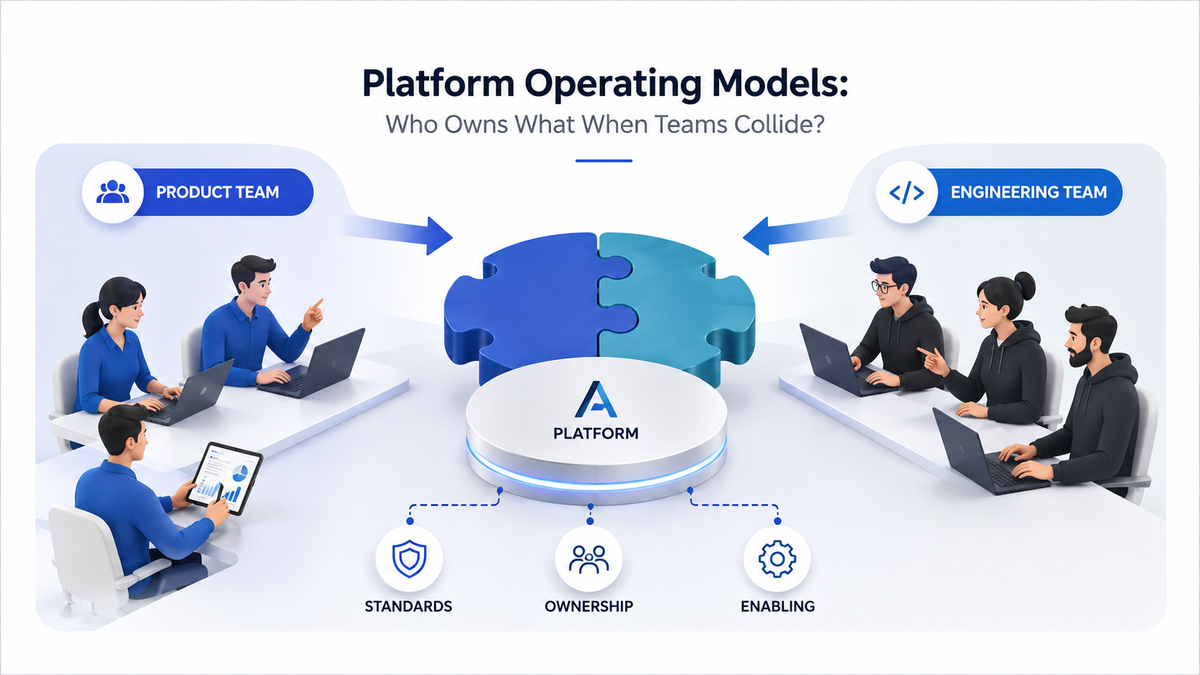
Most platform problems arrive dressed as technology problems.
The platform is slow. Developer experience is poor. Cloud costs keep climbing. Three teams have built three nearly identical logging setups. Infrastructure ownership is fuzzy. Security reviews add two weeks to everything.
Sit in on the retrospectives, though, and a less technical problem keeps surfacing underneath every one of them: nobody is completely sure who owns what.
That's the problem a platform operating model exists to solve.
As organisations shift from project-based delivery to product teams, platform engineering, cloud infrastructure and shared digital capabilities, the boundaries between teams multiply. A product team owns an application. A platform team provides shared capabilities. Infrastructure manages the cloud environments. Security defines controls. Data owns the pipelines. Architecture sets standards. And leadership expects all six to move fast at the same time.
When those boundaries are unclear, teams collide, and the collisions follow a script we've seen at client after client. One team assumes another owns a capability, so nobody does. A platform team builds something nobody asked for and nobody uses. Product teams quietly build their own solutions because the central platform takes three weeks to provision anything. Security becomes a final gate everyone resents. Cloud costs become everyone's problem, which means they're nobody's responsibility.
A good platform operating model fixes this by making ownership, decision rights and service expectations explicit. It's one of the core pieces of our Platform & Architecture practice at Applore, alongside target architecture roadmaps, resilience, observability and delivery governance. And the objective is worth stating upfront, because it's the opposite of what people fear: not more governance. Clearer governance, so teams can move faster.
What Is a Platform Operating Model?
A platform operating model defines how platform capabilities are designed, delivered, governed and consumed across an organisation.
It answers the questions that otherwise get answered in incident channels at 2 a.m. Who owns the platform? Who consumes it? Who makes architectural decisions? Who's on the hook for reliability? Who pays for the infrastructure? Who responds to incidents? Who approves changes? Which capabilities are centralised, and which decisions stay with product teams?
Notice this is different from technical architecture. Architecture explains how systems fit together. The operating model explains how people and teams work around those systems. You need both, and organisations routinely invest heavily in the first while leaving the second to evolve by accident.
Why Platform Ownership Becomes Difficult
In a small company, ownership is easy because it's implicit. Five engineers manage infrastructure, applications, deployments and monitoring, and everyone knows everything.
Then the organisation grows and responsibilities split. One team takes cloud infrastructure. Another takes developer tooling. Security becomes its own function. Product teams own applications. A data team owns pipelines. The platform becomes a shared dependency for all of them.
And here's the rule that explains most of the friction: every shared dependency creates an ownership boundary, and every unclear boundary creates friction. The maths compounds. Ten teams sharing eight capabilities is eighty boundaries, and if even a quarter of them are ambiguous, you've built a full-time negotiation problem into your engineering organisation.
The Three Questions Every Platform Model Must Answer
Strip the frameworks away and a useful operating model makes three things unambiguous.
Who decides?
Decision rights have to be written down. Who decides which cloud services are approved? Who sets API standards? Who picks the observability stack? Who rules on whether a capability belongs on the central platform or in a product team?
Who delivers?
The team that builds a capability isn't always the team that governs it, and that distinction has to be visible, or every roadmap discussion turns into a jurisdiction dispute.
Who operates?
Production ownership cannot be vague. When a platform service fails at 2 a.m., someone has to already know they're the responder. This matters double for shared platforms, because one failure hits every product team at once, and "we thought you had it" is an expensive sentence when six teams are down.
Platform Teams Should Not Become Internal IT Help Desks
Here's the most common way platform teams die: they get created with good intentions and immediately become a central service desk.
Every product team files requests. The platform team manually provisions infrastructure. Developers wait for access. Security reviews every change. Architecture reviews every deployment. Within a year, the platform team is the slowest thing in the delivery pipeline, and everyone resents the function that was supposed to speed them up.
A modern platform team aims for the opposite: self-service capabilities with sensible guardrails. The goal isn't "ask us to create your environment." It's "use the approved capability yourself, within the boundaries we've defined." One sentence of difference, and it's the difference between a platform and a queue.
Platform as a Product
The strongest idea in platform engineering is also the simplest: treat the internal platform as a product whose users happen to be your own teams.
And those users have expectations, the same as any customer. Fast onboarding. Reliable services. Documentation that isn't eighteen months stale. Self-service workflows. Predictable performance. Transparent costs. Security controls that don't require a PhD. A developer experience that doesn't make people sigh.
Which means the platform team's job is understanding user needs, not just shipping infrastructure. And it gives you the single most honest metric in this whole space: if developers consistently bypass the platform, that's a product signal. The platform is too slow, too restrictive, poorly documented, or solving a problem nobody actually has. Shadow infrastructure isn't a compliance failure first. It's customer churn.
Centralise the Right Things
Not everything should be centralised, and the organisations that get this wrong get it wrong in both directions. Centralisation buys consistency; too much of it buys bottlenecks.
The question that cuts through: which capabilities genuinely benefit from being shared?
Usually the answer includes identity and access, security controls, observability standards, deployment infrastructure, cloud foundations, shared data services, developer tooling and common integration services. Those are the same foundations that decide whether the organisation can support things like enterprise AI agents later, which is why we treat them as part of AI readiness rather than as plumbing.
Meanwhile product teams keep business logic, product-specific workflows, customer experience, domain decisions and product-level data interpretation. Consistency where sharing pays, autonomy where it doesn't. That's the whole trick.
The Problem With "You Build It, You Own It"
"You build it, you own it" is a good principle that goes wrong when taken literally.
It encourages accountability, which is why it spread. But picture ten product teams each independently building logging, auth integrations, monitoring, deployment pipelines, feature flags and data pipelines. Every team technically owns its implementation. The organisation pays ten times for six capabilities, and later pays again to consolidate them during the next legacy system modernization effort.
The more useful version of the principle: product teams own the outcomes they control, while shared platforms provide reusable capabilities that kill unnecessary duplication. Ownership doesn't mean building everything yourself. It means being accountable for the result.
Define Service Boundaries
Every platform capability needs a stated boundary, and deployment is the classic example.
The platform team owns the deployment platform. Does it therefore own application deployment failures? Not necessarily. The platform team owns the deployment infrastructure, tooling, platform reliability and documentation. The product team owns application configuration, application code and its own release decisions.
Skip this distinction and every incident becomes an ownership argument conducted live, while the thing is still down. Write it down once and incident management gets boring, which is exactly what incident management should be.
Create Explicit Decision Rights
The model gets dramatically stronger the moment decision rights go on paper.
Take a cloud architecture decision. Architecture defines the enterprise principles. The platform team implements the approved cloud foundation. Security defines the mandatory controls. The product team chooses whichever services its application needs within those boundaries.
Four parties, four clear lanes, no meeting required. This avoids the two failure modes: complete central control, which creates bottlenecks, and complete decentralisation, which creates chaos. Guardrails with autonomy are the whole game. It's the same discipline we apply when defining AI agent governance: decide once who can decide what, then let them.
Platform Governance Should Be Lightweight
Governance fails when organisations confuse it with approval.
Approval asks "can you do this?" Good governance asks "are the rules clear enough that you can decide this yourself?" Those are different questions producing different organisations.
The diagnostic is simple. If a product team needs three approvals to provision a standard environment, the model is too centralised. If teams can deploy anything with no security or architecture standards at all, it's too decentralised. The target is the middle, and most organisations know instinctively which side they're falling off.
Establish Platform Service Levels
Shared platforms need explicit expectations, the same way an external vendor would: availability targets, incident response, provisioning times, support boundaries, maintenance windows, security responsibilities, documentation standards.
This cuts both ways, which is the point. Platform teams know exactly what they must provide. Product teams know exactly what they can expect, and what they can't. Half the platform-versus-product resentment we encounter comes from expectations that were never stated by either side.
Measure Platform Success
Platform teams love activity metrics. Deployments run. Users onboarded. Environments provisioned. Tickets closed. Useful, and largely beside the point, because none of them proves the platform created value.
The measures that do: developer onboarding time. Deployment lead time. Platform adoption and self-service rate. Reliability and incident recovery. Hours product engineers spend on infrastructure tasks. Developer satisfaction. Cost per workload. And the number of duplicated capabilities still alive in the estate.
One sentence summarises all of it: a platform exists to make product teams faster. If it isn't, the organisation should ask why, and be prepared for an uncomfortable answer. It's the same logic as measuring AI agent ROI beyond hours saved: count the outcome, not the activity.
The Role of Architecture
Architecture teams get squeezed between strategy and delivery. They set standards; product teams read those standards as restrictions; everyone's a little unhappy.
The operating model dissolves a lot of that tension by giving each layer a job. Architecture sets principles and long-term direction. Platform teams translate those principles into reusable capabilities. Product teams use the capabilities to ship business outcomes.
That produces a chain: Strategy → Architecture → Platform → Product → Business Outcome. When the layers run independently, friction compounds. When they're connected, governance gets easier because most decisions no longer need governing. Organisations that lack someone senior enough to hold this chain together are usually the ones where our CTO-as-a-Service engagements start.
Platform Operating Models Need to Evolve
No operating model is permanent, and pretending otherwise is how good models become bad ones.
Ten engineering teams need a different model from a hundred. A startup gets by with one platform engineer. A scaling business stands up a dedicated platform team. A large enterprise may run several, organised around infrastructure, developer experience, data, security and integration. The model should track organisational complexity, reviewed roughly yearly, not enshrined.
That's consistent with how we think about everything at Applore: systems should be designed to evolve as organisations, teams and technology change, because they will, whether the design allows for it or not.
What Happens When Teams Collide?
When two teams disagree about ownership, the answer is not another meeting. It's four questions.
What capability are we actually discussing? Who is its primary user? What decision needs to be made? And who carries the operational consequence if it goes wrong?
Those four questions expose the real problem fast. Two teams both claiming ownership means the boundary was never drawn. Neither team wanting it means the capability has no defined owner at all, which is worse. One team owning delivery while another owns operations means the handoff itself needs redesigning. In our experience, question four settles most disputes on its own: the team that gets paged owns the thing.
Building a Platform Model in Practice
Start with an inventory of shared capabilities. List everything teams currently depend on, then record for each: current owner, primary users, operational responsibility, decision authority, cost ownership, security responsibility and reliability expectations. The blank cells in that table are your operating model, or rather, the absence of one.
Then hunt for collisions. Where do teams repeatedly disagree? Where do requests sit in queues? Where has the same capability been built twice? Where do incidents get passed around like a hot dish? Those spots are your starting points, and fixing the worst two usually pays for the whole exercise.
Conclusion
A platform is not a pile of infrastructure and developer tools. It's an organisational system, and the ownership, decision rights, service boundaries and incentives around the technology usually decide whether the technology works at scale.
A strong platform operating model gives teams enough autonomy to move quickly and enough consistency to avoid duplication and risk. The objective was never to make everyone follow the same process. It's to make the right decisions happen at the right level, so the organisation spends less time negotiating boundaries and more time building.
Because that's the whole point of a platform: making the rest of the organisation faster.
If your teams are colliding and you can't cleanly answer "who owns what," that's exactly the kind of engagement our Platform & Architecture practice runs. Book a consultation and we'll map your capability ownership, find the collisions, and tell you which two boundaries to fix first.
Frequently asked questions
What is a platform operating model?+
It defines how shared technology platforms are owned, governed, delivered and operated, establishing responsibilities between platform, product, architecture, security and other teams.
What is the difference between platform engineering and a platform operating model?+
Platform engineering builds and runs the technical capabilities. The operating model goes further, defining ownership, decision rights, governance, service expectations and how teams interact with the platform.
Should platform teams own everything related to infrastructure?+
No. Central platform teams should own shared capabilities and standards, while product teams keep responsibility for application-specific requirements and business outcomes
How can organisations prevent platform teams from becoming bottlenecks?+
Self-service is the key mechanism. Standard capabilities should be consumable by product teams within defined guardrails, without a manual approval for every routine request.
How should platform teams measure success?+
Platform adoption, developer onboarding time, self-service rates, deployment speed, reliability, incident recovery, cost per workload and developer experience, rather than raw activity counts.
Why do platform and product teams often conflict?+
Usually unclear ownership, competing priorities, over-centralisation, undefined service boundaries or different definitions of success. A clear operating model resolves most of it by writing down responsibilities and decision rights.