Agentic AI for Credit Underwriting: Design, Explainability and Human Sign-Off
Explore how Agentic AI is reshaping credit underwriting by supporting document analysis, risk assessment, decision workflows, and policy checks. Learn how to design explainable AI agents with clear decision trails, governance controls, and human sign-off to improve underwriting efficiency while keeping accountability and oversight at the center.
Credit underwriting was never just a prediction problem. A lender has to collect information, verify documents, understand the borrower, assess risk, apply policy, and reach a decision that can survive later review. That makes it a promising but sensitive place for agentic AI.
Agents can help gather evidence, analyse documents, compare information against policy, and prepare underwriting recommendations. But the goal isn't an invisible automated credit officer. The stronger model is AI-assisted underwriting, where the agent prepares the evidence and analysis while authorised credit professionals keep decision authority. The RBI has repeatedly stressed robust, periodically tested models and flagged bias and lack of transparency as risks in AI-based financial decisions, which is why this piece sits alongside the finance agentic AI hub.
What it is, and why underwriting suits it
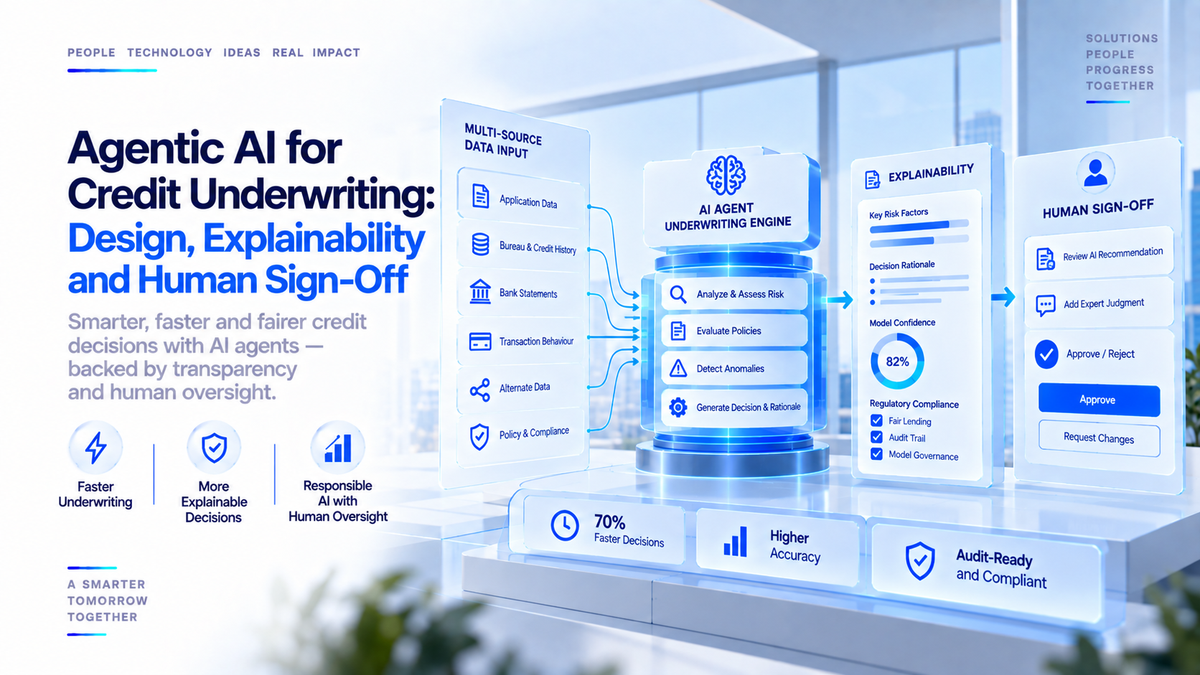
Traditional underwriting can involve dozens of actions: reviewing the application, verifying documents, analysing financial statements and bank statements, assessing cash flows, checking credit history, comparing policy criteria, identifying exceptions, preparing a credit memo, and requesting more information. An agentic system coordinates many of these, retrieving approved data sources, analysing documents, flagging gaps, and preparing a structured recommendation, after which the human underwriter evaluates and decides.
Underwriting suits agents because it's high in document volume (financial statements, tax documents, bank statements, identity records), backed by structured policies, repetitive in its information-gathering, clear in its outputs (approve, reject, or escalate), and anchored by human accountability. The workflow runs from application received, to completeness check, to data extraction, to financial analysis, to internal and approved external data retrieval, to policy matching, to exception identification, to credit memo preparation, to human review, to decision. The important part: the agent shouldn't just produce a score, it should create a traceable evidence package.
Explainability, credit memos, and alternative data
A lender can't lean on "the AI says this borrower is high risk", that's not an explanation. The system should surface the evidence behind a recommendation: revenue trend, cash-flow pattern, repayment history, leverage, document inconsistencies, policy exceptions, concentration risks, whatever the institution's model uses. It should also separate observed fact from AI interpretation from recommendation, which makes review far easier.
One of the most practical uses is credit memo preparation: an agent gathers the information and drafts a structured memo covering borrower profile, business overview, financial summary, repayment history, requested facility, identified risks, policy exceptions, supporting evidence, and questions for the underwriter, who then edits, validates, and approves. Applore's CSL Finance case is relevant here, its AI-assisted credit intelligence digitised a proprietary assessment methodology and supported the process. On alternative data (transaction history, GST information, banking activity, cash flows, digital payment patterns), more data doesn't automatically mean better lending; every source needs assessment for reliability, relevance, consent, privacy, bias, and explainability.
Human sign-off, model risk, and staying inside policy
Human approval shouldn't be a button at the end, it should be architecture: the agent collects and analyses evidence, a validation layer checks output against rules, a credit officer reviews evidence and recommendation, an approval system records the authorised decision, and an audit layer stores the evidence and actions. That's a far stronger accountability structure than letting an agent approve loans independently. Credit models fail through poor data, drift, biased training data, wrong assumptions, changing borrower behaviour, shifting economic conditions, and implementation errors, so, consistent with the RBI's emphasis on model risk and governance, an agentic underwriting system needs continuous evaluation against historical cases, edge cases, and incomplete or contradictory information. And the agent must operate inside the institution's policy framework rather than inventing lending rules; policy defines permitted data, required documentation, eligibility, thresholds, escalation, prohibited actions, and exception handling, and guardrails belong in the architecture, not just the prompt, exactly as covered in AI agent governance.
Start with the most repetitive parts of the process: map the journey, isolate high-volume manual activities, separate evidence gathering from decision authority, integrate approved data sources, build structured outputs and audit logs, launch with human review, measure accuracy and processing time, test for bias and failure, then expand gradually. The objective isn't faster decisions, it's better decision support that keeps accountability where it belongs.
Frequently asked questions
What is agentic AI credit underwriting?+
The use of AI agents to coordinate underwriting activities like document analysis, information retrieval, policy checks, and credit memo preparation.
Can AI approve loans automatically?+
It can technically support automated decisions, but high-impact credit decisions require governance, validation, and clear accountability.
Why is explainability important in AI lending?+
It helps underwriters understand why a recommendation was produced and supports review, auditability, and responsible decisions.
What is AI credit memo automation?+
Using AI to gather borrower information and draft a structured credit memo for an authorised credit professional to review.
Does agentic AI replace credit policy?+
No. The agent operates inside the institution's policy framework; it should never invent lending rules.
How should alternative data be used in AI underwriting?+
Carefully. Assess each source for reliability, consent, privacy, and bias, and remember more data doesn't guarantee better lending.