AI Agents in Loan Collections: What to Automate and What Must Stay Human
Discover how AI agents can streamline loan collections by automating payment reminders, customer communication, follow-ups, and case prioritization. Learn which collection workflows can be safely automated and which decisions should remain human-led to balance efficiency, customer experience, compliance, and responsible lending practices.
Loan collections are both operationally intensive and highly sensitive. Teams monitor accounts, spot delinquency, contact borrowers, document interactions, negotiate repayment, and escalate cases, and a large chunk of that is repetitive, which creates a real opening for AI agents.
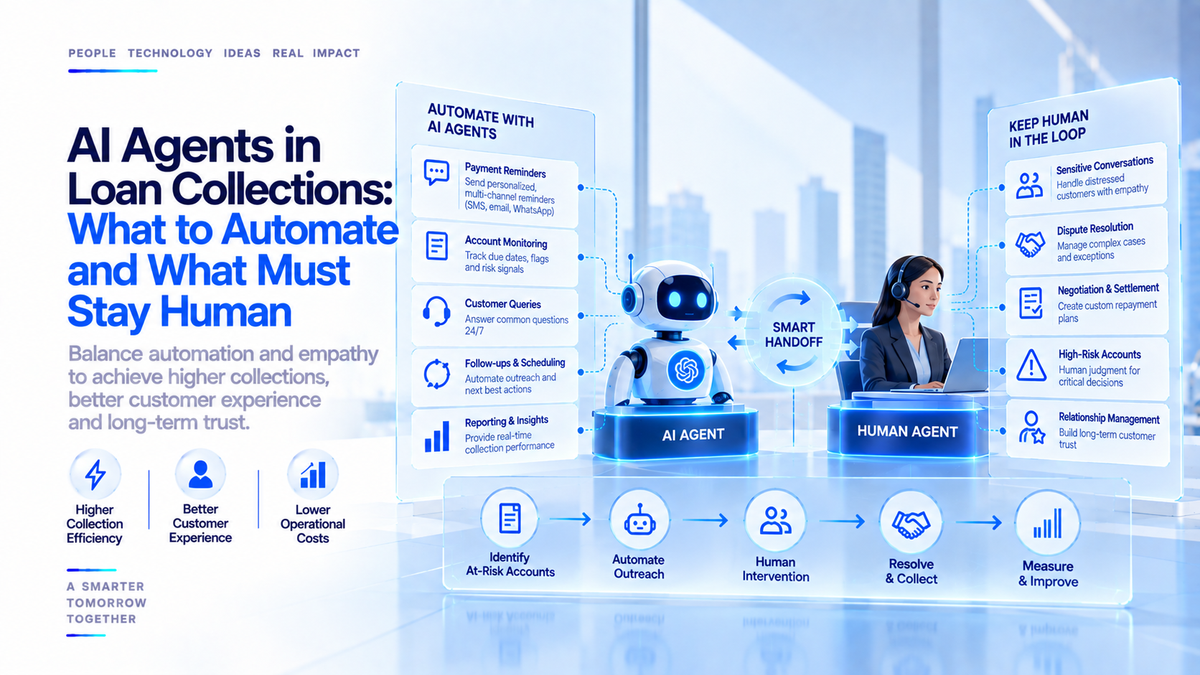
But collections is also where too much automation causes customer-experience, compliance, and reputational damage. The goal isn't to automate every borrower interaction. It's to use AI for the operational load while keeping sensitive conversations, exceptions, and consequential decisions under human oversight, the same controlled-autonomy principle running through the agentic AI in finance hubs.
Where AI helps, and how early outreach works
Agents can assist with account prioritisation, delinquency monitoring, borrower information retrieval, communication preparation, interaction summaries, payment-status updates, promise-to-pay tracking, case routing, analytics, and escalation management, becoming an operational coordinator rather than just a calling bot. On early delinquency, the earlier a lender spots an issue the more options exist to resolve it, so an agent can identify the account, retrieve relevant information, determine the permitted communication workflow, prepare an appropriate message, record the interaction, and escalate if needed. The aim isn't to pressure every borrower identically; it's timelier, more structured outreach.
Voice AI can help with high-volume, repetitive conversations, say a borrower confirming a payment status or a previously agreed action, but voice agents need strict boundaries and clear stop-and-transfer triggers: disputes, hardship, complaints, vulnerability, legal escalation, identity uncertainty, or anything unusual. Never design the system around the assumption that every conversation can finish automatically.
What must stay human, and the architecture that enforces it
Some parts of collections need judgment and empathy. Human involvement is essential when a borrower disputes the debt, discloses hardship, makes a complaint, faces potential legal action, has uncertain identity, may be vulnerable, or needs a negotiated arrangement that requires discretion. AI can prepare the information; it doesn't need to own the relationship. A robust collections agent is layered: an account data layer for authorised information, a policy layer defining permitted actions and communications, a communication layer for approved channels, a decision layer that separates routine from escalation, a human-escalation path for complex cases, and an audit layer recording actions. That's a controlled workflow, not an unrestricted conversational system.
One of the most valuable applications is simply prioritisation. A team with thousands of accounts can have AI categorise them by approved criteria, new delinquency, repeated missed payments, documentation issues, an approaching payment promise, disputes, escalation-required, so employees focus where human involvement matters most. For NBFCs with large portfolios, agents can coordinate borrower communication, case documentation, collection-agent allocation, payment follow-up, exception handling, and management reporting, always designed around the applicable regulatory and internal-policy environment, which the RBI governance guide sets out.
Measuring it, managing risk, and rolling out safely
Don't measure the number of automated calls. Measure contact success rate, promise-to-pay rate, promise fulfilment, average handling time, case resolution time, employee productivity, escalation rate, complaint rate, delinquency movement, and cost per resolved case, business outcomes, not AI activity. The risks to manage are real: incorrect borrower identification, inappropriate communication, privacy, inaccurate account information, biased prioritisation, excessive automation, poor escalation, and thin audit trails, which is why production systems need controlled access, clear policies, and monitoring, with Applore's architecture emphasising permissions, structured outputs, guardrails, evaluation, and human escalation, detailed in how enterprise AI agents are built.
Roll out in stages: start with summaries and internal retrieval, add case prioritisation and workflow recommendations, introduce assisted borrower communication, allow limited automated interactions under strict rules, and continuously evaluate complaints, errors, and escalation outcomes. Each stage produces evidence before you increase autonomy. Collections is fundamentally a human-sensitive process, so the strongest approach isn't "AI instead of people", it's AI for scale, humans for judgment.
Frequently asked questions
Can AI agents automate loan collections?+
They can automate or assist selected operational activities, including prioritisation, reminders, documentation, and routine interactions.
Can AI voice agents call borrowers?+
They can support approved voice workflows, but organisations need clear communication boundaries, escalation rules, and controls.
Which collections tasks should stay human?+
Disputes, hardship cases, complaints, sensitive situations, and consequential decisions generally require stronger human involvement.
How can NBFCs measure AI collections?+
Resolution time, contact rate, promise-to-pay performance, complaints, escalation rates, and cost per resolved case.
What's the biggest risk in collections AI?+
Excessive automation of sensitive conversations, plus incorrect identification, privacy issues, and weak escalation.
How should collections AI be rolled out?+
In stages, starting with low-risk internal tasks and expanding autonomy only after evidence from complaints, errors, and escalations.