Agentic AI Solutions in Finance: Where AI Agents Work in Lending, Banking and NBFC Operations
Explore how Agentic AI solutions are transforming finance across lending, banking, and NBFC operations. From credit assessment and underwriting to document processing, risk management, and customer operations, AI agents can automate multi-step workflows while keeping human oversight, governance, and compliance at the core. Discover how Applore Technologies builds production-ready agentic AI systems designed for real financial operations.
Financial institutions have never been short of data. What they've lacked is a way to turn that data into timely action without piling on another layer of manual work.
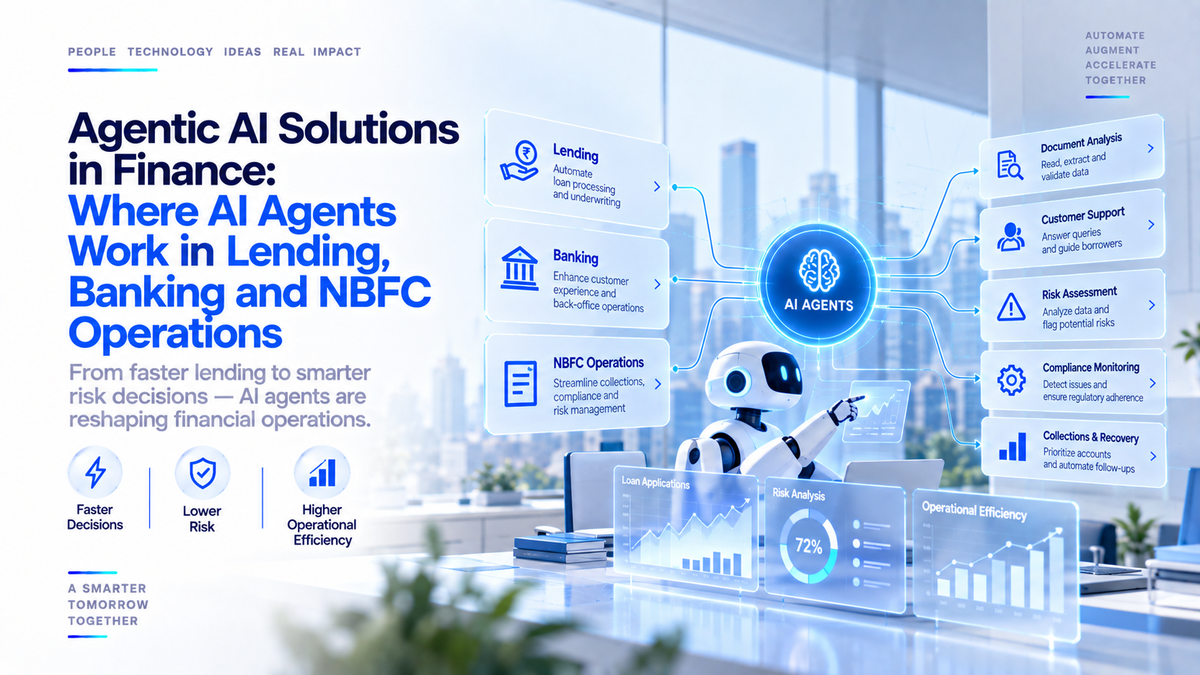
A lending officer might have to review bank statements, GST data, financial documents, credit reports, and internal records before making a single decision. A compliance team monitors transactions, chases alerts, and writes up reports. Operations spend hours reconciling records across systems. Collections manage thousands of borrower interactions a month. Traditional automation can strip out individual repetitive tasks. Agentic AI solutions in finance go a step further: an AI agent can understand a business objective, pull information from approved systems, run multiple steps, use tools and APIs, spot exceptions, and escalate the decisions that need human judgment.
That does not mean handing an agent unrestricted control over financial operations. In finance, the model that actually works is controlled autonomy: agents handle the structured work while humans keep authority over high-impact decisions. Applore's approach to agentic AI is built exactly this way, with tool integration, permissions, structured outputs, guardrails, evaluation, observability, and human escalation designed in from the start, the same production discipline covered in how to build enterprise AI agents.
What is agentic AI in finance?
Agentic AI describes systems that can perform a sequence of actions toward a defined goal, not just generate a response. A traditional chatbot answers "why was my loan application rejected?" by retrieving information and writing a reply. An AI agent connected to approved lending systems could retrieve the application, check its status, review the decision factors, pull the supporting documents, compare the case against policy, prepare an explanation, escalate if a human review is needed, and record the interaction. The difference isn't just intelligence. It's agency plus access to tools, and in banking and lending that matters, because an incorrect answer is one problem while an incorrect financial action is another.
Why finance is becoming a key agentic AI use case
Financial services are full of workflows that are repetitive, document-heavy, rule-driven, data-intensive, spread across multiple systems, wrapped in approval steps, and measurable through clear KPIs. Those traits make many finance processes well suited to carefully scoped AI agents. The RBI's 2025 FREE-AI Committee report itself points to AI opportunities across credit assessment, fraud detection, risk monitoring, customer engagement, and financial-sector operations, while flagging risks around bias, explainability, data protection, cybersecurity, and governance. So the opportunity was never just "automate finance." It's to find where an agent can safely do work without removing accountability.
Where agents fit: lending, banks, and NBFCs
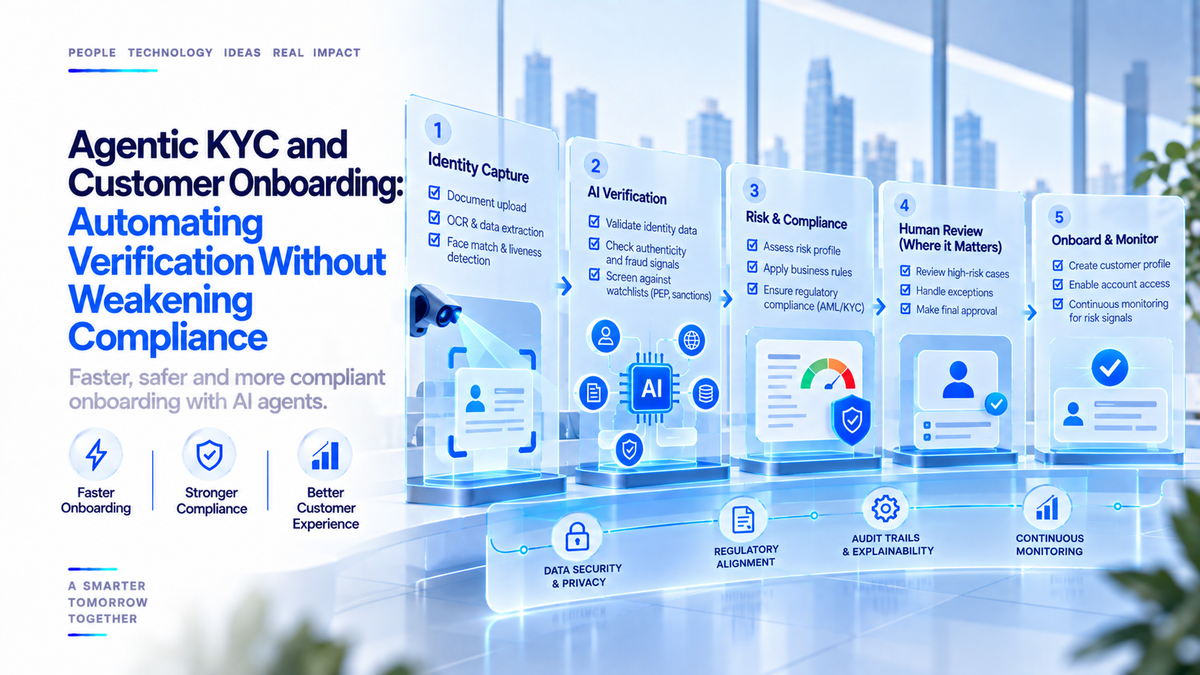
In lending, a loan application spans multiple documents, data sources, and verification steps. Agents can coordinate application document extraction, financial statement analysis, bank statement categorisation, completeness checks, credit memo preparation, policy matching, exception identification, collateral verification, borrower communication, underwriting support, and post-sanction documentation. An underwriting agent could gather approved borrower information, summarise the financials, flag missing documents, and prepare a structured credit brief for an analyst, without becoming the decision authority. Applore's CSL Finance work reflects this: AI-assisted credit intelligence digitised a proprietary credit methodology for an NBFC and supported assessment rather than replacing the credit function, which the agentic credit underwriting guide explores in depth.
In banks, thousands of internal workflows move information between systems, teams, and approval stages. Agents can support customer service (retrieving customer, transaction, and knowledge-base context), operations (classifying and routing cases), compliance (policy monitoring, document review, evidence preparation), fraud operations (collecting information around an alert and drafting an investigation summary), and internal knowledge (traceable answers from approved sources). The key requirement is that access follows the employee's existing permissions rather than creating a new unrestricted data layer.
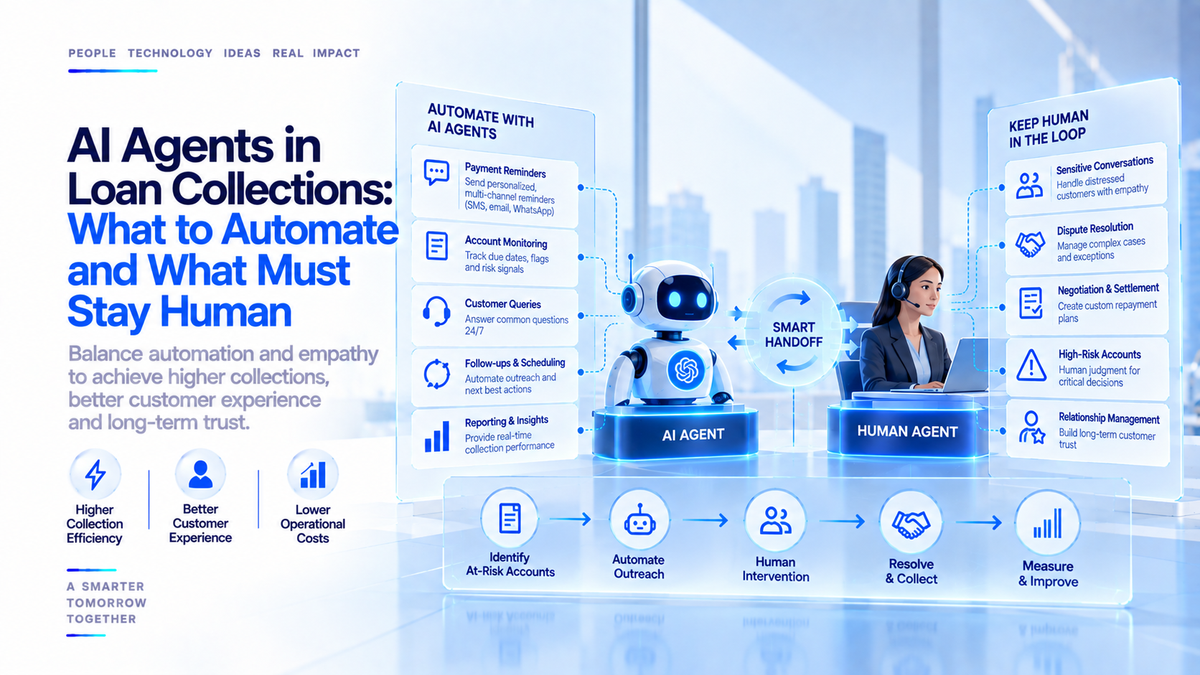
In NBFCs, with their specialised lending models and heavy semi-structured documentation, agents fit loan origination, underwriting preparation, document verification, credit analysis, onboarding, collections, portfolio monitoring, reconciliation, and reporting. For a growing NBFC, the win is more capacity without manual processing rising as fast as loan volume, provided the architecture accounts for regulation, customer data, model risk, and auditability.
Human-in-the-loop is not a weakness
One of the biggest mistakes in financial AI is treating human involvement as proof that automation failed. It's usually the opposite. A better architecture assigns different levels of autonomy. Low-risk tasks like classification, summarisation, internal search, and document extraction, the agent can complete automatically. Medium-risk tasks like customer communication, case routing, reconciliation exceptions, and compliance summaries, the agent prepares and an employee reviews. High-risk tasks like credit approval, adverse customer decisions, large transactions, and regulatory submissions, the agent provides analysis but an authorised human decides. Applore's AI agent governance guidance similarly classifies agents by the consequences of being wrong, with stronger controls for financial, credit, and regulatory workflows.
The risks, and what a production-ready finance agent needs
The sector can't treat an agent like an ordinary productivity app. Data risk means access must be controlled at the system and data level. Model risk means an agent can reach a wrong conclusion even with correct data. Permission risk means an over-permissioned agent can cause a much bigger failure. Explainability, prompt injection, and vendor dependency all matter too, and the RBI FREE-AI report names data privacy, algorithmic bias, explainability, cybersecurity, operational resilience, third-party dependencies, and governance as core concerns.
So a serious implementation needs more than an LLM: identity and permissions (the agent knows exactly what it can access), tool controls (defined inputs, outputs, and permissions per action), structured outputs (validated before affecting downstream systems), audit trails, human-approval gates for high-impact actions, evaluation against representative financial scenarios, observability into what the agent did and where it failed, and rollback to recover from mistakes.
How to start, and where it's heading
Don't begin with "where can we put an agent?" Begin with "which workflow has enough repetitive work and structured decision logic to justify controlled autonomy?" Map the workflow and its approval points, measure the recoverable value (time, error rates, volume, cost), classify the risk, design the permissions, start with assisted execution before autonomous execution, establish evaluation against historical and synthetic scenarios, then measure business outcomes. The next phase of financial AI won't be defined by more chatbots; it's the shift from AI that answers questions to AI that participates in workflows, an underwriting agent working with a document agent, a compliance agent, and a reporting system. The goal isn't maximum automation. It's controlled, measurable, auditable automation.
Frequently asked questions
What are agentic AI solutions in finance?+
AI agents that perform multi-step financial workflows, interact with approved systems, retrieve information, execute defined actions, and escalate decisions that need human judgment.
How can AI agents help banks?+
They support customer operations, compliance, fraud investigation, internal knowledge, document processing, reconciliation, and other structured workflows.
Can AI agents make loan approval decisions?+
They can support underwriting by analysing information, flagging exceptions, and preparing recommendations. Whether an agent makes the final call depends on the institution's risk framework and governance.
Why is human-in-the-loop important in financial AI?+
It provides an accountability layer for high-impact actions like credit decisions, regulatory reporting, and material transactions.
How can an NBFC start with agentic AI?+
Begin with one measurable workflow, set a baseline, classify the risks, define permissions, and launch an assisted workflow before expanding autonomy.
Is more data always better for lending AI?+
No. Every data source needs assessment for reliability, relevance, consent, privacy, and bias. Poor data produces unreliable decisions regardless of the model.