AI Agents for Finance Operations: Close, Reconciliation, Accounts Payable and Treasury
Discover how AI agents are transforming finance operations by automating reconciliation, accounts payable, financial close, and treasury workflows. Learn how intelligent agents can reduce manual effort, improve accuracy, accelerate decision-making, and connect fragmented finance processes while maintaining the governance and human oversight required for enterprise operations.
Finance teams get measured on accuracy, speed, and control all at once. They have to close the books faster, reconcile accurately, process invoices, watch cash positions, and produce reliable reports, yet much of this still runs on spreadsheets, email approvals, manual data entry, and staff hopping between ERP, banking, and reporting systems.
That's where AI agents for finance operations come in. Unlike a simple automation script, an agent can coordinate several steps, interpret unstructured information, retrieve data, and handle exceptions inside defined boundaries. The opportunity is especially relevant to CFO organisations, because finance is thick with repetitive work. Applore already flags invoice processing, reconciliation, expense classification, and report preparation as practical agentic use cases; the next step is designing those agents around the real finance operating model, using the production principles in how enterprise AI agents are built.
What "AI agents for finance operations" actually means
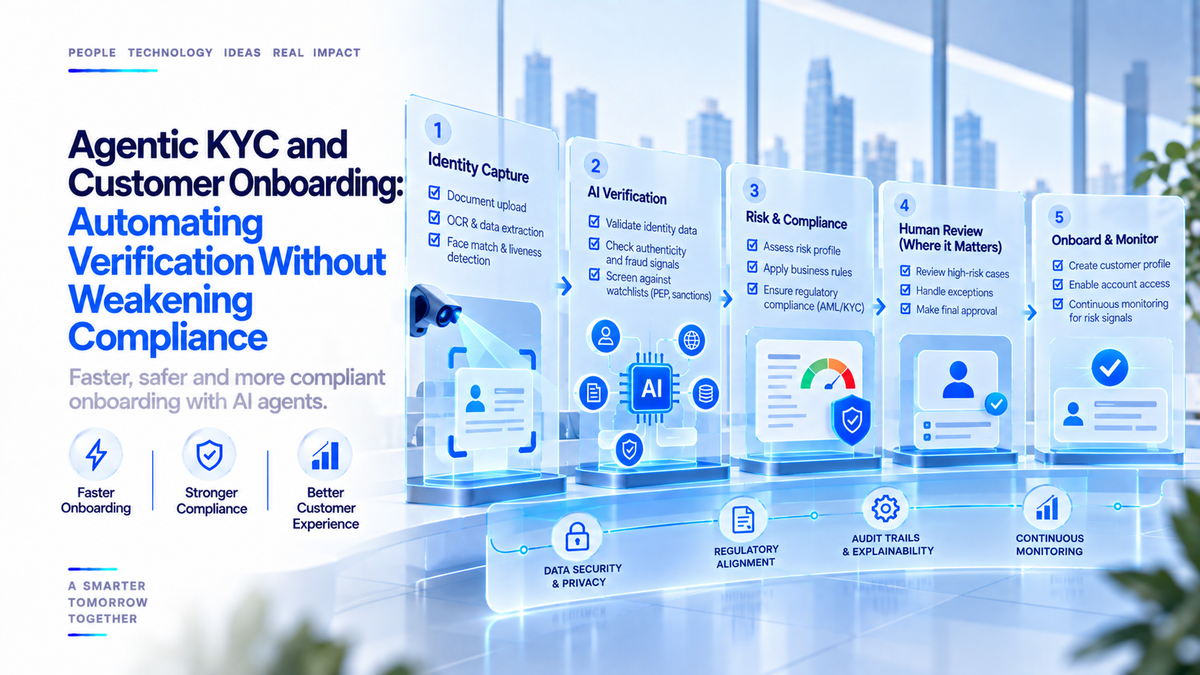
A finance AI agent performs one or more connected activities, not a single step. An accounts payable agent could receive an invoice, extract the information, match it to purchase-order data, spot discrepancies, check vendor details, route exceptions, prepare the invoice for approval, and update the system once it's authorised. It isn't just reading an invoice; it's coordinating a workflow, which matters because finance operations are rarely single-step.
Close, reconciliation, AP, record-to-report, and treasury
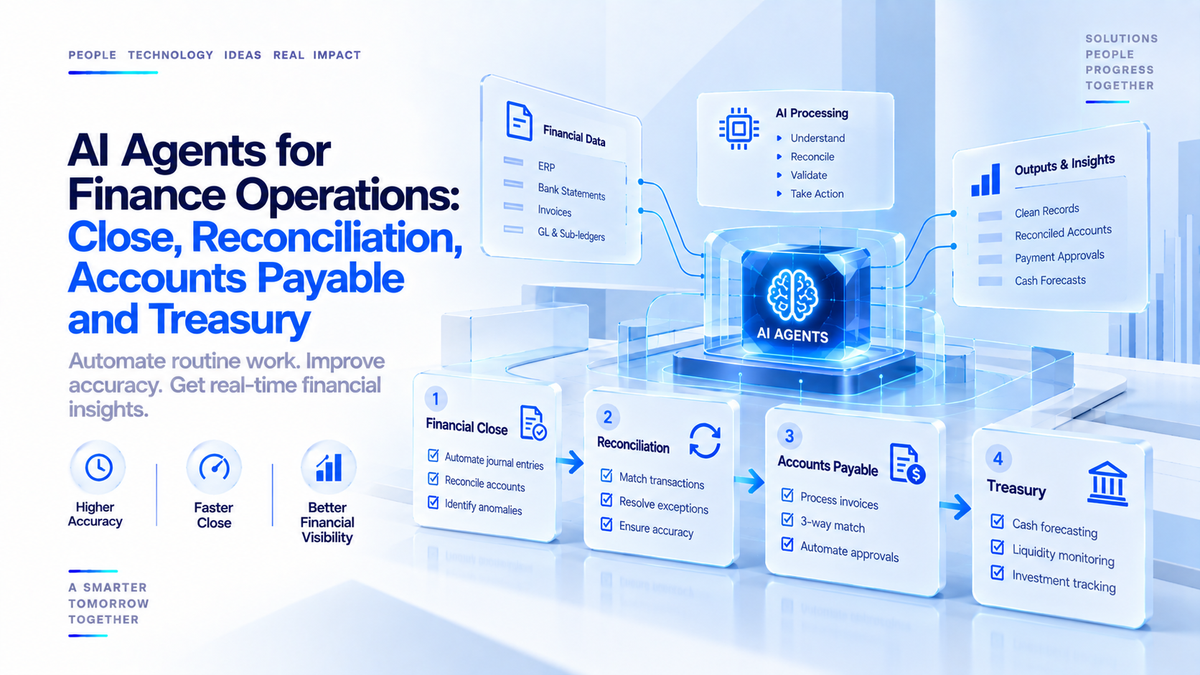
In financial close, an agent can pull supporting data together, reconcile accounts, flag material variances, retrieve the underlying transactions, and draft an explanation for an accountant to review, cutting admin without cutting control.
In reconciliation, which mixes structured matching rules with messy exceptions, an agent can compare bank transactions, ERP entries, payment records, invoices, settlement files, and ledger balances; document the matches; and, where they don't match, investigate and prepare an exception summary. The division of labour is clean: the system matches, investigates, and prepares, while the finance professional reviews and approves.
In accounts payable, an agent can go beyond OCR field extraction to interpret the invoice, compare it against the PO, identify inconsistencies, and decide the next workflow, running received to extracted to vendor-verified to PO-matched to tax-checked to exception-identified to approval-routed to payment-prepared, while payment authority stays with authorised employees. That last point is critical: an agent shouldn't get unrestricted permission to move money just because it can technically reach a payment API.
In record-to-report, agents can help with journal-entry support, reconciliation, variance analysis, management reporting, and first-pass commentary that a finance professional validates, shortening the gap between "books closed" and "leadership understands what happened."
In treasury, agents can assist with cash-position consolidation, transaction monitoring, payment tracking, liquidity reporting, exception detection, and forecasting support, though permissions must be tight: a system may recommend an action without being allowed to execute it.
Agents vs RPA, and the controls finance needs
RPA follows predefined steps; agents handle variable or unstructured inputs. Two invoices make the point: invoice A follows the standard template, invoice B has odd formatting, a missing reference, and a PO discrepancy. Rigid automation stops; an agent can interpret the exception, gather more information, and route it. This isn't agents replacing RPA, in many environments RPA executes deterministic steps while AI handles interpretation and orchestration.
Finance automation can't be designed purely for speed, though. It has to respect segregation of duties, access controls, auditability, data protection, approval thresholds, exception handling, transaction limits, and system reliability. Applore's agent architecture guidance emphasises least-privilege access, structured tool contracts, validation, and guardrails rather than relying on prompts alone, which matters most when agents touch ERP, banking, or accounting systems.
How CFOs should evaluate it, and a roadmap
Start with a baseline: transactions processed, processing time, cost per transaction, error rate, rework, exception rate, close duration, employee capacity, and SLA performance. Applore's AI-agent ROI guidance similarly recommends measuring the process before launch, because without a baseline, "AI saved time" is impossible to prove. Then run a staged rollout: pick one high-volume, measurable workflow; map its systems, users, data, and approvals; separate decisions from actions; build the integration layer to ERP, accounting, document, and workflow systems; launch in assisted mode; evaluate accuracy, exceptions, security, and edge cases; and expand autonomy only once the workflow is stable.
The most valuable use of these agents isn't making finance teams disappear. It's removing the administrative work that keeps finance professionals from analysis, controls, and business decisions. So the CFO question should be: which finance workflow can we make faster without weakening financial control?
Frequently asked questions
What are AI agents for finance operations?+
AI systems that coordinate multi-step finance workflows such as reconciliation, invoice processing, reporting, and exception management.
Can AI agents automate financial close?+
They can automate or assist many close activities, including data collection, reconciliation, variance identification, and reporting preparation.
Can AI agents make payments?+
Technically yes, but high-impact financial actions should carry strict permissions, transaction limits, and appropriate human approval.
How is agentic AI different from RPA in finance?+
RPA follows deterministic rules; AI agents interpret variable inputs, reason within boundaries, and coordinate multiple actions.
What should a CFO measure after implementing an agent?+
Processing time, cost per transaction, error rates, exceptions, rework, close time, capacity released, and SLA performance.