Best AI Implementation Consulting Firms in 2026
AI implementation consulting firms help businesses move from AI strategy and planning to real-world deployment. This guide explores the best AI implementation consulting firms in 2026, covering their expertise in AI integration, automation, data and technology infrastructure, and enterprise AI deployment to help organizations turn AI initiatives into measurable business outcomes.
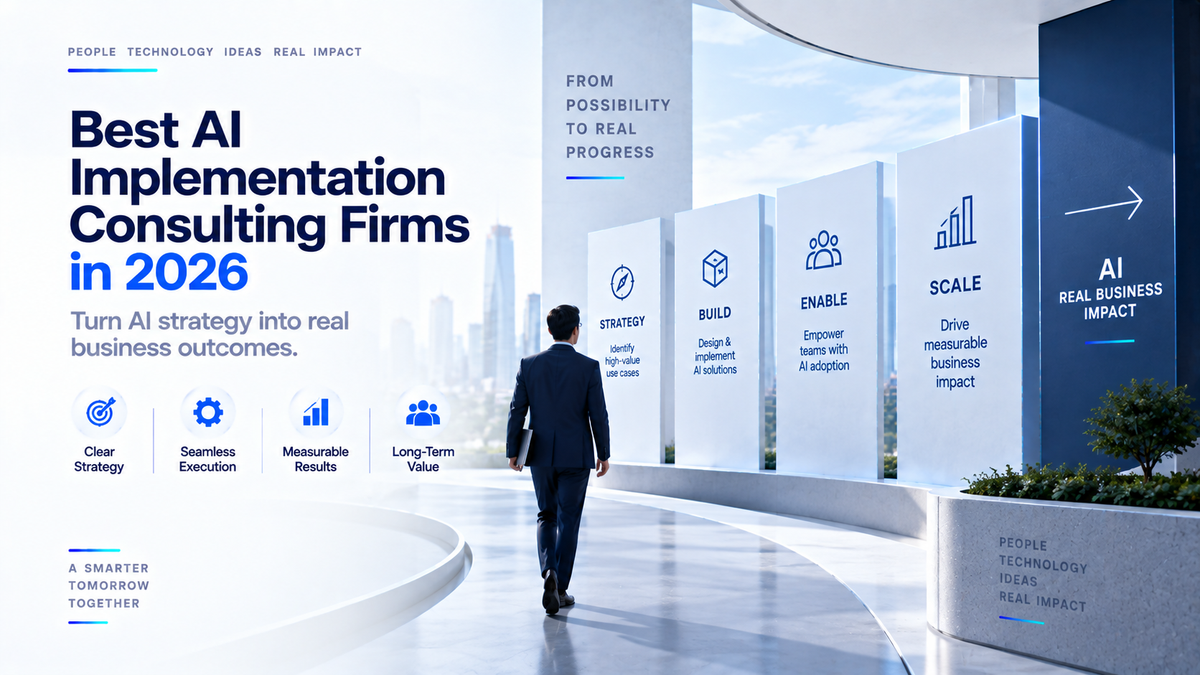
AI strategy is no longer the hard part. For a lot of organisations, the strategy already exists. Executives know they want to automate workflows, sharpen decision-making, roll out generative AI, deploy AI agents, or use machine learning more effectively. The roadmap is sitting on a deck somewhere. The harder question, the one that actually keeps programmes stuck, is simpler and more brutal: who can actually implement it?
That single question explains why the AI consulting market is quietly splitting in two, strategy on one side, implementation on the other. A company can spend months producing a polished AI roadmap and still have exactly zero production systems to show for it. So the best AI implementation consulting firms in 2026 have to do far more than recommend technologies. They have to connect business objectives to architecture, data, engineering, security, deployment, governance, and adoption, and then get the thing live. A recent 2026 industry comparison draws the same line, separating true implementation partners from firms that mostly deliver advisory work, and judging them on whether clients actually receive working AI systems rather than strategy documents.
What is AI implementation consulting?
AI implementation consulting is the work of turning an AI strategy or business use case into a working production system. In practice that spans AI readiness assessment, data preparation, model selection, application development, generative AI integration, RAG implementation, AI agent development, API integration, cloud deployment, security, evaluation, monitoring, governance, and user adoption.
The implementation layer is where most AI projects get complicated, and where a surprising number quietly die. A model can look brilliant in a controlled demo and then fall apart the moment it has to operate against real enterprise data, real permissions, and real systems that were never designed to talk to it. The gap between "it worked in the demo" and "it works every day for thousands of users" is the entire job.
How we evaluated AI implementation consulting firms
A useful evaluation focuses on ten things: strategy-to-execution capability, production AI experience, data engineering, AI and ML expertise, cloud and platform engineering, security and governance, integration capability, evaluation and monitoring, industry expertise, and post-launch adoption. The firms below bring different strengths, so weigh them against the shape and maturity of your own programme rather than against each other.
1. Accenture
Accenture is one of the strongest choices for enterprise-scale AI implementation, and its edge is breadth. Large AI programmes rarely stay contained; they pull in strategy, data transformation, cloud, application modernisation, AI engineering, change management, and managed services all at once.
A global systems integrator can put all of those under one transformation programme, which is exactly what enterprises need when the AI work can't be separated from a wider technology overhaul. If your last attempt stalled because five different vendors couldn't agree on ownership, this single-programme capacity is often the fix.
Best for: Large enterprises and global AI transformation programmes.
2. BCG X
BCG X pairs strategy with product, technology, and AI execution, which makes it particularly useful when you need to translate a business problem into an actual technology product rather than a recommendation. Its retail AI work, for instance, combines industry expertise with solutions around pricing, merchandising, and personalisation.
That blend matters most when the business transformation and the product build have to move together, when the point isn't just to deploy a model but to change how a commercial function operates. BCG X tends to keep the business outcome in the frame while the engineering happens.
Best for: Strategic AI initiatives where business transformation and product development need to work together.
3. Slalom
Slalom is a strong fit for organisations that want hands-on, delivery-focused implementation without the weight of a mega-integrator. It works close to the business, pairing modern cloud and data engineering with applied AI, and tends to move quickly on focused, high-value use cases.
For companies that have a clear problem and want a partner who will build alongside their team rather than hand down a governance framework from a distance, that collaborative, execution-led style lands well, especially in the cloud-native environments where Slalom is most comfortable.
Best for: Mid-size and enterprise teams wanting fast, delivery-led implementation on modern cloud.
4. Capgemini
Capgemini is a strong candidate when implementation depends heavily on data, cloud, and enterprise architecture, which, in truth, is most of the time. AI implementation almost never happens in isolation; it has to integrate with data warehouses, ERP systems, CRM, identity systems, cloud infrastructure, and a long tail of internal applications.
Capgemini's engineering and data heritage is built for exactly those complex, interconnected environments. If your bottleneck is the plumbing between the model and the systems it needs to reach, this is the kind of partner that closes it at scale and across geographies.
Best for: Enterprise AI implementations involving significant data and infrastructure modernisation.
5. Publicis Sapient
Publicis Sapient is the pick when AI implementation is really about the digital experience and the customer-facing product. It blends design, data, and engineering to build modern applications, then threads AI through the journeys customers actually touch, rather than leaving it in a back-office model.
For businesses where the app or storefront is the revenue engine and every improvement shows up directly in conversion or engagement, that experience-led, build-heavy approach fits. It suits organisations that want AI embedded in the product, not bolted onto it after launch.
Best for: Product- and experience-led organisations implementing AI in customer-facing systems.
6. Thoughtworks
Thoughtworks has long focused on modern software engineering, architecture, and digital transformation, which makes it a natural fit for organisations that want AI implemented as part of a modern engineering environment rather than duct-taped onto legacy processes.
That engineering-first culture matters more than it sounds. A lot of AI failures are really software-delivery failures in disguise, weak testing, brittle integration, no path to production. Thoughtworks brings the disciplines that keep AI systems maintainable long after the launch, which is exactly what a multi-year replatform or modernisation demands.
Best for: Product-centric organisations that prioritise modern architecture and engineering practices.
7. EPAM
EPAM is an engineering-led option for organisations that need AI actually built, integrated, and running reliably in production. It combines strong digital engineering, cloud, and data capability with a growing applied-AI practice, and it's comfortable in integration-heavy, large-scale environments.
For a company that already knows what it wants to build and needs a partner who can ship it dependably at scale, EPAM's delivery depth is the draw. It's less about deciding the strategy and more about executing it without the wheels coming off during rollout.
Best for: Enterprises needing engineering-led AI delivery and integration at scale.
8. Applore Technologies
Applore is positioned specifically around moving past recommendations. Its AI consulting practice describes the engagement as diagnose, then build, then adopt, with capabilities including AI opportunity diagnosis, build-versus-buy analysis, model selection, risk and governance, data readiness, applied AI, agentic systems, adoption instrumentation, and handover. Its broader technology capability spans AI and ML, data infrastructure, product engineering, cloud, DevOps, and security and compliance.
That end-to-end shape makes it particularly relevant for businesses that need an implementation partner rather than a strategy-only consultant. The build-versus-buy framing helps decide what to develop versus adopt before a rupee is spent on custom work, and the production discipline carries through to how it builds and governs enterprise AI agents. For a mid-market or growth-stage organisation, having one senior team own the thread from diagnosis to a live, adopted system often matters more than a famous name on the proposal.
Best for: Mid-market and enterprise organisations wanting senior-led AI strategy and implementation together.
What separates AI implementation firms from AI strategy firms?
The distinction is more consequential than it looks. A strategy consultancy typically delivers an opportunity assessment, an AI roadmap, a business case, and a target operating model. An implementation partner has to deliver architecture, data pipelines, applications, APIs, AI models, infrastructure, monitoring, and an actual production deployment. One produces a plan; the other produces a system. The strongest firms can do both, and the honest test is whether the engagement ends with a slide or with something running in your environment. This is the same divide covered in what AI business transformation consulting actually involves.
What does a production AI implementation actually require?
Take an internal AI knowledge assistant. On the surface it sounds trivial: connect an LLM to company documents. In production, the real requirements pile up fast. Data ingestion, because documents have to be collected and processed. Access control, so users only ever retrieve information they're authorised to see. Retrieval, so the system surfaces genuinely relevant content. Generation, so the model produces a useful answer. Evaluation, so you actually know whether that answer is reliable. Monitoring, so performance is watched after launch, not assumed. Security, so sensitive information stays protected. And adoption, so employees trust the thing enough to use it. The model is one component among many, and rarely the one that decides success. Deciding what such a system may and may not do is exactly the discipline in a pre-automation checklist for agentic AI in operations.
AI implementation checklist
Before you choose a partner, check they can genuinely handle each layer.
- Data: pipelines, data quality, data governance, and data security.
- AI: machine learning, generative AI, RAG, AI agents, and model evaluation.
- Engineering: APIs, backend systems, applications, and cloud infrastructure.
- Operations: monitoring, logging, cost control, and reliability.
- Governance: access controls, auditability, model risk, and compliance.
- Adoption: user training, workflow redesign, adoption measurement, and handover. A partner strong in the first two layers but weak in the last two will hand you an impressive demo and a stalled rollout.
Why AI pilots fail to reach production
The single biggest implementation problem is the gap between a proof of concept and a production system. Applore has previously flagged data readiness, stakeholder alignment, governance, project scope, and model monitoring as the considerations that decide whether AI scales from POC to production, and it's worth taking seriously because a pilot succeeds for reasons production strips away.
A pilot often works precisely because the data was manually prepared, the users were highly technical, the scope was narrow, errors were quietly corrected by hand, and there was no real production load. Production removes every one of those crutches. The system now has to work repeatedly, securely, and economically, for people who won't tolerate a wrong answer and won't debug it for you. That's why so many "successful" pilots never ship, and why implementation experience matters more than demo polish.
How much does AI implementation cost?
There's no meaningful single price, and any firm that quotes one before understanding your environment is guessing. Cost turns on the number of integrations, data complexity, the AI model, infrastructure, security requirements, user volume, application complexity, governance requirements, and ongoing maintenance. A simple internal AI assistant and a multi-agent platform wired into enterprise systems are not the same order of magnitude.
So instead of asking "how much does AI implementation cost?", ask "what is the smallest production system that can validate the business case?" That reframe is a far better starting point, because it forces scope discipline and gives you a real number tied to a real outcome, rather than an open-ended enterprise programme you'll struggle to defend.
Build vs buy vs partner
AI implementation decisions generally land in one of three buckets.
- Buy when a mature SaaS product already solves the problem well and the capability isn't a differentiator.
- Build when the capability creates genuine competitive advantage and owning it matters.
- Partner when you understand the business problem but lack the technical capacity to implement it in-house. A good AI consulting firm should help you make this call honestly rather than reflexively selling custom development, which is the exact judgement laid out in build versus buy for AI agents.
Conclusion
The best AI implementation partner depends on the size and complexity of your programme. Accenture is strong for global enterprise transformation. BCG X is compelling for strategy-led AI product development. Slalom fits fast, delivery-led work on a modern cloud. Capgemini fits complex data and infrastructure environments. Publicis Sapient suits customer-facing and experience-led implementations. Thoughtworks is the pick for engineering-first modernisation. EPAM brings engineering delivery at scale. And Applore is built around connecting AI diagnosis, architecture, implementation, and adoption under one senior team.
Ultimately, the best AI implementation partner is the one that can answer three questions clearly: what are we building, how will it work inside our existing environment, and how will we know it actually changed the business? If a firm can't answer all three, you're most likely buying an AI strategy, not an AI implementation, which is the same trap covered in how mid-market companies should start AI transformation.
Frequently asked questions
What is AI implementation consulting?+
It's the work of designing, building, integrating, deploying, and operating AI systems inside a real business environment, not just advising on them.
What's the difference between AI consulting and AI implementation?+
AI consulting can stop at strategy and recommendations. AI implementation turns those recommendations into working production systems that run in your environment.
Which firms are best for enterprise AI implementation?+
Large firms like Accenture, Capgemini, and EPAM suit complex enterprise programmes, while specialists can be better for focused or faster implementations.
How long does AI implementation take?+
A focused application can take weeks to a few months. Enterprise-wide transformation runs across multiple quarters depending on data, integrations, and organisational complexity.
Why do AI implementations fail?+
Usually poor data, unclear objectives, weak integration, thin governance, low user adoption, and failing to design for production conditions rather than demo conditions.
Should companies build or buy AI?+
It depends on differentiation, cost, data requirements, integration complexity, and strategic importance. Buy the commodity, build the differentiator, partner for the gap.